
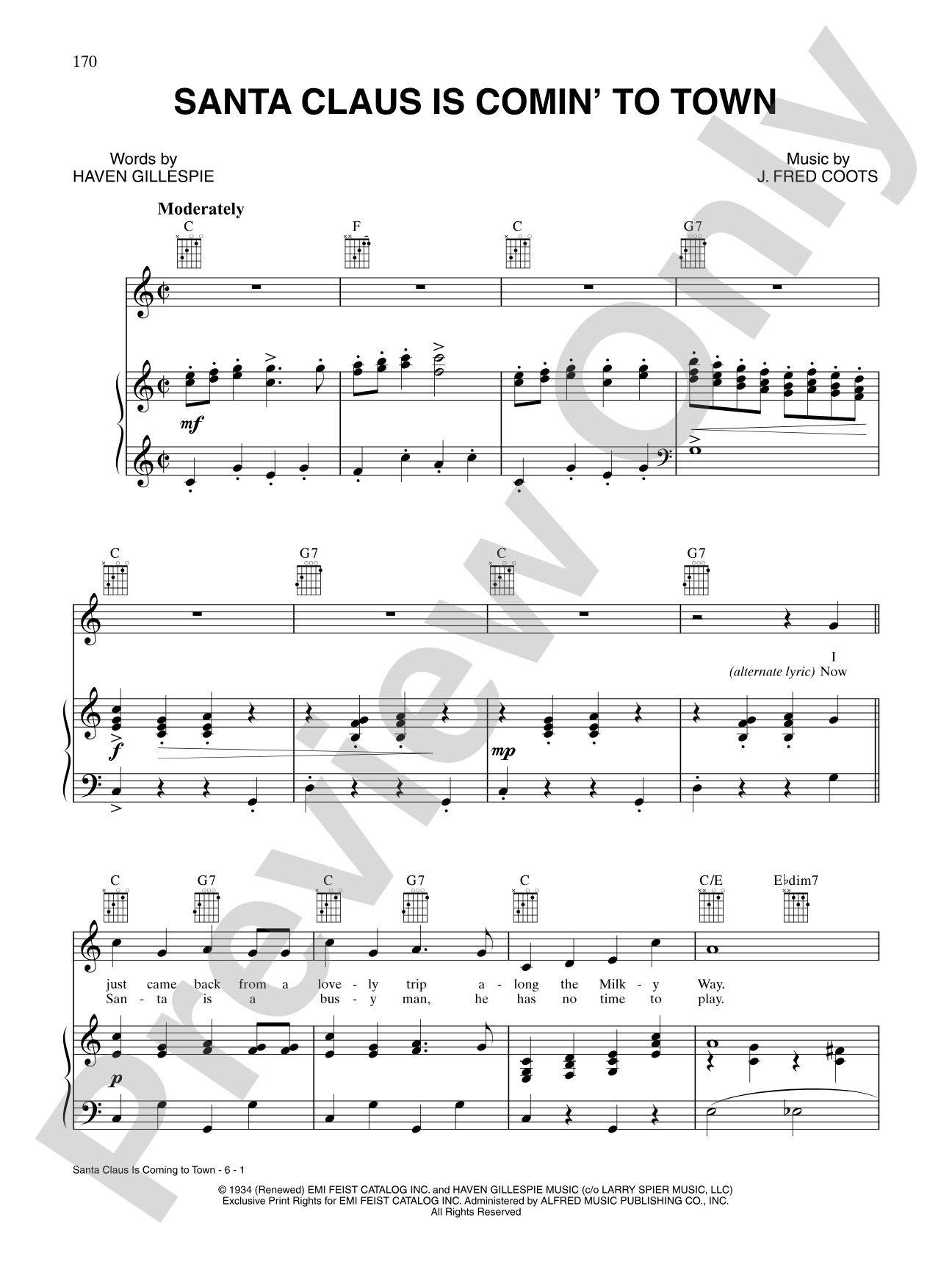
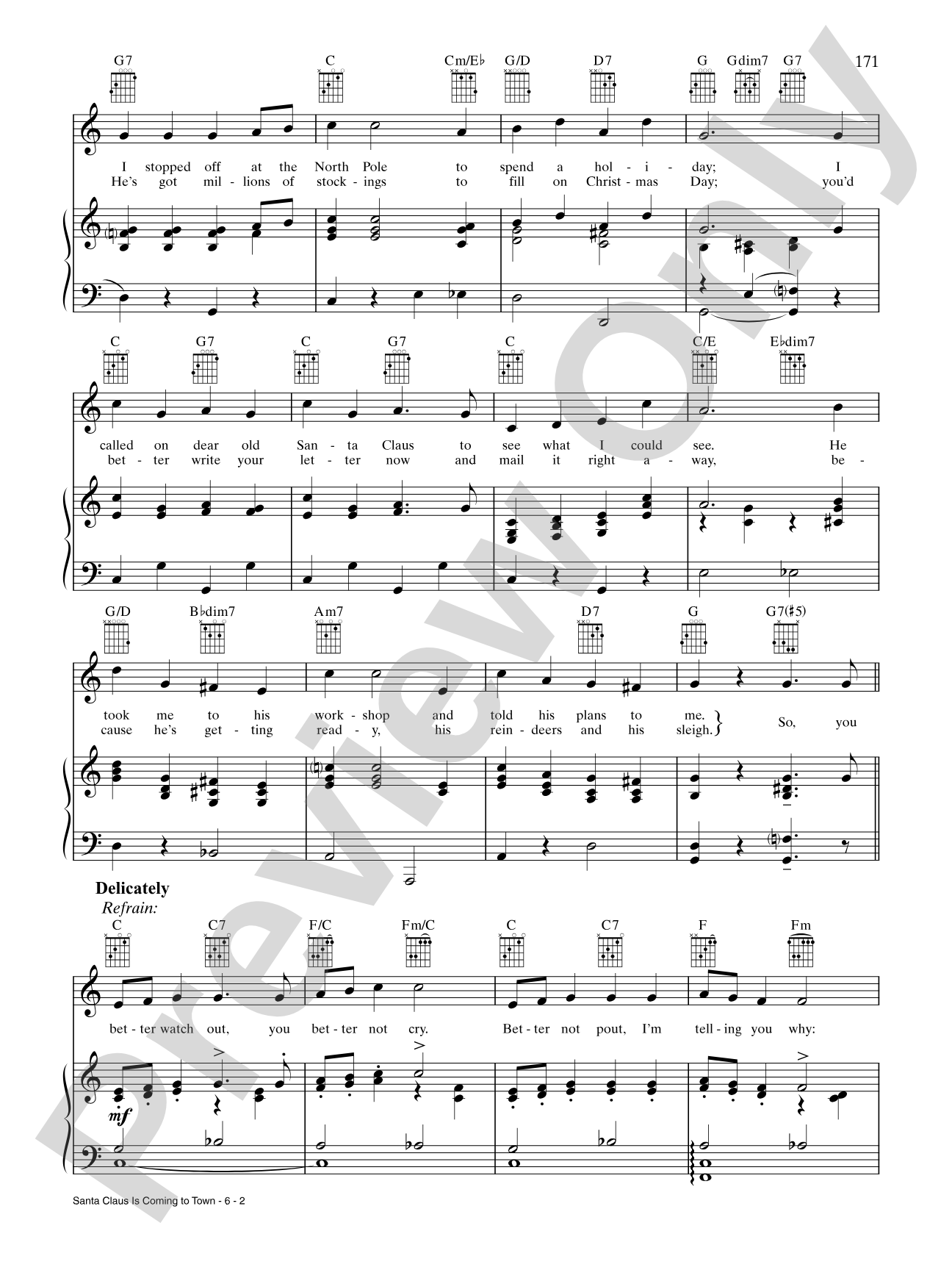

Santa Claus Is Comin' to Town: Piano/Vocal/Chords
64 Fun and Familiar Holiday Favorites
Item: 00-PS-0015682
$5.99
One moment…
Related Items
Jolly Old Saint Nicholas: Piano/Vocal/Chords |
$4.99
|
View | |
Rudolph, the Red-Nosed Reindeer: Piano/Vocal/Chords |
$4.99
|
View | |
Heat Miser: Piano/Vocal/Chords |
$4.99
|
View | |
Even Santa Fell in Love: Piano/Vocal/Chords |
$4.99
|
View | |
Buon Natale (Means Merry Christmas to You): Piano/Vocal/Chords |
$4.99
|
View | |
Snow Miser: Piano/Vocal/Chords |
$4.99
|
View | |
Christmas Vacation: Piano/Vocal/Chords |
$5.99
|
View | |
Gesù Bambino (The Infant Jesus): Piano/Vocal/Chords |
$5.99
|
View |
Description
Play and sing everybody's favorite Christmas songs! This collection of more than 220 pages of sheet music contains everything from traditional carols to popular Christmas standards and novelties---64 songs in all. It's the perfect songbook for any occasion, from family sing-alongs to holiday concerts. Titles: Angels We Have Heard on High * Auld Lang Syne * Away in a Manger * Believe (from The Polar Express) * Blue Christmas * Breath of Heaven (Mary's Song) * Buon Natale (Means Merry Christmas to You) * Christmas Comes Anew (Noël Nouvelet) * Christmas Vacation (from National Lampoon's Christmas Vacation) * Christmas Wrapping * Dance of the Sugar Plum Fairy (from The Nutcracker Suite) * Deck the Hall * Even Santa Fell in Love * Felíz Navidad * The First Noel * Gesù Bambino * The Gift * Go Tell It on the Mountain * God Rest Ye Merry, Gentlemen * Good King Wenceslas * Grandma Got Run Over by a Reindeer * Hallelujah! Chorus (from The Messiah) * Happy Xmas (War Is Over) * Hark! The Herald Angels Sing * Have Yourself a Merry Little Christmas * Heat Miser (from The Year Without a Santa Claus) * A Holly Jolly Christmas * (There's No Place Like) Home for the Holidays * I'll Be Home for Christmas * It Came Upon the Midnight Clear * It's the Most Wonderful Time of the Year * Jesu, Joy of Man's Desiring * Jingle Bells * Jolly Old St. Nicholas * Joy to the World * Let There Be Peace on Earth * The Little Drummer Boy * Mary Sweet Mary * Mele Kalikimaka * Nut Rocker * O Christmas Tree * O Come, All Ye Faithful (Adeste Fideles) * O Come, O Come, Emmanuel * O Holy Night * O Little Town of Bethlehem * Patapan * Rockin' Around the Christmas Tree * Rudolph, the Red-Nosed Reindeer * Santa Baby * Santa Claus Is Comin' to Town * Silent Night * Silver and Gold (from Rudolph, the Red-Nosed Reindeer) * Sleigh Ride * Snow Miser (from The Year Without a Santa Claus) * These Are the Special Times * The Twelve Days of Christmas * Ukranian Bell Carol * Up on the Housetop * We Three Kings of Orient Are * We Wish You a Merry Christmas * What Child Is This? (Greensleeves) * When Christmas Comes to Town (from The Polar Express) * You're a Mean One, Mr. Grinch (from How the Grinch Stole Christmas!) * 'Zat You, Santa Claus?


Discover MakeMusic Cloud: thousands of interactive titles your students can play along with today.
Sample Audio
No sample audio found.
Sample Video
No sample videos found.
Additional Details
Series:
A to Z
Publisher:
Alfred Music
Page Count:
224
SKU:
00-PS-0015682
More about this title
About the Composer: J. Fred Coots
J. Fred Coots (1897-1985) was a prolific songwriter and composer who shaped American popular music across several decades. His catalog spans Broadway shows, film scores, and radio standards, with "Santa Claus Is Comin' to Town" standing as one of his most enduring and recognizable works. Coots had a gift for melody that felt both accessible and memorable, making his compositions natural choices for educational and community music settings.
Beyond his holiday classic, Coots contributed significantly to the Great American Songbook and wrote for theatrical productions that reached wide audiences. His work demonstrates how strong melodic writing and clear harmonic language can create music that survives generations of performance.
Why we love this
This collection pairs the title track's infectious melody with 63 other Christmas standards and novelties, giving pianists and singers genuine flexibility across styles and eras. The mix spans classical movements (Sugar Plum Fairy, Hallelujah Chorus), pop standards (Blue Christmas, It's the Most Wonderful Time of the Year), and contemporary hits (Believe from The Polar Express), so you can build a holiday program that feels cohesive without sounding repetitive. Piano/vocal/chord layout means pianists can comp, lead, or accompany depending on what your rehearsal needs.
What to expect
Opening this book is like walking into a well-stocked Christmas music library where every page offers something genuinely familiar. The writing is straightforward and vocally friendly, with piano parts that support the melodic line without demanding virtuosity. You get the warmth of tradition alongside the energy of popular holiday hits, all presented in clear, readable notation.
Who it's for
Pianists accompanying singers in holiday programs, church musicians building seasonal repertoire, and music teachers who need flexible, singable standards for recitals or school events. Anyone managing a mixed-format holiday concert will find legitimate alternatives to the same five songs every ensemble performs.
How to get the most out of it
- Balance the melody line with accompaniment; the chord symbols give you freedom to add texture without overwhelming the singer's line.
- Scout the key of each song before rehearsal. With 64 different pieces, you'll want to know which ones sit naturally for your vocalist and which might need transposition.
- Use the lyrical content and style variety as rehearsal anchors. Group similar-era or similar-mood pieces in sequence so singers and pianists build momentum rather than starting cold each time.
- Shape phrasing around text, not just harmonic cadences. The novelty numbers and contemporary songs benefit from conversational delivery, while the traditional carols call for longer line shapes.
How to use it
Build a multi-song holiday concert where different singers showcase contrasting material: open with a classical carol, move into a pop standard, include a novelty number for variety, and close with something reflective. Alternatively, select 8-12 pieces that match your ensemble's strengths and program them throughout the season rather than cramming everything into one holiday concert. The range of keys and styles also makes this useful for identifying audition material or solo performance pieces for individual students.
Skills your students will build
- Reading chord symbols and translating them into piano accompaniment
- Adapting melodic phrasing across multiple musical styles and eras
- Managing modulation and key changes across a diverse repertoire
- Sight-singing in varied harmonic contexts with clear accompaniment support