
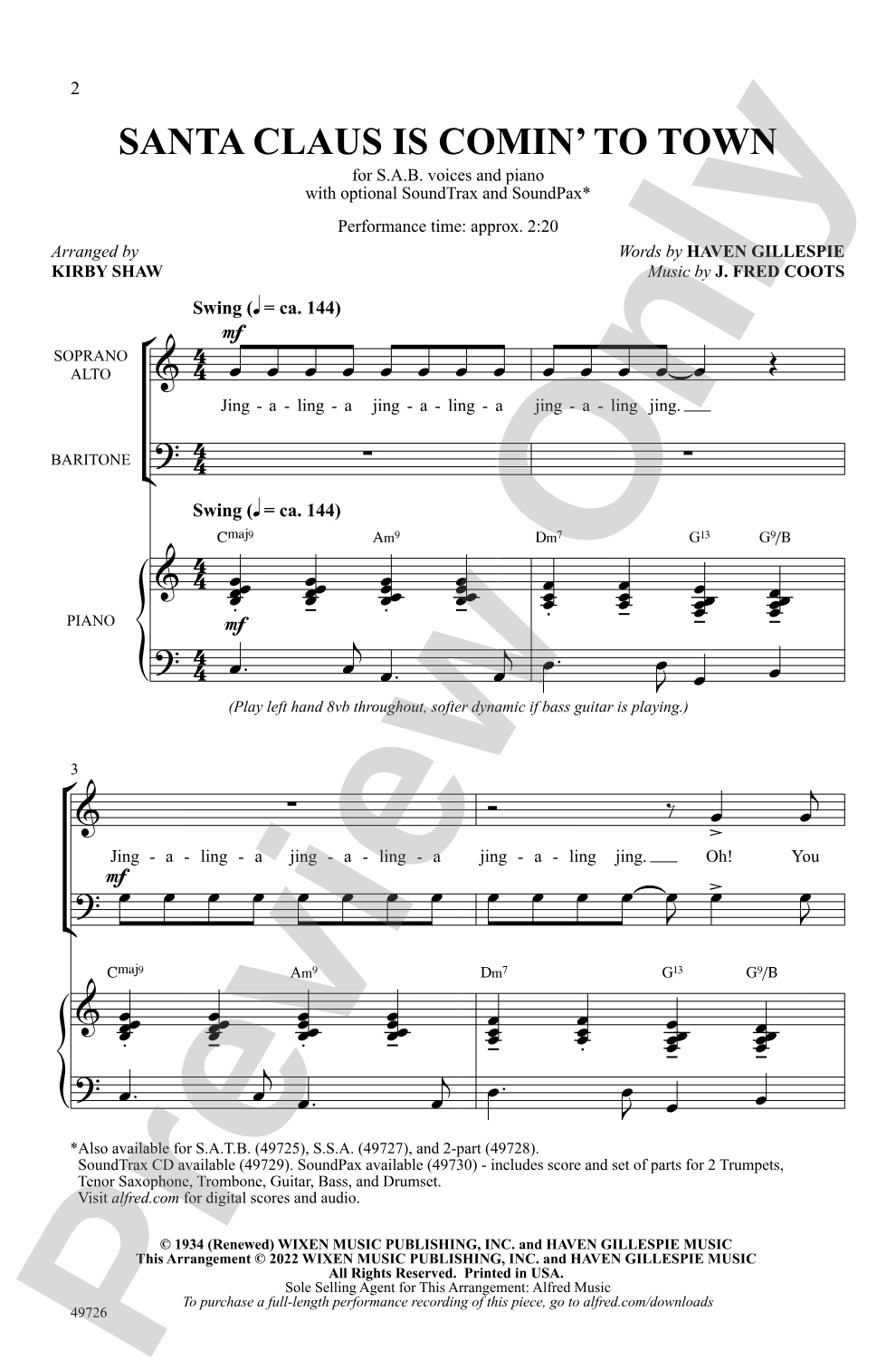
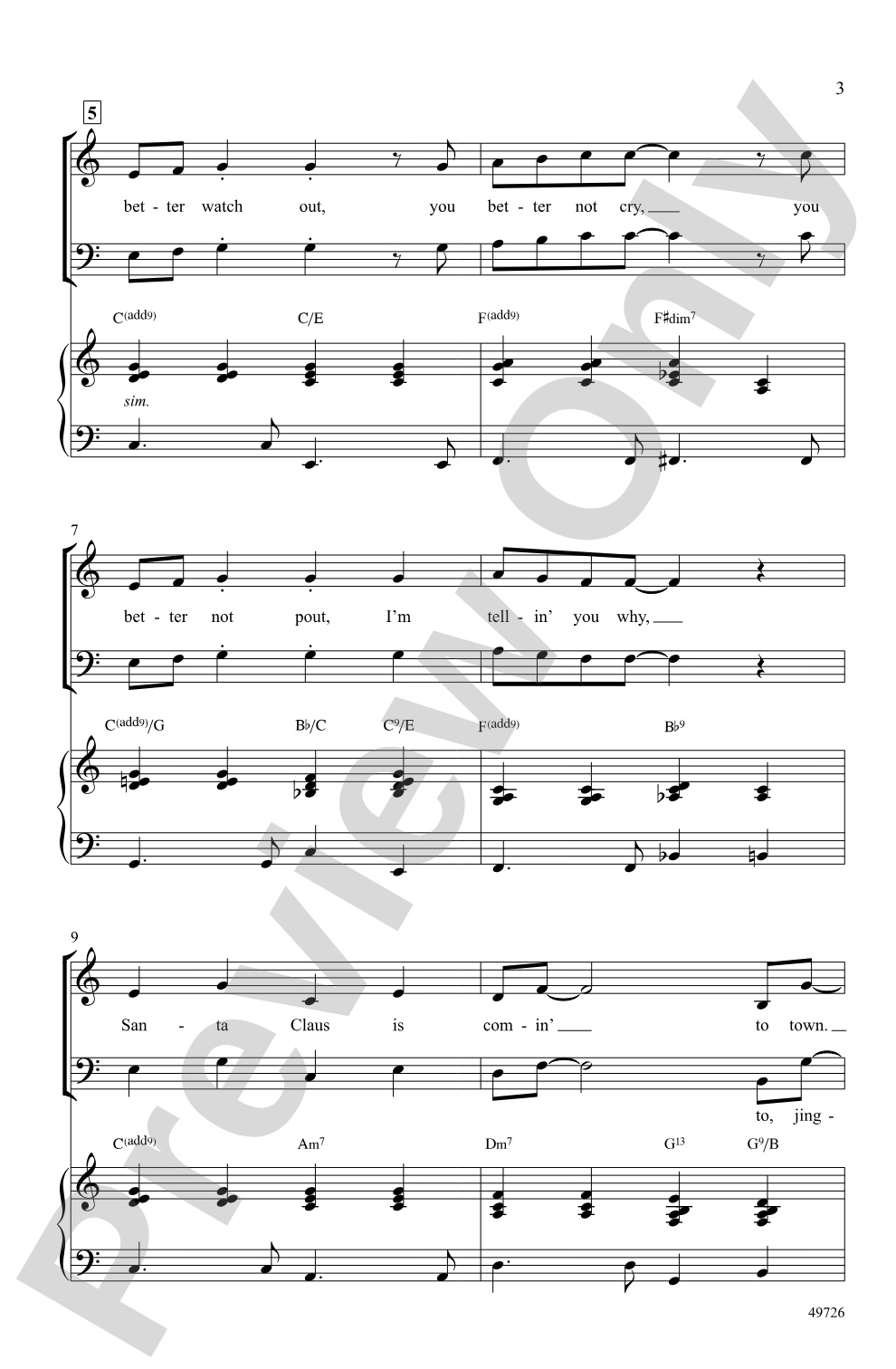
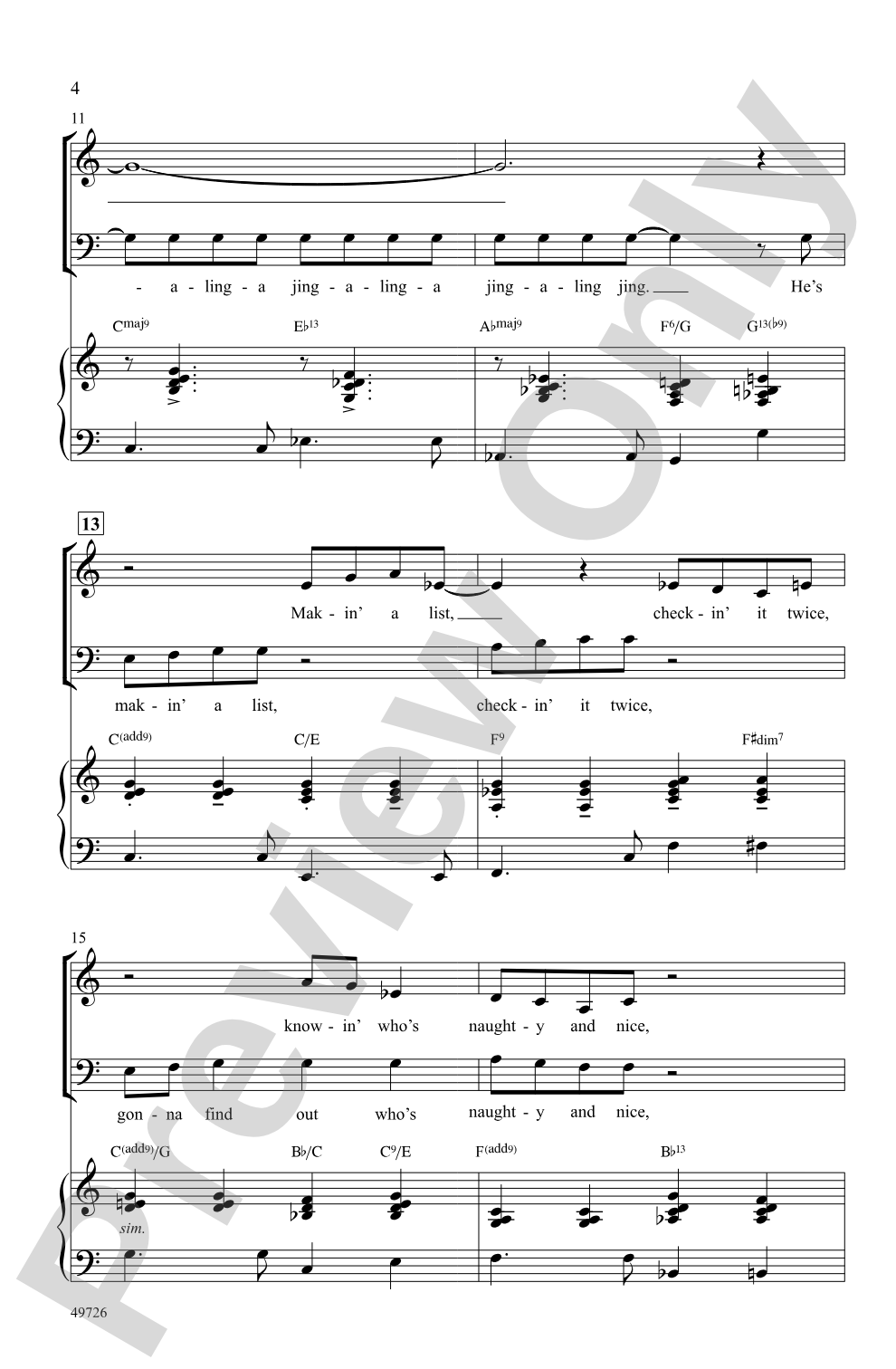

Santa Claus Is Comin' to Town: SAB Choral Octavo
Words by Haven Gillespie, music by J. Fred Coots / arr. Kirby Shaw
Item: 00-PO-0006929

$2.10
Minimum order quantity: 20 copies
Pickup currently not available
Related Items
Santa Claus Is Comin' to Town: SATB Choral Octavo |
$2.10
|
View | |
Santa Claus Is Comin' to Town: SSA Choral Octavo |
$2.10
|
View | |
Santa Claus Is Comin' to Town: 2-Part Choral Octavo |
$2.10
|
View | |
Santa Claus Is Comin' to Town: Choral SoundPax |
$30.00
|
View | |
Santa Claus Is Comin' to Town: SATB Choral Octavo |
$2.10
|
View | |
Santa Claus Is Comin' to Town: SAB Choral Octavo |
$2.10
|
View | |
Santa Claus Is Comin' to Town: SSA Choral Octavo |
$2.10
|
View | |
Santa Claus Is Comin' to Town: 2-Part Choral Octavo |
$2.10
|
View | |
Santa Claus Is Comin' to Town: Choral Octavo SoundTrax CD |
$29.99
|
View | |
Santa Claus Is Comin' to Town: Choral SoundPax |
$30.00
|
View |
Description
Jolly "jing-a-ling-a's" provide hip transitions and bright bookends in this jazzed-up version of the great Christmas standard. Kirby's arrangement fits the tune like a glove, and will last in your library year after year. Eight bars in the middle may be repeated as many times as desired, and opened up to include vocal and/or instrumental soloists, improvisation, scat singing, gradual stacking of written lines, etc. Just be sure to save a little something for the shout chorus that follows! SoundPax includes four horn parts, but easily adapts for rhythm section alone.


Don't just read it, hear it, play along with it, and watch your students grow with it. In MakeMusic Cloud, Santa Claus Is Comin' to Town: SAB Choral Octavo comes alive with professional accompaniment, adjustable tempo, and built-in practice tools that turn solo practice into real progress.
Open in the Player
Jump straight in and assign it today.
Start Your Free Trial
Open this title and explore the full library in minutes.
Sample Audio
1
Audio File
--:--
0:00
0:00
Sample Video
Additional Details
Series:
Alfred Pop Choral Series
Publisher:
Alfred Music
Page Count:
12
SKU:
00-PO-0006929
More about this title
About the Composer: J. Fred Coots
J. Fred Coots composed "Santa Claus Is Comin' to Town" in 1934, creating one of the most enduring holiday standards in American popular music. His gift for melody and his ability to write instantly memorable tunes made him a prolific and successful composer for film, radio, and stage throughout the twentieth century.
Why we love this
Kirby Shaw's arrangement respects the song's infectious charm while injecting genuine swing and energy that feels fresh without overwhelming the melody. The flexible eight-bar section in the middle transforms a static holiday standard into a playground for your singers, letting you layer voices, feature soloists, or invite improvisation without losing the structure that makes the piece work. It's the kind of arrangement that plays beautifully straight but invites you to have genuine fun with it.
What to expect
Bright, swinging, and genuinely playful. The arrangement captures the tune's warmth while injecting jazz language and rhythmic snap that makes the familiar instantly exciting. There's room to breathe and to shine individually, yet the piece holds together with unmistakable holiday charm.
Who it's for
Choirs with SAB voicing seeking a holiday standard that energizes audiences without requiring complex vocal techniques or instrumental accompaniment. Directors who want a piece that works as both a concert feature and an accessible, joyful addition to a winter show or pops program.
How to get the most out of it
- Lock in the groove during the "jing-a-ling-a" transitions; these moments define the arrangement's character and set the energy for what follows.
- Plan your eight-bar section strategically before rehearsal. Decide which singers get the solo spotlight, where you'll stack voices gradually, and whether you'll include instrumental improvisation so the choir knows what to expect.
- Balance the three parts clearly in the shout chorus that closes the piece; SAB voicing can muddy if the alto line sits too high in the mix.
- If using the recorded accompaniment, have your singers listen to it in full once before rehearsing so they hear the intended groove and phrasing.
How to use it
Anchor a holiday pops concert or winter choral program with this as a confident crowd-pleaser that lets your ensemble showcase both their vocal blend and their ability to swing. The flexible middle section makes it an ideal closer or penultimate number, where you can build energy and involvement throughout the performance.
Skills your students will build
- Singing in a swing groove and maintaining rhythmic precision with syncopation
- Balancing three-part SAB voicing with clear part independence
- Improvisation and scat singing (in the flexible eight-bar section)
- Responding to soloists and ensemble texture changes within a structured framework
- Ensemble blend and dynamic control in a modern pop arrangement