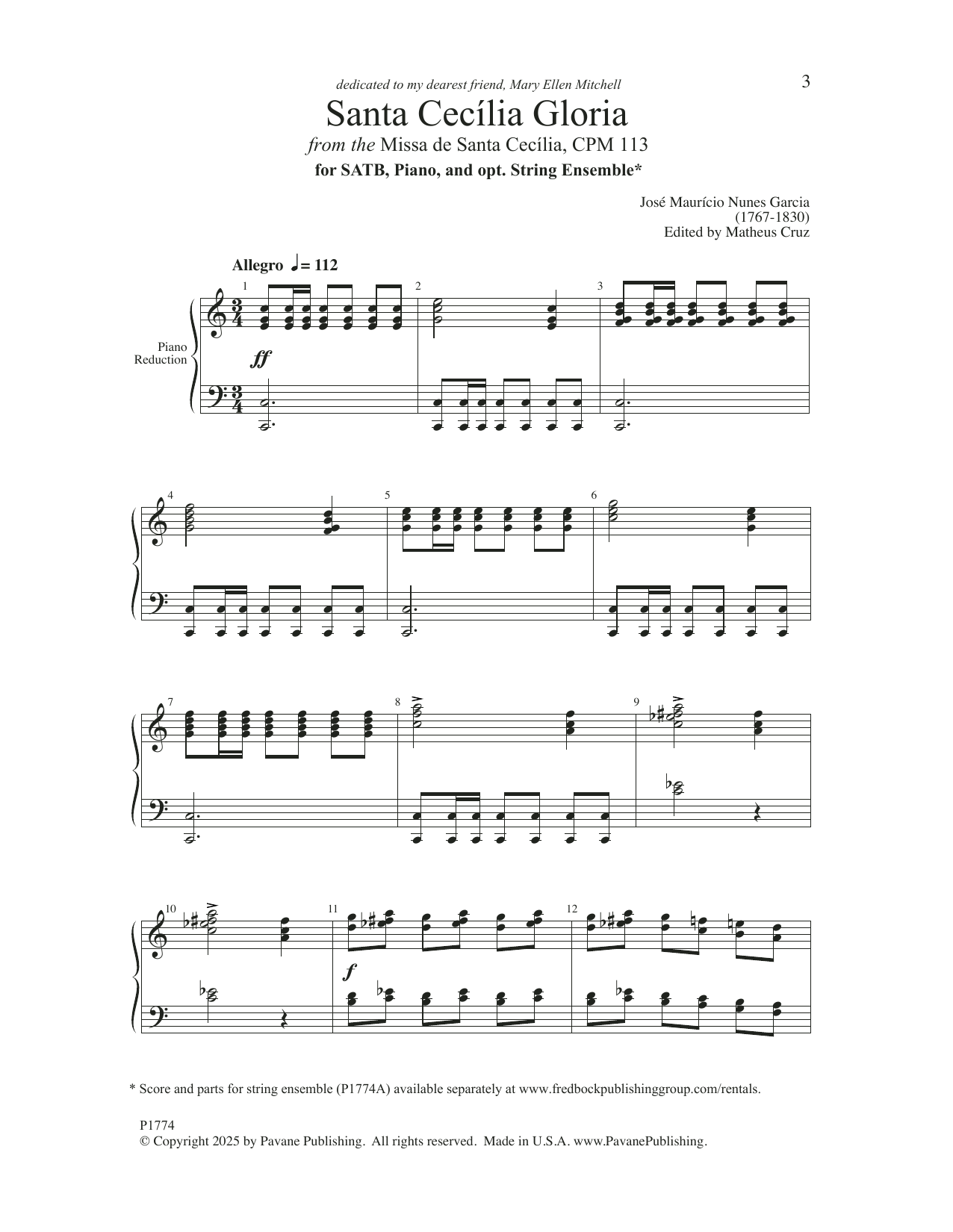
Santa Cecilia Gloria (ed. Matheus Cruz) Sheet Music Preview

Santa Cecilia Gloria (ed. Matheus Cruz): SATB Choral Octavo

By JOSÉ MAURÍCIO NUNES GARCIA / Edited by Matheus Cruz

Item: 35-DS01576750

Digital Download
$3.35
Description

Santa Cecilia Gloria (ed. Matheus Cruz): SATB Choral Octavo isn't in MakeMusic Cloud just yet...but it could be. Let us know you'd like to see it, and you'll help shape what comes next. In the meantime, start a free trial and dive into thousands of interactive titles your students can play along with today.

Sample Audio
No sample audio found.
Sample Video
Additional Details
Publisher: Hal Leonard
Page Count: 8
SKU: 35-DS01576750

More about this title

About the Composer: JOSÉ MAURÍCIO NUNES GARCIA

José Maurício Nunes Garcia (1780-1830) stands as Brazil's most significant composer of the colonial and early independent periods. Working primarily in Rio de Janeiro, he shaped the musical life of the Portuguese court in exile and laid the foundation for Brazilian classical music through his sacred works, operas, and chamber compositions. His technical mastery of counterpoint and harmonic language reflects his deep study of European tradition, yet his music carries a distinctive character that would influence generations of Brazilian composers.

Why we love this

Nunes Garcia's sacred music offers sophisticated four-part writing that rewards careful rehearsal without demanding virtuosic display. This gloria provides genuine musical substance: clean harmonic language, singable lines across all voices, and the kind of structural clarity that lets your choir focus on phrasing and blend rather than decoding notation.

What to expect

Formal yet expressive, with the clarity and directness of classical sacred music. The writing has warmth without sentimentality, dignity without austerity. Phrases arc naturally, and the harmonic language unfolds with elegant inevitability.

Who it's for

This octavo suits intermediate to advanced SATB choirs seeking repertoire beyond the most familiar Renaissance and Baroque options. It works equally well for concert programming, liturgical use, or academic study of Brazilian musical heritage.

How to get the most out of it

  • Balance the soprano line against the inner voices, which carry harmonic weight. The alto and tenor parts are melodically interesting and deserve projection.
  • Shape longer phrases by thinking in terms of harmonic arrival points rather than breathe points. This creates momentum across eight pages.
  • Observe the register changes carefully. When voices shift between higher and lower tessitura, adjust blend and weight to maintain cohesion.
  • Treat accidentals as landmarks. They signal harmonic movement and help singers hear the architecture of each section.

How to use it

Pair this with other Latin American sacred music for a concert exploring the richness of colonial and early independence-era composition. It also serves as a substantial anchor piece in a program mixing European and New World repertoire, or as a standalone offering during holiday or sacred music series performances.

Skills your students will build

  • Reading and performing classical four-part counterpoint
  • Sustaining longer phrase lines with textual clarity
  • Balancing soprano melody against harmonic interest in lower voices
  • Executing clean harmonic changes and chromatic inflections
  • Understanding early Brazilian musical style and its relation to European training

You May Also Like