Sans Day Carol: Timpani Sheet Music Preview

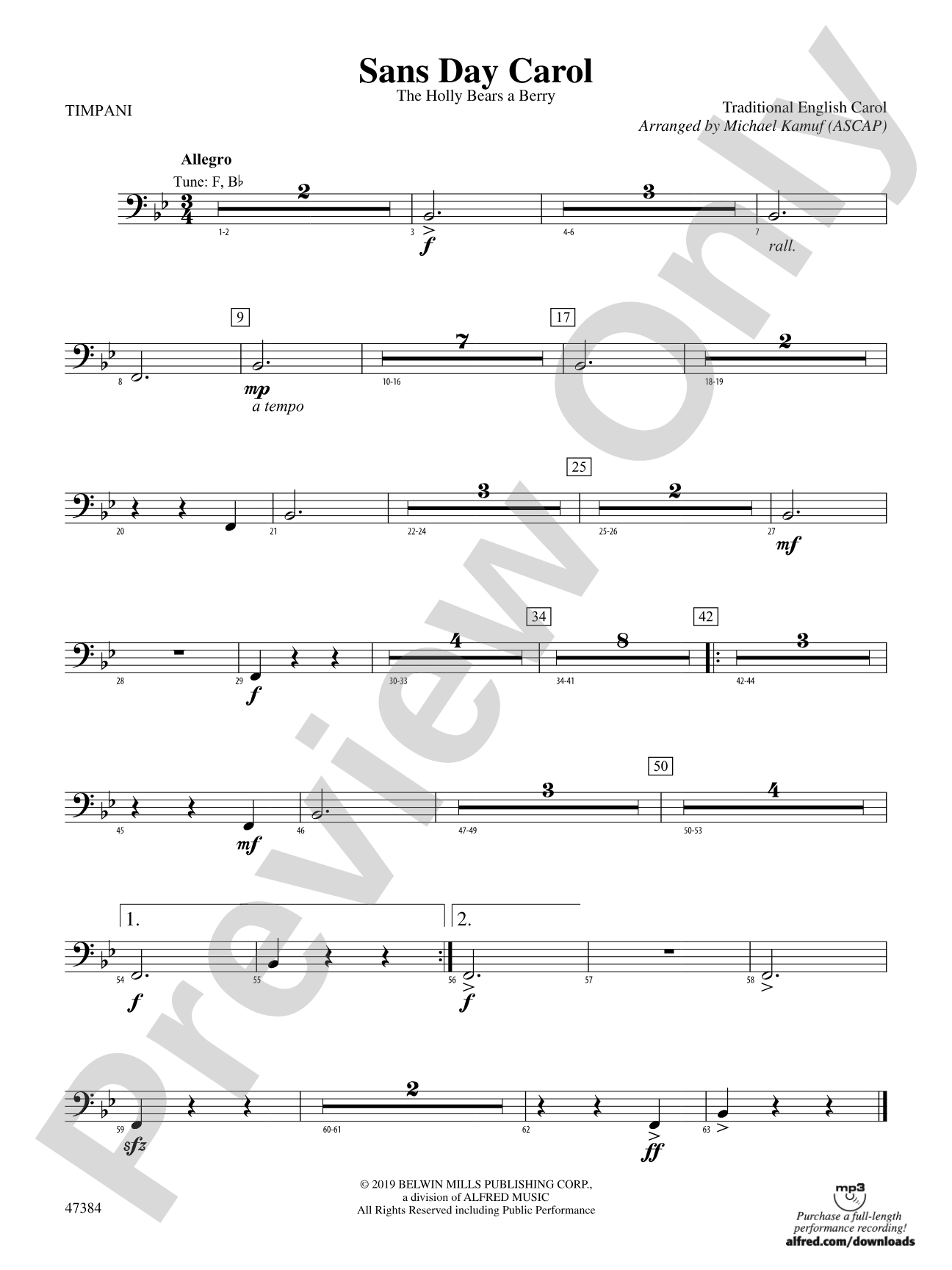
Sans Day Carol: Timpani

The Holly Bears a Berry

Traditional English Carol / arr. Michael Kamuf

Grade: 1 (Very Easy)

Item: 00-PC-0017918_TMP

Digital Download
$3.00
Description
This piece dates back to 19th-century Cornwall County in southwest England, and the lyrics most associated with this melody are similar to the text of "The Holly and the Ivy." This arrangement of the beautiful carol gives beginning band students an opportunity to work on expressive playing while using limited technical demands. Fitting for both holiday and festival performances. (1:45)

Don't just read it, hear it, play along with it, and watch your students grow with it. In MakeMusic Cloud, Sans Day Carol: Timpani comes alive with professional accompaniment, adjustable tempo, and built-in practice tools that turn solo practice into real progress.

Sample Audio
0:00
0:00
Sample Video
Additional Details
Series: Belwin Beginning Band
Publisher: Alfred Music
Page Count: 132
SKU: 00-PC-0017918_TMP

More about this title

About the Arranger: Michael Kamuf

Michael Kamuf

Michael Kamuf earned Bachelor of Music degrees in Jazz Performance and Music Education from the Dana School of Music at Youngstown State University, followed by a Master of Arts in Instrumental Conducting from George Mason University. His compositions and arrangements have been recorded by the Woody Herman Orchestra, Glenn Miller Orchestra, USAF Airmen of Note, US Navy Commodores, and soloists including James Moody, Eddie Daniels, Sean Jones, and Bill Watrous. He has over 100 publications in print across jazz, orchestra, and concert band catalogs.

Kamuf taught instrumental music in Montgomery County Public Schools for thirty years, spending twenty-seven of those years as Director of Bands and Orchestras at John T. Baker Middle School in Damascus, Maryland. Under his leadership, the Baker ensembles earned consistent festival recognition and commissioned multiple works for young concert bands. He currently leads the Mike Kamuf Little Big Band, a jazz octet based in the Baltimore and Washington, DC region.

Why we love this

Kamuf respects what beginning band students actually need: the chance to make beautiful sound without wrestling with demanding technique. This arrangement strips away the complexity while keeping the carol's warmth intact, giving your ensemble early success with expressive playing. The modest 1:45 duration fits naturally into both winter concerts and festival rotations without demanding excessive rehearsal time.

What to expect

A carol born from Cornish tradition finds warmth and dignity in straightforward orchestration. The piece has the quiet contentment of folk melody arranged without affectation, inviting singers and listeners alike to hear something both familiar and gently renewed.

Who it's for

Beginning concert bands ready to explore expressive musicality without technical overload. This works equally well for students encountering carols for the first time and for ensembles whose instrumentation or skill level calls for accessible but musically satisfying arrangements.

How to get the most out of it

  • Shape the melody with dynamic contrast between the phrase beginnings and endings; a slight swell at phrase peaks will draw out the carol's lyrical character.
  • Balance the inner voices so that harmonies support without masking the primary melodic line, especially when the tune passes between sections.
  • Let the final cadence breathe; resist the urge to rush into the final chord, allowing the resolution to settle naturally.

How to use it

Pair this with one or two other carols of varying styles to create a meaningful seasonal segment, or let it stand alone as the emotional anchor of a winter concert. Its modest technical demands make it an ideal choice for festivals where sight-reading or limited rehearsal time is a reality.

Skills your students will build

  • Expressive phrasing and dynamic shaping in simple melodic contexts
  • Balance between principal melody and harmonic support
  • Legato playing across phrase boundaries
  • Attention to intonation in sustained chords

You May Also Like