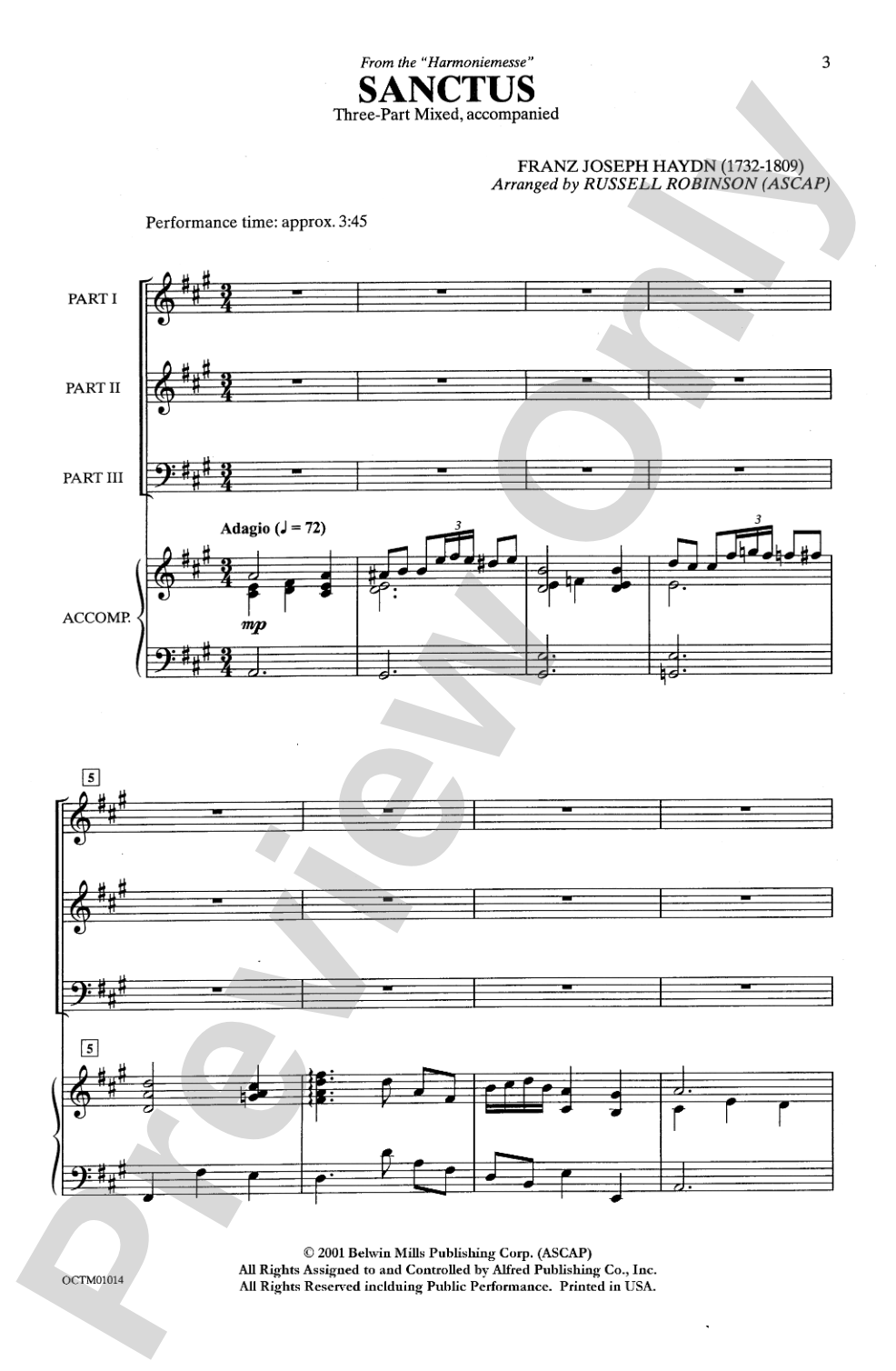
Sanctus Sheet Music Preview

Sanctus: 3-Part Mixed Choral Octavo

By Franz Joseph Haydn / arr. Russell Robinson

Level: Moderate

Item: 00-PO-0006796

Digital Download
$1.65

Minimum order quantity: 20 copies

Description
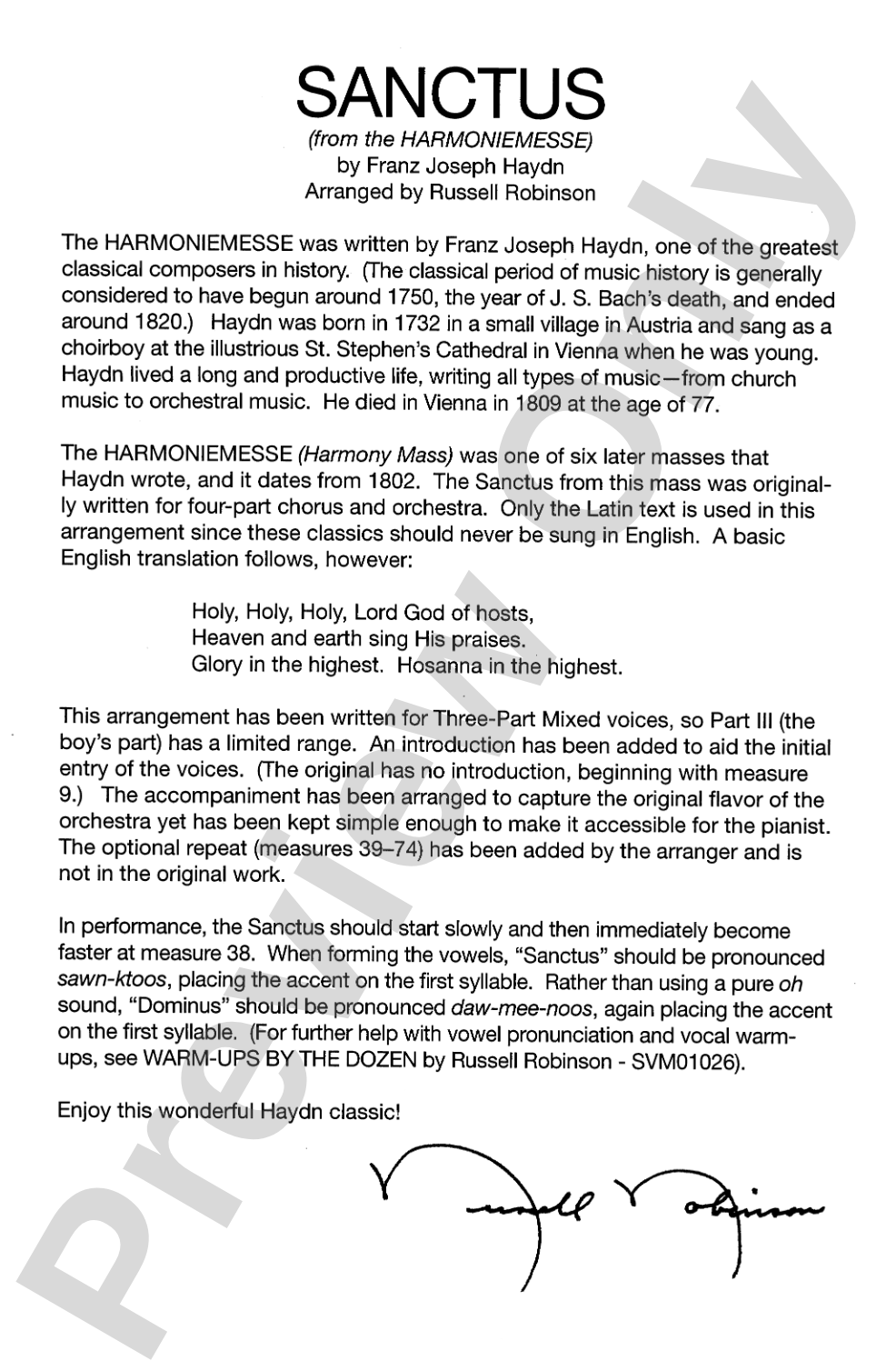
The latest addition to our Developing SATB Repertoire series is from Haydn's Harmoniemesse (1802). It's classic Haydn and a staple in the choral literature. This edition brings SATB performance into the realm of your developing (younger) singers.

Sanctus: 3-Part Mixed Choral Octavo isn't in MakeMusic Cloud just yet...but it could be. Let us know you'd like to see it, and you'll help shape what comes next. In the meantime, start a free trial and dive into thousands of interactive titles your students can play along with today.

Sample Audio
No sample audio found.
Sample Video
Additional Details
Series: Alfred Archive Edition: Belwin Festival Series
Publisher: Alfred Music
Page Count: 12
SKU: 00-PO-0006796

More about this title

About the Composer: Franz Joseph Haydn

Franz Joseph Haydn (1732–1809) was a cornerstone of the Classical era, composing across every major genre and earning the title "Father of the Symphony." His sacred music represents some of the most elegant and inventive writing in the choral canon, blending formal sophistication with immediate accessibility. The Harmoniemesse, from which this Sanctus is drawn, showcases Haydn's gift for creating spiritually resonant music that never sacrifices craft for sentiment.

As a teacher and innovator, Haydn shaped the language of Classical composition that Mozart, Beethoven, and generations of musicians after them would inherit. His sacred works remain essential to choral pedagogy because they reward careful listening and singing while remaining genuinely singable for developing ensembles.

Why we love this

Russell Robinson's arrangement captures the architecture and elegance of Haydn's original while genuinely serving younger singers. The SAB voicing doesn't reduce the harmonic interest or musical integrity; it simply opens this masterwork to singers who aren't ready for full SATB. Directors appreciate that it sounds complete and refined, not simplified.

What to expect

Serene and dignified without being heavy. The music breathes with Classical restraint and clarity; there's warmth in the harmony but no excess. Singing it feels like being part of something timeless and carefully crafted, the kind of piece that teaches singers what "good writing" actually sounds like.

Who it's for

Directors building a core choral repertoire with singers in grades 5–7 or younger high school singers still developing independence and blend. This arrangement works for singers who can hold a line but may not yet be ready for four independent parts or more complex rhythmic demands.

How to get the most out of it

  • Shape the melodic line with gentle, natural phrasing rather than forcing drama; Haydn's clarity comes from good diction and ensemble blend, not intensity.
  • Pay attention to the harmonic motion underneath the melody. Even in a 3-part texture, Haydn's voice leading reveals intention; singers who understand how their part fits within the progression will commit to pitch with confidence.
  • Balance the voices so the top line sings through without drowning out the inner harmonies. This is especially important in a smaller voicing where each part carries structural weight.
  • Use the text underlay as your guide for phrasing and breathing. Haydn's setting respects the liturgical text's natural rhythm.

How to use it

This works beautifully as a concert centerpiece or as part of a sacred or liturgical program. It also pairs well alongside other Classical sacred works or as a counterpoint to more contemporary choral selections, showing singers where much of the harmonic language they encounter comes from.

Skills your students will build

  • Sustaining long tones with steady breath support and blend
  • Reading three independent vocal lines simultaneously
  • Intonation within Classical harmonic progressions
  • Text-driven phrasing and articulation in sacred Latin
  • Understanding voice leading and harmonic function through singing

You May Also Like