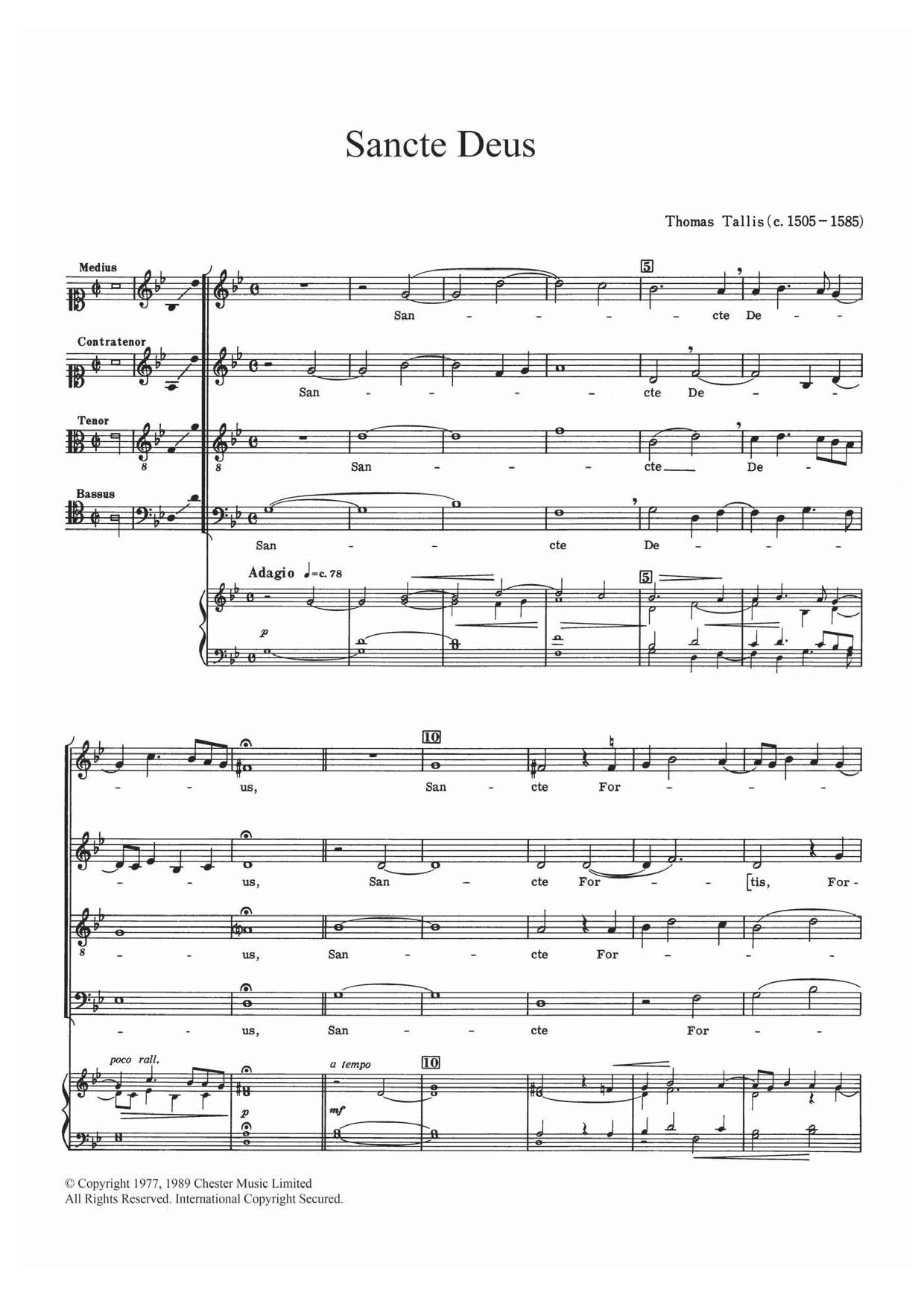
Sancte Deus Sheet Music Preview

Sancte Deus: SATB Choral Octavo

As performed by Thomas Tallis

Item: 35-DS00366855

Digital Download
$2.99
Description

Sancte Deus: SATB Choral Octavo isn't in MakeMusic Cloud just yet...but it could be. Let us know you'd like to see it, and you'll help shape what comes next. In the meantime, start a free trial and dive into thousands of interactive titles your students can play along with today.

Sample Audio
No sample audio found.
Sample Video
Additional Details
Publisher: Hal Leonard
Page Count: 6
SKU: 35-DS00366855

More about this title

About the Artist: Thomas Tallis

Thomas Tallis (c. 1505-1585) stands as one of the most accomplished English composers of the Renaissance, serving as organist and master of the choristers at the Chapel Royal for decades. His output spans sacred Latin motets, English anthems, and keyboard works that showcase sophisticated harmonic thinking and an intuitive grasp of vocal writing across multiple registers. Tallis bridged the reign of five English monarchs and navigated the religious upheaval of the Reformation without losing his compositional voice or position, a testament to both his diplomatic skill and the enduring quality of his music.

Why we love this

Tallis's Latin motets contain a meditative purity that resonates with singers and audiences alike, and this six-page octavo sits at an accessible entry point to his catalog. The harmonic language feels both modern in its openness and timeless in its spiritual directness, giving even confident high school choirs a piece that rewards careful ensemble listening without demanding virtuosic technique. Programming a Tallis motet signals that your choir engages with early music on its own terms, not as historical exercise.

What to expect

The piece unfolds with contemplative clarity, its polyphonic lines weaving together without haste or drama. There's an almost crystalline quality to the harmonic sonorities, a kind of spatial openness that lets each voice retain its individual character while contributing to a unified whole. Singing it feels like being part of something ancient and precise at once.

Who it's for

Intermediate and advanced SATB choirs with secure independent voice lines and a director interested in Renaissance repertoire beyond the typically programmed Palestrina or Orlando di Lasso. This works equally well for concert choirs, secular ensembles, and cathedral or liturgical programs seeking authentic Tudor-era sacred music.

How to get the most out of it

  • Balance the voices by ear rather than dynamic markings. Let the soprano and alto lines breathe without overwhelming the inner voices, which often carry important harmonic material.
  • Shape phrases around the natural breath points in the text; resist the urge to break within a phrase just because you've reached a convenient rest.
  • Approach the harmonic rhythm with flexibility. Some passages sit longer on a single sonority than modern ears expect; allow that stillness to settle before moving forward.
  • Record a rehearsal and listen back for tuning stability in the vertical sonorities, particularly where voices approach the same note from different directions.

How to use it

Position this as an anchor for a Renaissance program or place it alongside other early sacred works to build a concert around the span of English choral music. It also serves as a meaningful encore, fitting naturally after a longer contemporary work and leaving audiences with a sense of timelessness rather than spectacle.

Skills your students will build

  • Reading Renaissance notation and harmonic language
  • Maintaining independent lines in dense polyphonic textures
  • Adapting phrasing and breath to text-based musical architecture
  • Intonation within open, sparsely-scored vertical sonorities
  • Understanding liturgical Latin pronunciation and text stress

You May Also Like