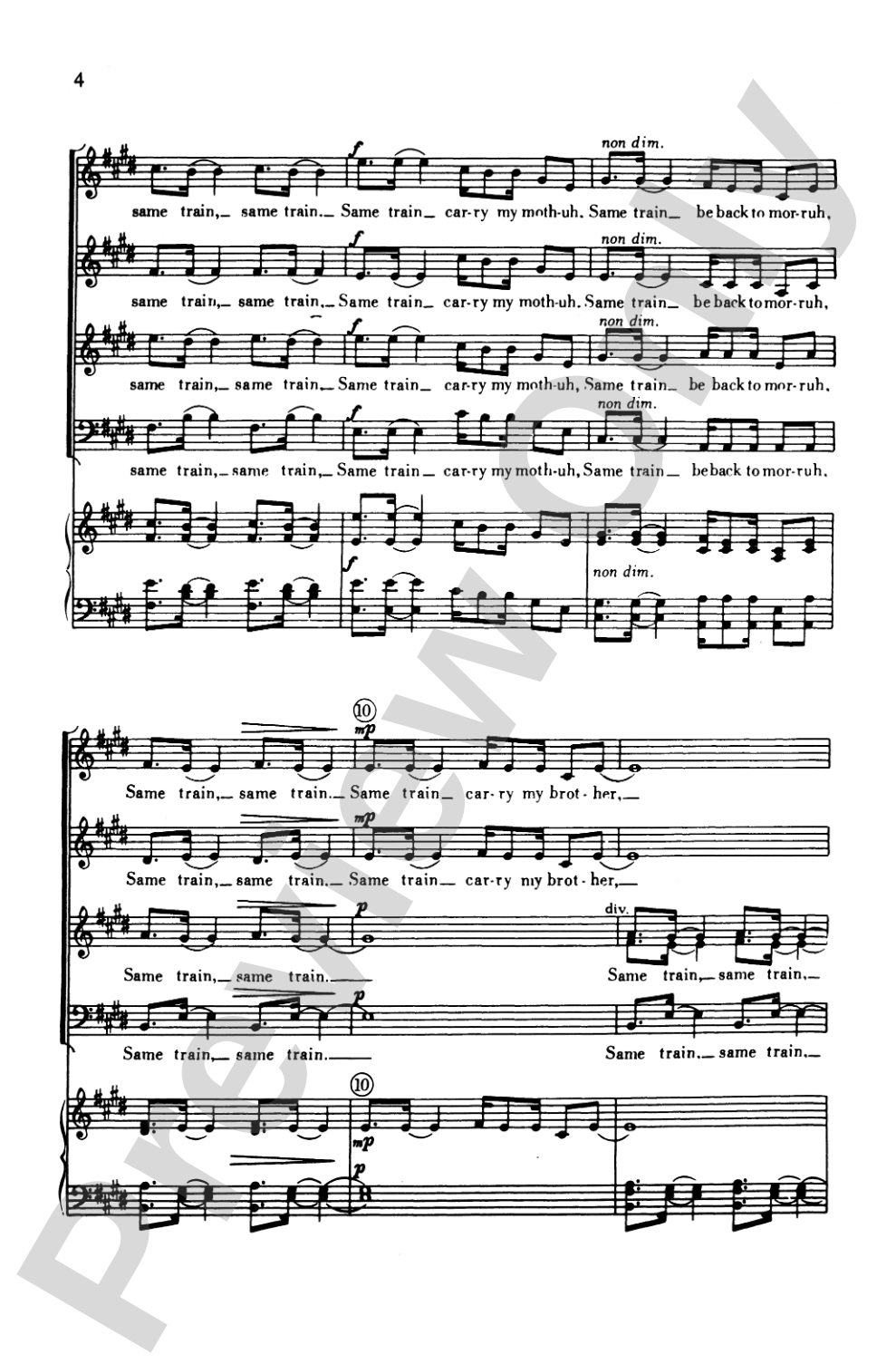
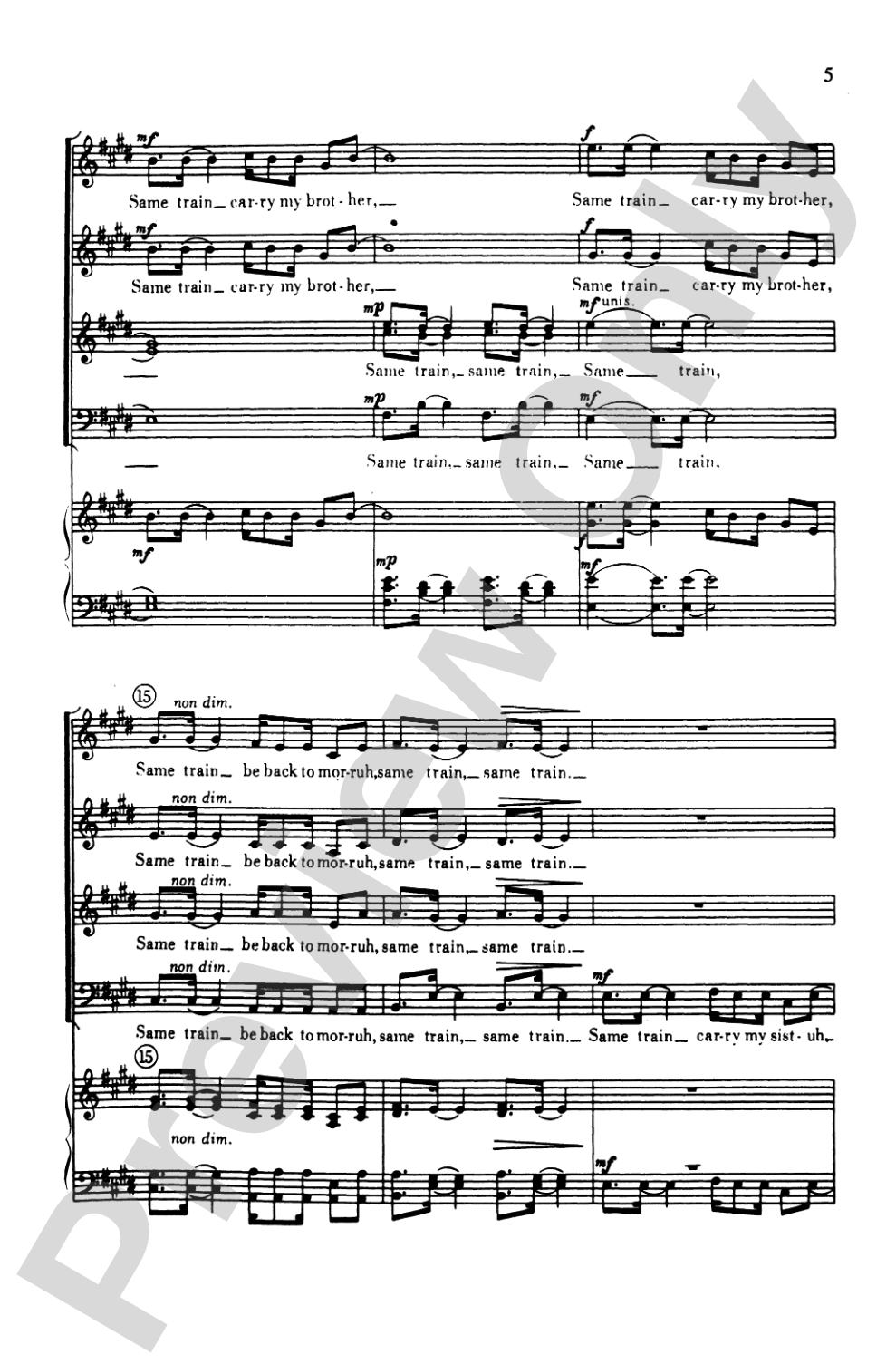
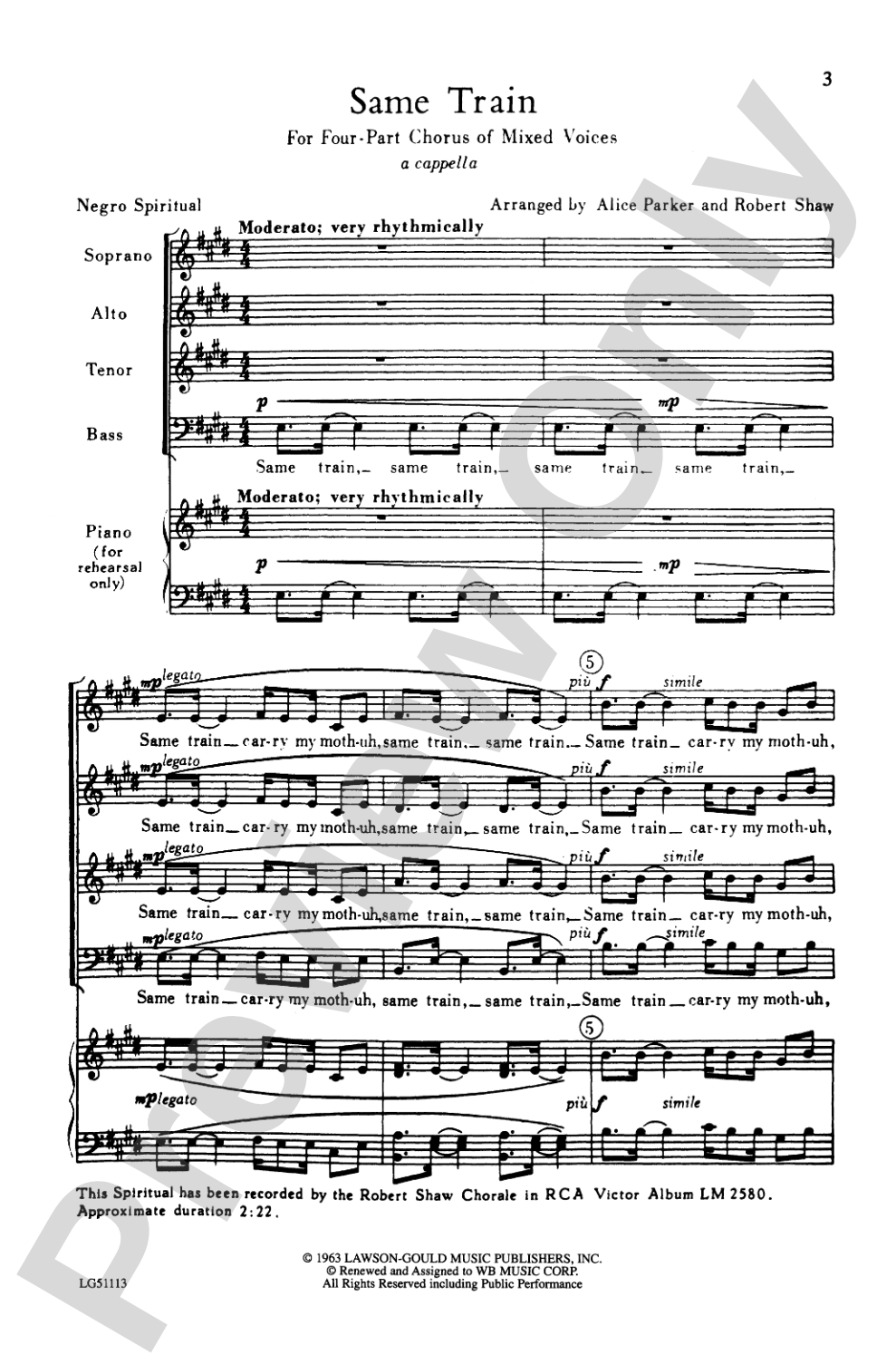
Same Train Sheet Music Preview

Same Train: SATB Choral Octavo

Arr. Robert Shaw and Alice Parker

Item: 00-PO-0003011

Digital Download
$2.95

Minimum order quantity: 20 copies

Description

Same Train: SATB Choral Octavo isn't in MakeMusic Cloud just yet...but it could be. Let us know you'd like to see it, and you'll help shape what comes next. In the meantime, start a free trial and dive into thousands of interactive titles your students can play along with today.

Sample Audio
No sample audio found.
Sample Video
Additional Details
Series: Alfred Archive Edition: Lawson-Gould Music Publishers
Publisher: Alfred Music
Page Count: 16
SKU: 00-PO-0003011

More about this title

About the Arranger: Robert Shaw

Robert Shaw (1916-1999) was a conductor, arranger, and choral educator whose influence shaped American choral music for over six decades. He founded the Robert Shaw Chorale in 1948 and later served as associate conductor of the Atlanta Symphony Orchestra, where his arrangements and conducting philosophy emphasized clarity, musicality, and the human voice as an instrument of profound expressiveness. Shaw's arrangements of spirituals and folk songs remain cornerstones of choral literature, valued for their accessibility without sacrificing artistic depth.

Shaw collaborated extensively with Alice Parker on choral arrangements, bringing both scholarly rigor and emotional authenticity to traditional material. His legacy extends through countless directors and singers who continue to perform his arrangements in concerts, festivals, and recordings worldwide.

Why we love this

Shaw's treatment of this spiritual carries the hallmark clarity and emotional directness that made his arrangements enduring favorites in choral programs. The a cappella texture puts the focus squarely on voices and interpretation, allowing singers to discover the song's expressive power without instrumental mediation. Programming this alongside other Shaw arrangements creates a cohesive artistic statement about how deep feeling emerges through disciplined ensemble singing.

What to expect

The spiritual carries the spiritual's timeless longing and hope, grounded in Shaw's arrangement through transparent voicing that lets each syllable breathe. The piece unfolds with quiet inevitability, building emotional resonance through harmonic richness rather than volume or complexity. Singing it feels like joining a conversation that spans generations.

Who it's for

This octavo suits intermediate and advanced high school choirs, college/university choral ensembles, and community or church choirs with solid blend and intonation. The a cappella format makes it accessible for groups without accompaniment accompaniment resources, while the spiritual's emotional weight rewards singers mature enough to engage with its cultural and historical significance.

How to get the most out of it

  • Release each chord cleanly and completely before moving to the next harmonic moment; Shaw's arrangements depend on space and silence as much as sound.
  • Explore the text's meaning phrase by phrase with your singers before refining technical details; emotional ownership precedes musical polish.
  • Balance the voice parts by listening for the melody's shape rather than individual part lines; SATB transparency serves the song's narrative.
  • Consider your tempo choice as the primary interpretive variable; even modest adjustments in pace reshape the spiritual's emotional terrain.

How to use it

This works beautifully as a concert centerpiece or festival selection, especially when programmed to honor African American cultural contributions to choral music. Pair it with other spirituals or folk arrangements to create a thematic set, or use it as a counterpoint to more elaborate contemporary works to remind audiences of the power of simplicity. Its 16-page length makes it ideal for singers who want substantial repertoire without overextending rehearsal time.

Skills your students will build

  • A cappella singing and blend without instrumental support
  • Interpretation of text and emotional expression in spiritual idiom
  • SATB voice independence while maintaining harmonic integrity
  • Sustained tone and breath management in longer phrases
  • Understanding of African American musical heritage and cultural context

You May Also Like