Sambalelé Sheet Music Preview

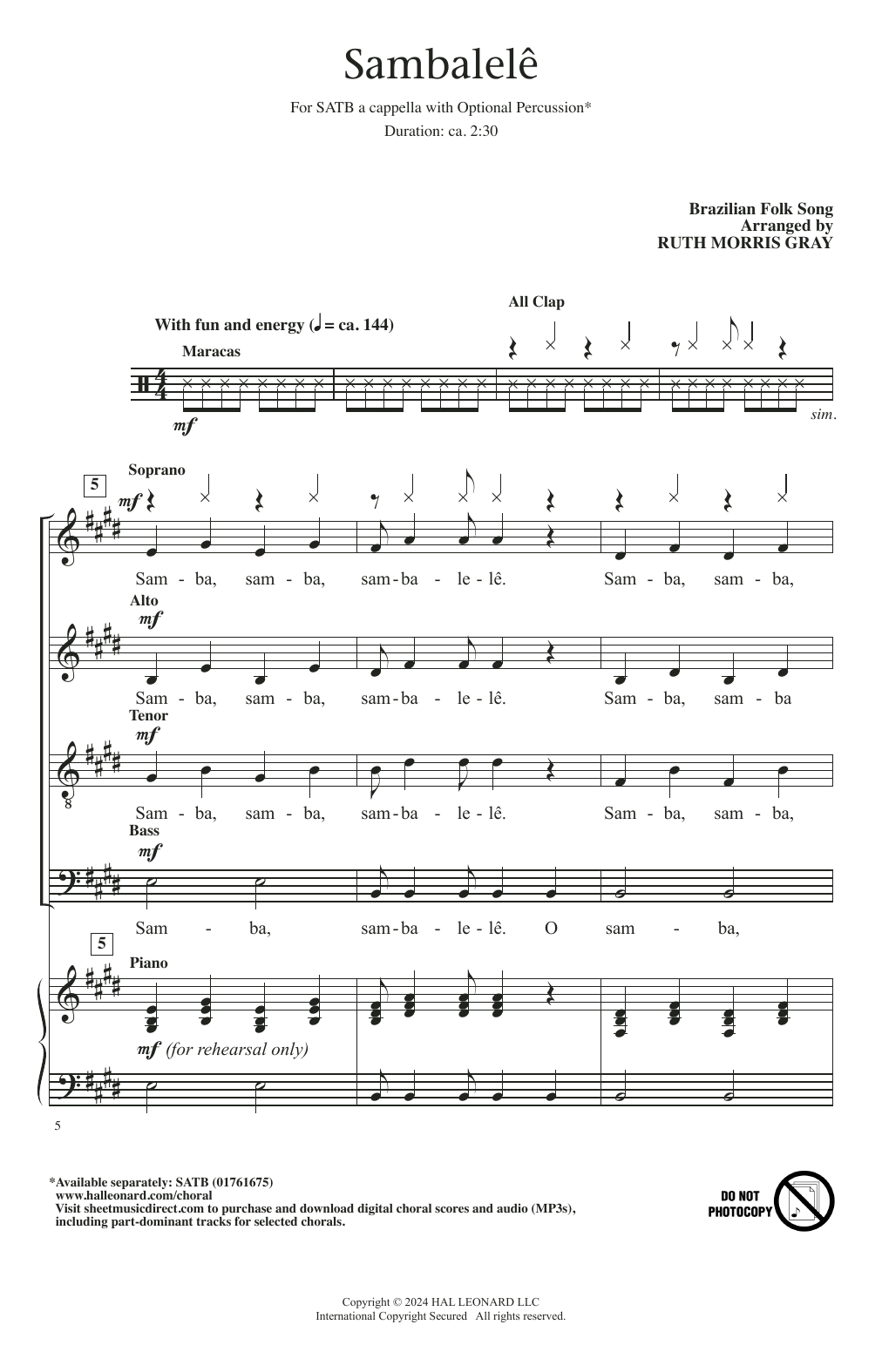
Sambalelé: SATB Choral Octavo

Arranged by Ruth Morris Gray

Item: 35-DS01575703

Digital Download
$2.75
Description

Sambalelé: SATB Choral Octavo isn't in MakeMusic Cloud just yet...but it could be. Let us know you'd like to see it, and you'll help shape what comes next. In the meantime, start a free trial and dive into thousands of interactive titles your students can play along with today.

Sample Audio
No sample audio found.
Sample Video
Additional Details
Publisher: Hal Leonard
Page Count: 15
SKU: 35-DS01575703

More about this title

About the Arranger: Ruth Morris Gray

Ruth Morris Gray

Ruth Morris Gray has shaped choral music education at Rosemead High School since 2004, where she directs the choirs while also teaching piano. Her compositional output exceeds 100 published works, reflecting decades of engagement with what singers need and what audiences respond to.

Gray holds a Bachelor of Music in Piano Performance and Composition from Biola University and a Master of Arts in Music Composition from UC Santa Barbara. She earned her California Single Subject Music Credential at Cal State Northridge. When not composing, teaching, or conducting, she travels, swims, reads, and rides e-bikes with her husband, Douglas.

Why we love this

Gray's arrangement captures the infectious rhythmic drive of this Brazilian classic while keeping the vocal writing accessible for singers at different levels. The four-part texture sits well for mixed ensembles and allows each voice to contribute meaningfully without excessive technical demands, making it equally suitable for concert programming or a community sing.

What to expect

Sambalelé radiates joy and forward momentum. The rhythmic vitality pulls singers into a dance-like experience, with parts weaving together to create a texture that feels both intricate and irresistibly singable.

Who it's for

High school and community choirs seeking repertoire that energizes singers and audiences alike. The SATB voicing adapts well to groups with varied ranges, and the musical content engages singers who want something beyond standard classical arrangements.

How to get the most out of it

  • Establish the rhythmic groove early in rehearsal by having singers tap or sing the driving pulse before adding melody. This foundation makes the layered complexity feel natural rather than cluttered.
  • Bring out the interplay between voice parts by adjusting dynamics slightly so no single line dominates the texture. The arrangement gains its energy from the collective conversation, not from one voice carrying everything.
  • Feel free to add subtle movement or hand gestures if your ensemble responds well to physical connection with the music. The samba ancestry lives in the body as much as in the ears.

How to use it

Place this piece where you need to shift the emotional temperature and get your audience leaning forward in their seats. It works beautifully in a world music or cultural music unit, or simply as a concert opener that reminds everyone why people sing together in the first place.

Skills your students will build

  • Rhythmic precision in ensemble contexts with syncopated, layered patterns
  • Blend and balance within a four-part texture with independent vocal lines
  • Musicality that connects physical gesture and rhythmic energy to phrasing
  • Exposure to Brazilian musical idioms and cultural context

You May Also Like