
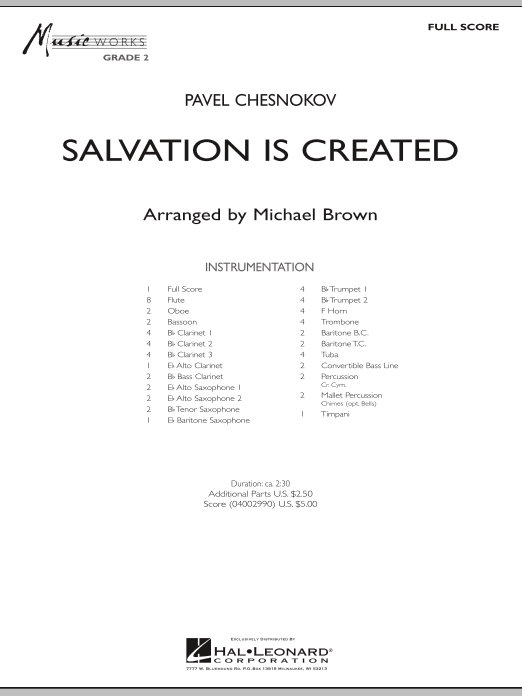

Salvation Is Created: Concert Band Conductor Score & Parts
By Pavel Chesnokov / Arranged by Michael Brown
Grade: 2
Item: 35-PK00156086
$65.00
Pickup currently not available
Buy Extra Parts (Digital PDF Download)
Parts Added to Cart!
Description
This Russian Orthodox-style choral anthem was composed in 1912. It was one of Chesnokov's last sacred works, and one he never heard performed. Michael Brown has skillfully and faithfully recreated this memorable chorale for young players using reduced instrumentation suitable even for smaller ensembles. Dur: 2:30


Salvation Is Created: Concert Band Conductor Score & Parts isn't in MakeMusic Cloud just yet...but it could be. Let us know you'd like to see it, and you'll help shape what comes next. In the meantime, start a free trial and dive into thousands of interactive titles your students can play along with today.
Request This Title
Tell us you want it.
Start Your Free Trial
Explore everything that's ready to play right now.
Sample Audio
No sample audio found.
Sample Video
No sample videos found.
Additional Details
Publisher:
Hal Leonard
SKU:
35-PK00156086
More about this title
About the Composer: Pavel Chesnokov
Pavel Chesnokov (1877–1944) was a Russian composer and conductor whose sacred choral works defined the sound of early 20th-century Orthodox church music. He spent much of his career as a composer, conductor, and teacher in Moscow, developing a distinctive harmonic language that honored traditional liturgical texts while embracing modern compositional techniques. His output was remarkably prolific, yet many of his finest works remained unheard during his lifetime, including Salvation Is Created.
Chesnokov's sacred music reflects a deep reverence for Russian Orthodox tradition combined with sophisticated voice leading and rich harmonic color. His works have become cornerstones of both liturgical and concert repertoire, offering conductors and singers access to a profound spiritual and musical legacy that continues to resonate across ensembles today.
Why we love this
Michael Brown's arrangement captures the solemn beauty of Chesnokov's original choral writing while making it accessible to young concert bands. The reduced instrumentation means you can program this even with modest ensemble numbers, yet it never sounds thin or compromised; instead, the orchestration feels intentional and respectful of the source material. At just 2:30, it's the perfect length for a program that needs a moment of genuine reverence without demanding an excessive rehearsal commitment.
What to expect
Salvation Is Created unfolds like a quiet procession, grounded in rich harmonic warmth and a hymnal simplicity that feels timeless. The piece carries an undeniable dignity, drawing strength not from flash or complexity but from its unwavering harmonic foundation and the clarity of its melodic gesture.
Who it's for
Grade 2 ensembles looking for a concert piece that brings gravitas and spiritual depth to their programming. It works equally well for directors building a mixed concert or seeking repertoire that challenges students to listen carefully to tuning and blend while maintaining forward musical momentum.
How to get the most out of it
- Shape the opening phrase with a gentle swell in the low brass and reeds to establish the hymn-like character before the melody enters.
- Balance the melodic line carefully across sections; this arrangement works best when no single voice overwhelms, creating a unified choral effect.
- Hold back on tempo during the central phrases to allow harmonic movement to breathe; resist rushing through the sustained sonorities.
- Use the full two and a half minutes to let the piece unfold with patience. A contemplative pace will transform a short work into something memorable.
How to use it
Pair this with a more energetic opening or closing work to create dynamic contrast; its contemplative nature makes it ideal as a program anchor between heavier repertoire. It also serves beautifully in concert programs that celebrate diverse musical traditions or in spring concerts where a moment of quiet reflection balances more ambitious works.
Skills your students will build
- Sustained tone production across the full range of the ensemble
- Harmonic tuning and blend in slow-moving chord changes
- Balancing between principal melody and supporting voices
- Control and precision at soft dynamic levels
- Phrasing in music without traditional rhythmic drive