
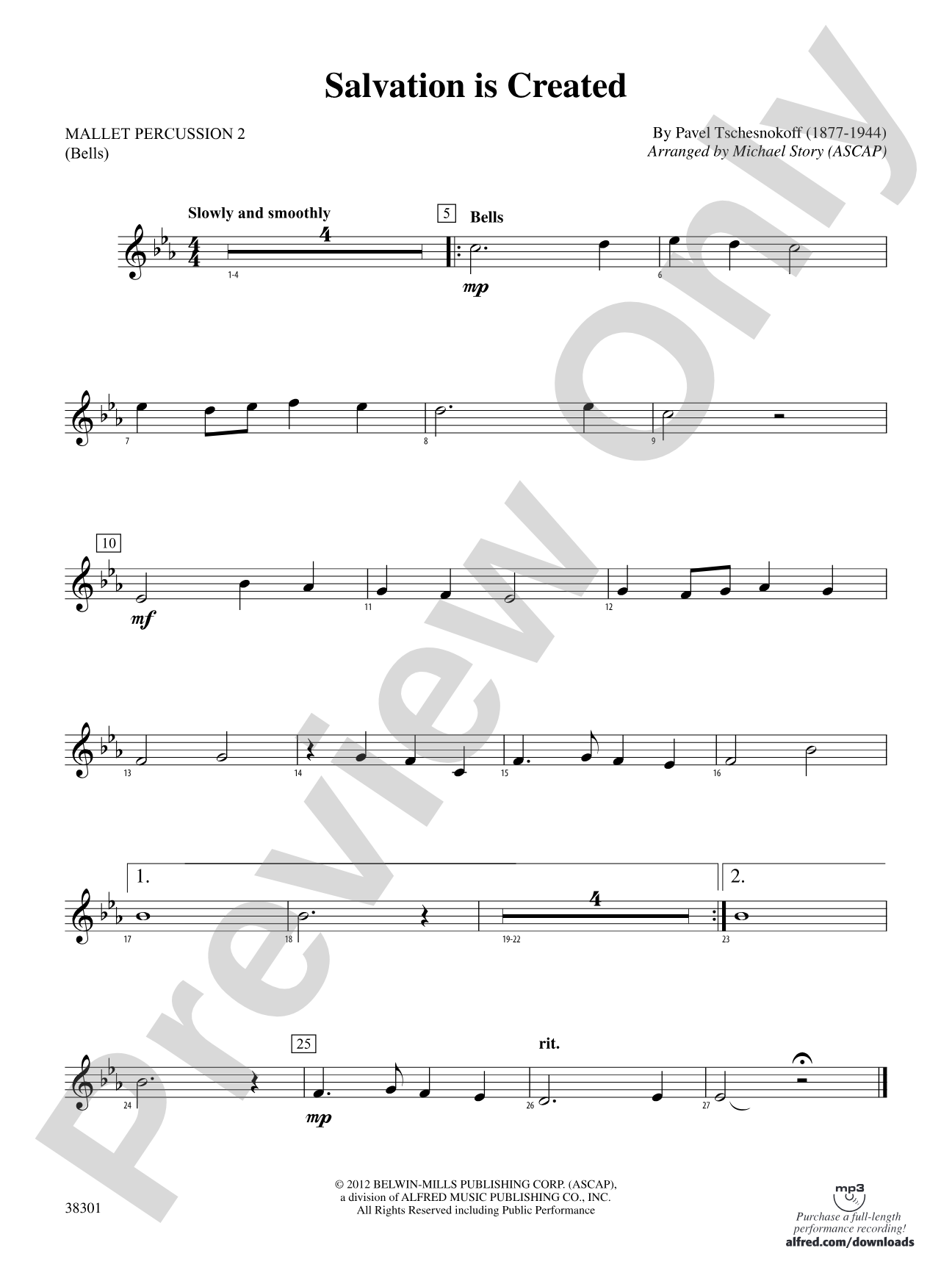

Salvation Is Created: 2nd Mallet Percussion
By Pavel Tschesnokoff / arr. Michael Story
Grade: 1 (Very Easy)
Item: 00-PC-0015404_M2
$3.00
Pickup currently not available
Description
"Salvation Is Created," written in 1912 by Russian composer, conductor, and teacher Pavel Tschesnokoff (1877--1944), was one of the last sacred choral works Tschnesnokoff wrote before being compelled towards secular music by the Soviet Union. One of the most enduring and beautiful chorales ever written, this stirring arrangement is a winner! (2:00)


Don't just read it, hear it, play along with it, and watch your students grow with it. In MakeMusic Cloud, Salvation Is Created: 2nd Mallet Percussion comes alive with professional accompaniment, adjustable tempo, and built-in practice tools that turn solo practice into real progress.
Open in the Player
Jump straight in and assign it today.
Start Your Free Trial
Open this title and explore the full library in minutes.
Sample Audio
1
Audio File
--:--
0:00
0:00
Sample Video
No sample videos found.
Additional Details
Series:
Belwin Beginning Band
Publisher:
Alfred Music
Page Count:
130
SKU:
00-PC-0015404_M2
More about this title
About the Composer: Pavel Tschesnokoff
Pavel Tschesnokoff (1877–1944) was a Russian composer, conductor, and pedagogue whose sacred choral works became foundational to the Orthodox choral tradition. His compositions were marked by luminous harmonies, spiritual depth, and a gift for writing vocal lines that felt both accessible and profound. "Salvation Is Created," composed in 1912, stands among his most celebrated works and represents the peak of his sacred output before Soviet cultural pressures redirected his artistic focus toward secular music.
Tschesnokoff's influence on choral music education extends far beyond Russia. His works remain staples in both professional and student choirs worldwide, valued for their musicality, spiritual resonance, and the way they challenge singers to find beauty in simplicity. His legacy as both composer and teacher shaped generations of musicians who understood that moving performances come from genuine musical understanding, not technical showmanship.
Why we love this
Michael Story's band arrangement captures every essential element of Tschesnokoff's original without sacrificing the work's profound spiritual character. At Grade 1, this is genuinely accessible to beginning ensembles, yet it never feels diminished; every section gets a moment to sing the melody, and the harmonic beauty remains intact. Programming a masterwork this early in the season builds student confidence and reminds everyone why they joined band in the first place.
What to expect
Serene, deeply moving, and contemplative. The arrangement unfolds with hymn-like simplicity, allowing each phrase to resonate with quiet dignity. There's a spiritual stillness here that transcends the mechanics of playing; students often feel the weight of the work regardless of their experience level.
Who it's for
Beginning concert bands and educational wind ensembles looking for substantive, culturally significant repertoire at an accessible level. Conductors seeking a piece that teaches musicianship, blend, and phrasing while honoring a genuine masterwork of the choral tradition.
How to get the most out of it
- Shape the melody with intentional dynamic contours rather than playing the entire arrangement at a uniform level. The piece gains dimension when phrases breathe and peak naturally.
- Balance the four-part harmony so no single voice overwhelms the others. This isn't a solo feature; it's a chorale, and ensemble blend is the priority.
- Allow time in rehearsal for students to understand the text and spiritual context. Even instrumentalists benefit from knowing what "Salvation Is Created" meant to Tschesnokoff and what it can communicate to an audience.
- Keep the tempo steady and unhurried. Resist the urge to rush; this piece's power lives in sustained, singing phrases rather than momentum.
How to use it
Open a concert with this piece to set a thoughtful, reverent tone for the entire program. It also pairs beautifully with other sacred or spiritual works, or stands as a meaningful standalone moment in a mixed setlist. Consider programming it early in the season when students are building foundational skills; its straightforward Grade 1 demands free up cognitive space for learning about phrasing, dynamic control, and what it means to "sing" on an instrument.
Skills your students will build
- Sustaining legato phrases and controlling long tones
- Four-part harmonic blend and balance
- Dynamic shaping within a narrow expressive range
- Reading concert band score layout and instrumentation
- Understanding and conveying musical expression without technical complexity