
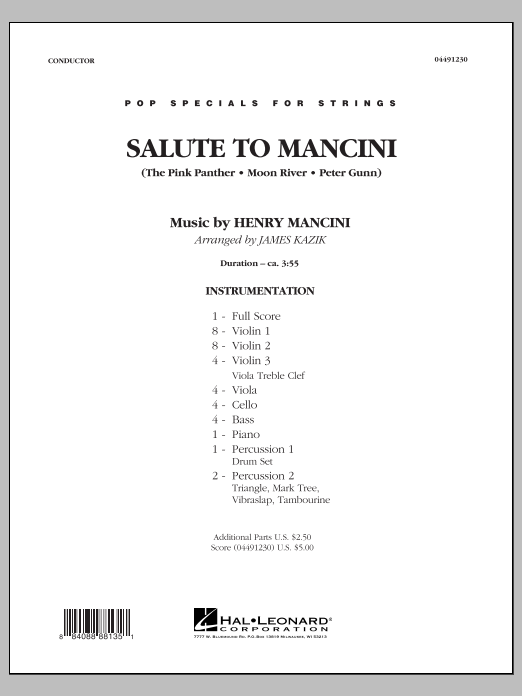

Salute to Mancini: String Orchestra Conductor Score & Parts
By Henry Mancini / Arranged by James Kazik
Grade: 3-4
Item: 35-PK00276894
$55.00
Pickup currently not available
Buy Extra Parts (Digital PDF Download)
| Product | Price | Quantity |
|---|---|---|
| Salute to Mancini - Conductor Score (Full Score) | $7.50 | |
| Salute to Mancini - Violin 1 | $7.00 | |
| Salute to Mancini - Violin 2 | $7.00 | |
| Salute to Mancini - Violin 3 (Viola Treble Clef) | $7.00 | |
| Salute to Mancini - Viola | $7.00 | |
| Salute to Mancini - Cello | $7.00 | |
| Salute to Mancini - Bass | $7.00 | |
| Salute to Mancini - Piano | $7.00 | |
| Salute to Mancini - Percussion 1 | $7.00 | |
| Salute to Mancini - Percussion 2 | $7.00 |
Parts Added to Cart!
Description
Through the years, some of the most recognizable themes from movies and television have come from the creative genius of Henry Mancini. Here is a concert showcase featuring several of his biggest hits. Includes: "The Pink Panther, Moon River" and "Peter Gunn". Dur: 3:55


Salute to Mancini: String Orchestra Conductor Score & Parts isn't in MakeMusic Cloud just yet...but it could be. Let us know you'd like to see it, and you'll help shape what comes next. In the meantime, start a free trial and dive into thousands of interactive titles your students can play along with today.
Request This Title
Tell us you want it.
Start Your Free Trial
Explore everything that's ready to play right now.
Sample Audio
No sample audio found.
Sample Video
No sample videos found.
Additional Details
Publisher:
Hal Leonard
SKU:
35-PK00276894
More about this title
About the Composer: Henry Mancini
Henry Mancini (1924-1994) shaped the sound of American popular music through his prolific film and television scoring. His gift for melody and orchestration made him one of the most awarded composers in entertainment history, with work spanning from the 1950s through the early 1990s.
For music educators, Mancini represents a bridge between classical training and commercial artistry. His accessible yet sophisticated arrangements teach students how strong melodic writing and intelligent orchestration can make music both emotionally engaging and technically rewarding to perform.
Why we love this
String directors know that programming recognizable material keeps students engaged and audiences delighted, but finding arrangements that don't sacrifice musicianship is rare. Kazik's treatment of these Mancini classics maintains elegant orchestration while keeping the parts playable at Grade 3-4 level, meaning your students are learning real compositional craft, not simplifications. The three-song medley format gives you substantial concert material without requiring a full-length piece.
What to expect
Sophisticated without pretense. The Pink Panther's slinky swagger, Moon River's tender lyicism, and Peter Gunn's cool jazz-inflected groove create a journey through Mancini's range. The orchestrations breathe with the elegance of 1950s-60s film scoring, which means students experience how melody, harmony, and texture work together to tell a story.
Who it's for
String orchestras at the intermediate level who want to build repertoire that challenges musical thinking without overwhelming reading demands. Directors seeking material that parents and students will recognize, creating natural enthusiasm for both rehearsal and performance.
How to get the most out of it
- Balance the melody between first violins and the section underneath; these tunes are radio-ready and should shine clearly, but the harmonic support from violas and second violins deserves audibility.
- Let the rhythm section (if adding pizzicato or light cello/bass figures) anchor the swing feel without overwhelming the strings. Mancini's sophistication comes from restraint.
- Mark phrase endings clearly in rehearsal. These are songlike melodies with built-in logical stopping points; students who understand where the 'sentences' end will shape the music with better intention.
How to use it
This arrangement works beautifully as a standalone pops concert or as a sophisticated lighter section within a mixed classical program. Schedule it after a demanding concerto or multi-movement work to give your audience a chance to reset while your players experience the satisfaction of nailing something immediately recognizable. It also pairs well with other standards-based repertoire if you're building a theme around American songwriting.
Skills your students will build
- Phrasing legit song melodies across changing harmonic contexts
- Balancing transparent orchestration where every section hears its role
- Reading and executing swing rhythm figures within a classical ensemble setting
- Sustaining long lines while maintaining dynamic subtlety across multiple sections