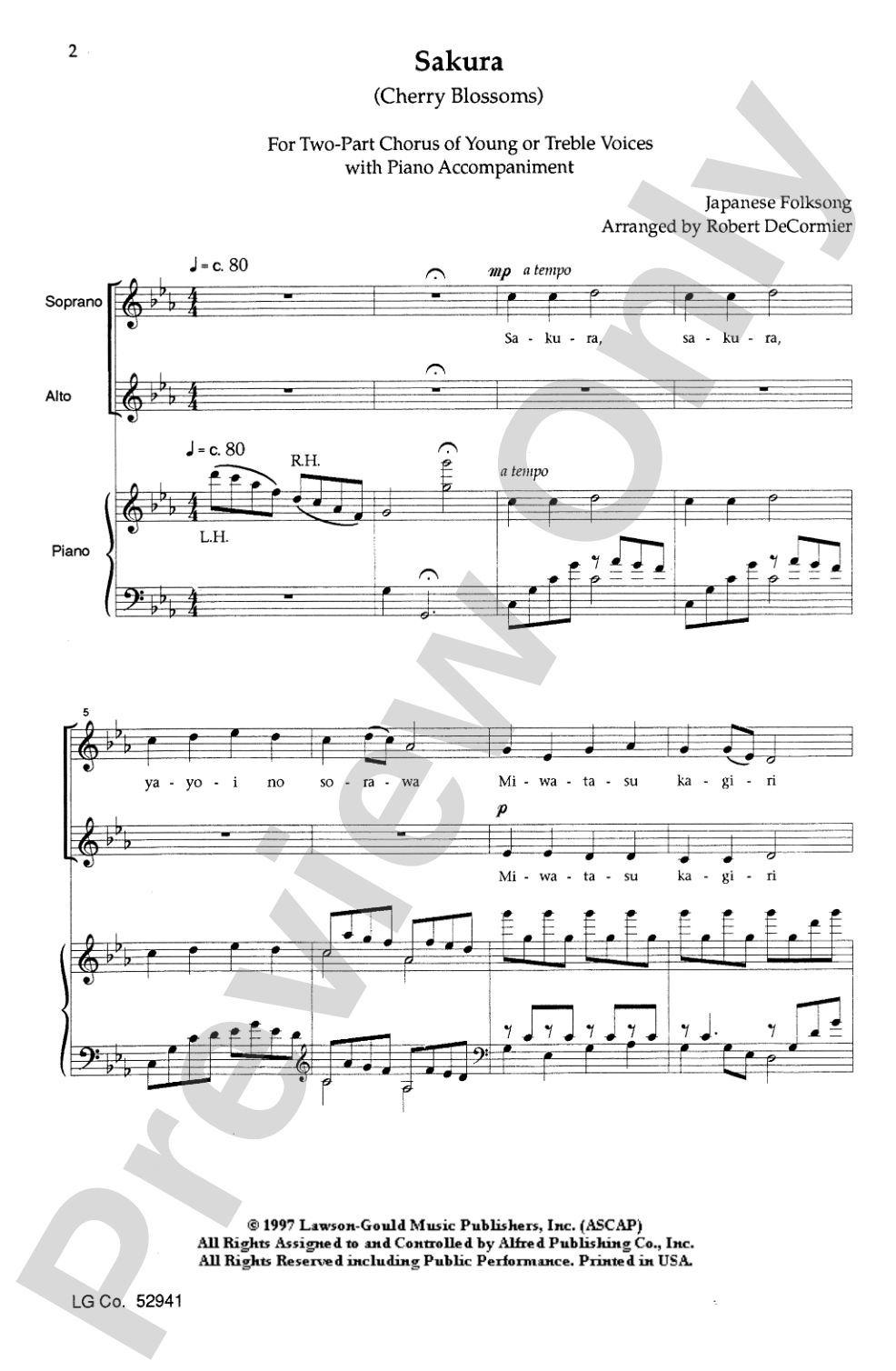
Sakura Sheet Music Preview

Sakura: 2-Part Young Voices Choral Octavo

Arr. Robert DeCormier

Item: 00-PO-0005101

Digital Download
$2.25

Minimum order quantity: 20 copies

Description

Sakura: 2-Part Young Voices Choral Octavo isn't in MakeMusic Cloud just yet...but it could be. Let us know you'd like to see it, and you'll help shape what comes next. In the meantime, start a free trial and dive into thousands of interactive titles your students can play along with today.

Sample Audio
No sample audio found.
Sample Video
Additional Details
Series: Alfred Archive Edition: Lawson-Gould Music Publishers
Publisher: Alfred Music
Page Count: 4
SKU: 00-PO-0005101

More about this title

About the Arranger: Robert DeCormier

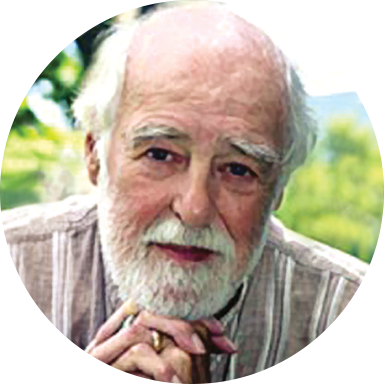
Robert DeCormier

Robert DeCormier trained at Juilliard and spent decades at the intersection of classical music, folk tradition, and popular song. He served as music director of the New York Choral Society for seventeen years, conducted and arranged for Harry Belafonte, and held the role of music director for Peter, Paul and Mary from 1978 to 2010. His work as an associate professor of conducting at the Eastman School of Music (1972-1977) shaped generations of choral musicians.

Beyond the concert stage, DeCormier founded the professional vocal ensemble Counterpoint in 2000 and led it through a decade of performances, workshops, and recordings across the Northeast. His arrangements span African-American spirituals, American folk songs, and international repertoire. His contributions to music education, the arts in Vermont, and choral excellence earned him the Vermont Governor's Award for Excellence in the Arts (2002) and a Lifetime Achievement Award from the New England Choral Arts Foundation (2006).

Why we love this

DeCormier's hand as arranger brings the authenticity of a musician who spent his career honoring folk tradition while making it accessible to singers of all levels. This 2-part arrangement respects the melody's elegant simplicity while creating genuine musicality in a format that works beautifully for developing choirs. The writing feels natural, never forced, because it comes from someone who understood both the folk source and the voice.

What to expect

A moment of quietude and reflection. The Japanese folk melody carries a serene quality, with gentle contours that invite singers to listen to each other. The 2-part texture creates warmth without heaviness, allowing the natural beauty of the tune to remain central.

Who it's for

Young voices choirs seeking accessible repertoire with cultural substance. This works well for middle school or early high school ensembles developing ensemble blend, intonation, and musicality without complex voice leading. It's equally suitable for school concerts and festival competition.

How to get the most out of it

  • Keep the opening phrases unhurried; let the melody breathe and the text become clear before building any momentum
  • Balance Part 1 and Part 2 so the harmony supports rather than overwhelms the primary line
  • Shape the phrase through text inflection rather than dramatic dynamic changes; the restraint makes the piece more effective

How to use it

Place this near the opening of a concert to establish an intimate tone, or use it as a gentle interlude between more energetic pieces. Its cross-cultural appeal and modest technical demands make it strong repertoire for programming that celebrates musical diversity without demanding extensive rehearsal time.

Skills your students will build

  • Singing with sustained legit tone across phrase boundaries
  • Balance and blend in simple two-part harmony
  • Clarity of diction with meaningful text
  • Awareness of folk melody as a form of musical communication across cultures

You May Also Like