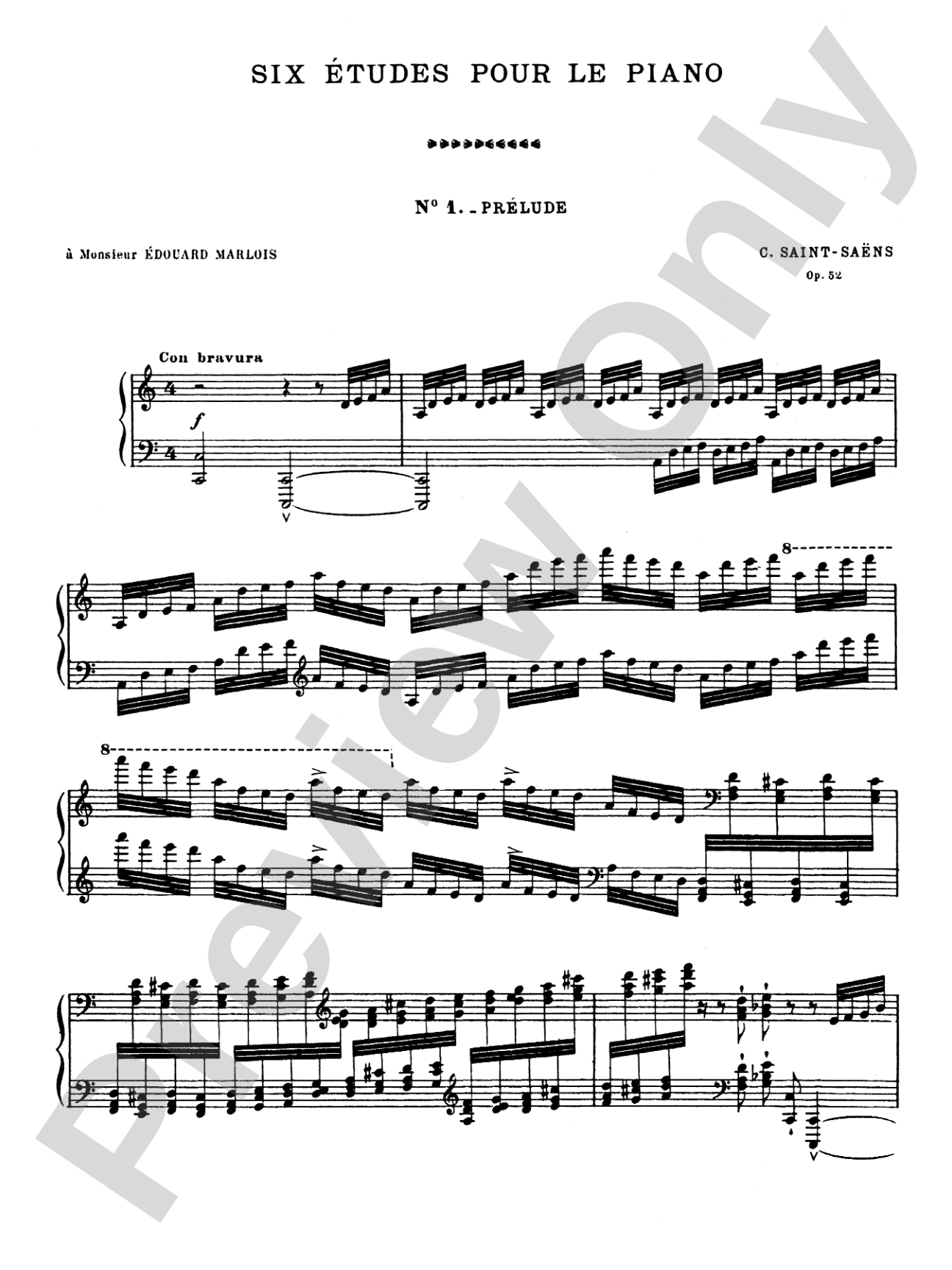
Saint-Saëns: Six Etudes, Op. 52 Sheet Music Preview

Saint-Saëns: Six Etudes, Op. 52

By Camille Saint-Saëns

Level: Intermediate / Advanced

Item: 00-PC-0012924

Digital Download
$0.99
Description
Titles: No. 1, Prélude * No. 2, Pour L'Indépendance des Doigts * No. 3, Prélude et Fugue * No. 4, Étude de Rhythme * No. 5, Prélude et Fugue * No. 6, En Forme de Valse.

Don't just read it, hear it, play along with it, and watch your students grow with it. In MakeMusic Cloud, Saint-Saëns: Six Etudes, Op. 52 comes alive with professional accompaniment, adjustable tempo, and built-in practice tools that turn solo practice into real progress.

Sample Audio
No sample audio found.
Sample Video
Additional Details
Series: Kalmus Edition
Publisher: Alfred Music
Page Count: 48
SKU: 00-PC-0012924

More about this title

About the Composer: Camille Saint-Saëns

Camille Saint-Saëns (1835-1921) was a French composer, organist, and pianist whose technical mastery and elegant orchestrations shaped late Romantic music. A child prodigy who studied composition at the Paris Conservatoire, he spent his career balancing virtuosic concert works with serious symphonic ambitions, earning respect across Europe for both his performing and compositional gifts.

Saint-Saëns wrote extensively for the piano throughout his life. His études occupy a distinctive place in the repertoire: they are concert pieces that happen to isolate specific technical challenges, rather than sterile exercises. The Op. 52 collection demonstrates his gift for combining pedagogical purpose with genuine musical substance.

Why we love this

These études refuse the false choice between musicality and technical work. Each piece pursues a coherent musical idea while developing mastery of a particular challenge, making them rewarding to learn and genuinely interesting to hear performed. The variety of forms and character across the six works means you can program them strategically to showcase different facets of a student's playing.

What to expect

Saint-Saëns writes with crystalline clarity and elegant restraint. The music glints with pianistic brilliance yet never becomes showy for its own sake. Moving through these six works traces a journey from introspective prelude through carefully constructed technical challenges to a finale that dances with Parisian wit.

Who it's for

Intermediate to advanced pianists ready to move beyond standard technical studies into music that demands both finger facility and musical sophistication. These études suit students preparing for conservatory examinations, those building recital programs that balance rigor with artistic substance, and ensemble musicians seeking rewarding solo material.

How to get the most out of it

  • Approach the prelude sections as songlike passages; let them sing with long-lined phrasing rather than treating them as mere introductions to what follows.
  • In the Étude de Rhythme, anchor the rhythmic patterns early in your practice so they become natural; avoid letting the complexity pull you into metrical confusion or sluggish tempos.
  • Balance the independence required in Pour L'Indépendance des Doigts with overall musical coherence; the exercise only succeeds if each hand's voice remains purposeful rather than mechanical.
  • Use the valse character of No. 6 to drive your interpretive choices; let the dance rhythm provide forward momentum and shape your dynamics accordingly.

How to use it

Program individual études strategically within student recitals to demonstrate technical growth across the year; a single étude can anchor a short recital program or appear alongside works by other composers. The variety of moods and forms makes it natural to select two or three pieces for a single performance rather than presenting the full cycle.

Skills your students will build

  • Finger independence and control across rapid scalar and figurative passages
  • Reading and executing mixed meters and rhythmic subdivisions
  • Phrasing across multiple registers and hand positions simultaneously
  • Balancing contrapuntal voices within a single hand
  • Stylistic interpretation of French Romantic keyboard writing
  • Performance stamina and clarity in moderate to fast tempos

You May Also Like