Saint-Saëns: Six Etudes, Op. 111
By Camille Saint-Saëns
Level: Intermediate / Advanced
Item: 00-PC-0012933
Pickup currently not available
Description
Don't just read it, hear it, play along with it, and watch your students grow with it. In MakeMusic Cloud, Saint-Saëns: Six Etudes, Op. 111 comes alive with professional accompaniment, adjustable tempo, and built-in practice tools that turn solo practice into real progress.
Jump straight in and assign it today.
Open this title and explore the full library in minutes.
Sample Audio
Sample Video
Additional Details
More about this title
About the Composer: Camille Saint-Saëns
Camille Saint-Saëns (1835-1921) was a French Romantic composer and virtuoso pianist whose technical mastery and musical sophistication shaped instrumental music across four decades. He wrote across all major genres—symphonies, concertos, chamber works, and keyboard music—with a gift for combining rigorous form with lyrical elegance. Saint-Saëns' piano writing reflects his own formidable abilities at the keyboard; his études and technical studies are designed not as mere finger exercises but as complete musical statements that demand both mechanical precision and interpretive depth.
His Op. 111 collection stands apart because these six études are conceived for the advanced amateur or professional pianist seeking repertoire that balances technical challenge with genuine artistic substance. Rather than isolating a single technical problem, Saint-Saëns integrates each étude's pianistic demand into a coherent musical form. This approach makes the collection valuable for developing musicianship alongside technique, a philosophy that defines his legacy in piano pedagogy.
Why we love this
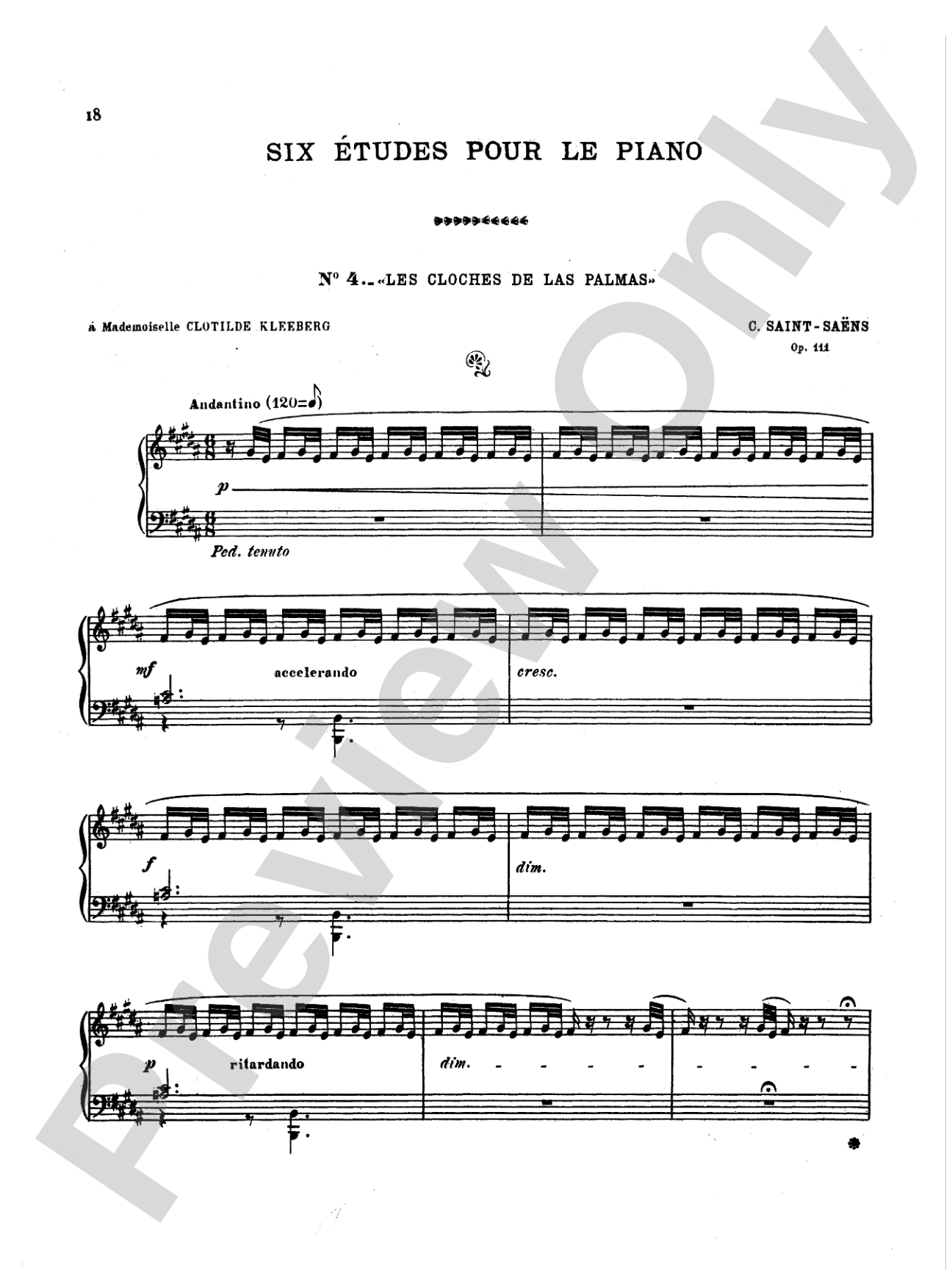
These études avoid the trap of being mere technical exercises; each one is a fully realized musical work that demands serious interpretive choices from the performer. The variety across the six pieces—from Baroque-influenced counterpoint (the Prélude et Fugue) to shimmering impressionistic color (Les Cloches de Las Palmas) to brilliant keyboard virtuosity (the Toccata)—gives advanced pianists meaningful repertoire that spans multiple compositional worlds within a single collection.
What to expect
Saint-Saëns' writing alternates between crystalline technical display and genuine lyrical warmth. Some pieces shimmer with impressionistic color and harmonic subtlety, while others surge with Classical architecture and Romantic virtuosity. Throughout the collection, there's an underlying sense of refinement and craftsmanship; these are studies for pianists who have already mastered the fundamentals and are ready to engage with works that ask for intelligence and artistry alongside speed and stamina.
Who it's for
Advanced intermediate to advanced pianists seeking technical studies that function as complete concert works, not just finger exercises. These études suit students preparing for university-level auditions, ambitious amateur pianists building a contemporary Romantic repertoire, and teachers searching for material that integrates technique, musicianship, and stylistic breadth into a single focused collection.
How to get the most out of it
- Treat the chromatic figurations in Nos. 2 and 5 as musical lines rather than pure technical displays; phrase them with the same care you would give to a melody, allowing the harmonic progression to guide your articulation and voicing.
- In the Prélude et Fugue, establish clear textural separation between the voices from the outset; the fugal section demands independence and clarity that reward careful practice with separate hands and deliberate part-voicing.
- Study the original context of the Toccata (No. 6), which draws from the Fifth Concerto; understanding the larger work enriches your interpretation and helps you identify where dramatic peaks and structural moments naturally occur.
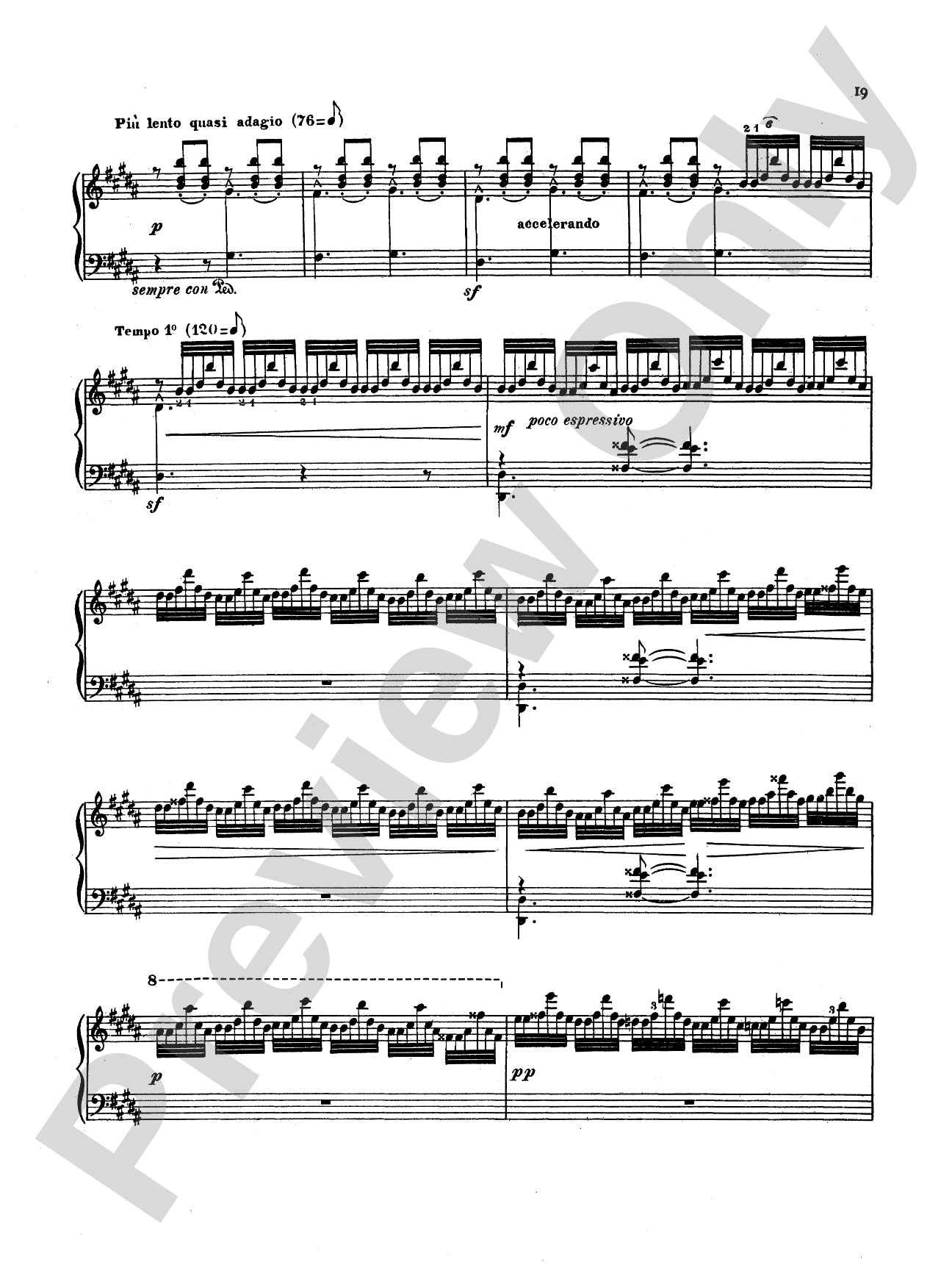
- Use the recorded accompaniment (if available separately) or practice alongside a metronome to lock the rhythmic propulsion of Les Cloches, which relies on precise tempo control to create its bell-like resonance.
How to use it
Program individual études from this collection to diversify your concert offerings without relying solely on larger forms. A single étude like Les Cloches or the Toccata works beautifully on a recital between a sonata movement and a contemporary piece, allowing you to showcase technical facility while maintaining musical sophistication. The Prélude et Fugue functions particularly well as a standalone work on programs emphasizing Romantic engagement with Baroque form.
Skills your students will build
- Playing rapid thirds and sixths with independence and evenness (No. 1)
- Executing chromatic scale passages with clarity and musical shape (Nos. 2 and 5)
- Sustaining independent voice lines in contrapuntal writing (No. 3)
- Achieving tonal control in rapid fingerwork while maintaining harmonic color (No. 4)
- Managing hand position and finger independence through extended keyboard patterns (No. 6)