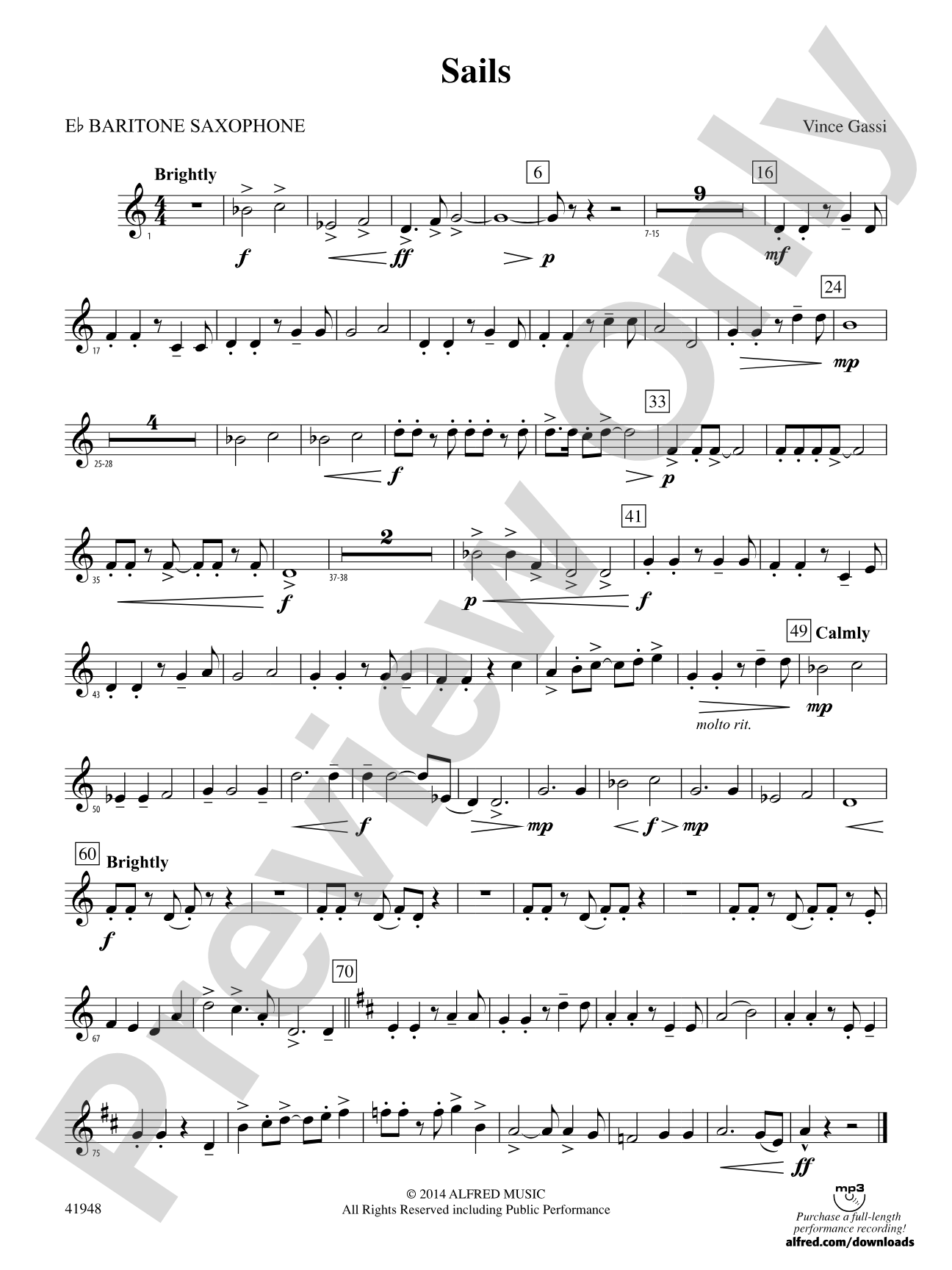
Sails: E-flat Baritone Saxophone Sheet Music Preview

Sails: E-flat Baritone Saxophone

By Vince Gassi

Grade: 2 (Medium Easy)

Item: 00-PC-0016430_BTX

Digital Download
$3.00
Description
You'll feel the wind at your back as this bright march weighs anchor with a bold opening and sets sail with flutes and oboes stating the main theme. Sails unfurl and the rest of the fleet (ensemble) joins in. Counter-lines and flourishes are added. Eventually the seas calm during a passage through a slower lyrical section where the opening thematic material is developed. But wait, there is land in sight! A new key is stated, and all return safely to port.

Don't just read it, hear it, play along with it, and watch your students grow with it. In MakeMusic Cloud, Sails: E-flat Baritone Saxophone comes alive with professional accompaniment, adjustable tempo, and built-in practice tools that turn solo practice into real progress.

Sample Audio
0:00
0:00
Sample Video
Additional Details
Series: Young Symphonic
Publisher: Alfred Music
Page Count: 180
SKU: 00-PC-0016430_BTX

More about this title

About the Composer: Vince Gassi

Vince Gassi

Vince Gassi has been composing and arranging for young musicians since earning his Bachelor of Music from the University of Western Ontario. His studies at the Dick Grove School of Music in Los Angeles and his Ph.D. from York University in Toronto shaped a compositional voice that balances musical substance with accessibility. Over 100 published works have established him as a trusted voice in young band and orchestra repertoire.

Gassi brings twenty-five years of classroom experience to his writing, and that foundation shows in every measure. His scores appear regularly on contest and concert lists across North America, Europe, and Japan. As a guest conductor, adjudicator, and clinician, he leads workshops on student engagement and creative process alongside his seminars on digital workflows for music directors.

Why we love this

Gassi writes marches that sound like marches. Sails opens with genuine swagger, gives every section something memorable to play, and sustains interest through real compositional choices rather than repetition. The lyrical middle passage offers genuine contrast and developmental opportunity, and the modulation into the final section feels earned rather than arbitrary.

What to expect

The opening strides forward with maritime confidence, sails billowing in a fresh breeze. As the ensemble swells, you feel the weight of a full fleet catching the wind. The lyrical middle section settles into calm waters, reflective and almost contemplative, before the key shift signals land ahead and the ensemble races home with renewed energy.

Who it's for

Grade 2 bands ready to move beyond simple march structures into music with genuine programmatic narrative and tonal variety. This score works for ensembles with solid fundamentals in blend and balance, but doesn't require advanced technical facility.

How to get the most out of it

  • Balance the flute and oboe statement of the main theme in the opening; let them float above the supportive inner voices rather than fighting for volume.
  • Shape the slower lyrical section as a true moment of repose; resist the urge to maintain march tempo energy here, and allow your band to breathe musically.
  • Articulate the counter-lines and flourishes crisply so they register without overwhelming the primary melodic material.
  • Mark the key change clearly in your preparation; your band will respond to a confident gesture that signals this structural pivot back to the main theme.

How to use it

Program Sails as your opening concert number; its bright character and narrative arc set a confident tone for the evening. It also works well in a thematic concert exploring nature or travel, or as a contest selection where its clear structure and musical integrity will impress adjudicators.

Skills your students will build

  • Reading and executing thematic material across multiple instrumental colors
  • Balancing accompaniment figures against primary melodies
  • Executing a key modulation and understanding its structural purpose
  • Shaping musical character through tempo and dynamic control in contrasting sections
  • Playing counter-lines and supplementary parts that support without dominating

You May Also Like