
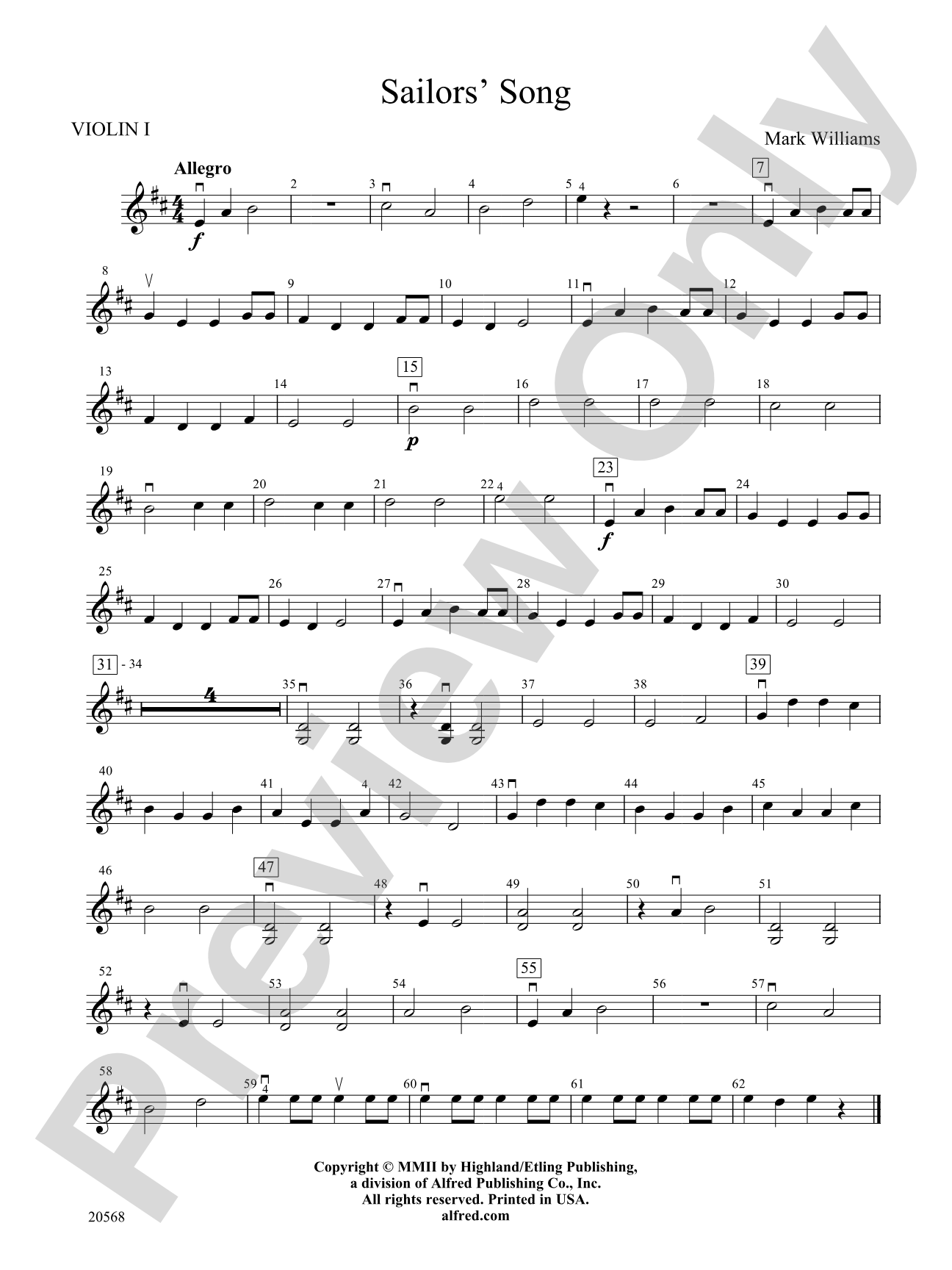

Sailor's Song: 1st Violin
By Mark Williams
Grade: 1
Item: 00-PC-0000407_VN1
$5.99
Pickup currently not available
Description
This vigorous original work cleverly uses open strings, plus only the first notes learned on the D and A strings, to evoke the sometimes charming, sometimes rough world of the sailor at sea. Open double stops reflect the raw power of the ocean waves. Mostly in E Dorian and Aeolian, this modal work has a sophisticated sound that's very easy to play for beginning strings. Correlated with Strictly Strings, Book 1, page 24 This title is available in MakeMusic Cloud.


Don't just read it, hear it, play along with it, and watch your students grow with it. In MakeMusic Cloud, Sailor's Song: 1st Violin comes alive with professional accompaniment, adjustable tempo, and built-in practice tools that turn solo practice into real progress.
Open in the Player
Jump straight in and assign it today.
Start Your Free Trial
Open this title and explore the full library in minutes.
Sample Audio
1
Audio File
--:--
0:00
0:00
Sample Video
No sample videos found.
Additional Details
Series:
Highland/Etling Strictly Strings
Publisher:
Alfred Music
Page Count:
72
SKU:
00-PC-0000407_VN1
More about this title
About the Composer: Mark Williams

Mark Williams built his reputation on understanding what beginning and intermediate players could accomplish when given music that challenged them musically without overwhelming them technically. A prolific composer with over 200 published works, he spent decades in Washington classrooms and concert halls, where he developed a philosophy that sophistication in sound need not require advanced technique. His collaborations on the Accent on Achievement Band Method shaped how generations of students learned instrumental music.
Beyond the page, Williams was a working musician and conductor who performed bassoon and arranged for the 560th Air Force Band. His travels as a clinician and guest conductor took him across North America and to Australia, experiences that informed his writing for young ensembles. The recognition he received from organizations like ASCAP and Western International Band Clinic validated what teachers already knew: his compositions were essential to their programs.
Why we love this
Williams captures something real here. The open strings and limited fingerboard positions create a raw, almost nautical sound that feels authentic rather than simplified. Beginning players will hear themselves making modal harmonies and open double stops that sound far more advanced than what they can technically play, which is exactly the kind of confidence builder every young orchestra needs.
What to expect
Salty and atmospheric. The open strings give the piece a ringing, almost medieval quality, while the modal harmony keeps it from feeling like a traditional folk arrangement. There's something both playful and slightly ominous about it, as though the sailor's life is being viewed from two angles at once.
Who it's for
String orchestra programs at the beginning level, particularly those working through Strictly Strings Book 1. This works for concert programming or festival play, giving early-stage ensembles a piece with real musical substance that still respects their technical constraints.
How to get the most out of it
- Lean into the open string resonance. The double stops aren't meant to be aggressive; let them ring with the natural sustain of open strings so the ocean-wave effect actually registers.
- Shape the modal melody with subtle dynamic shaping rather than tempo changes. The E Dorian and Aeolian modes benefit from phrasing that lets the mode speak for itself.
- Balance the ensemble so the double-stop texture stays transparent. Beginning players sometimes swell into double stops without realizing how much acoustic weight they carry.
How to use it
Pair this on a concert with contrasting material. Its modal sophistication and open-string sonority shine brightest next to more traditional tonality. It's also an ideal festival choice because it demonstrates musicianship and compositional awareness at a grade level where those qualities still surprise audiences.
Skills your students will build
- Playing with open double stops and sustaining their resonance
- Understanding modal harmony (E Dorian and Aeolian) by ear
- Executing first-position notes on D and A strings with accuracy
- Balancing ensemble texture when multiple voices use open strings
- Phrasing melodies within modal contexts