
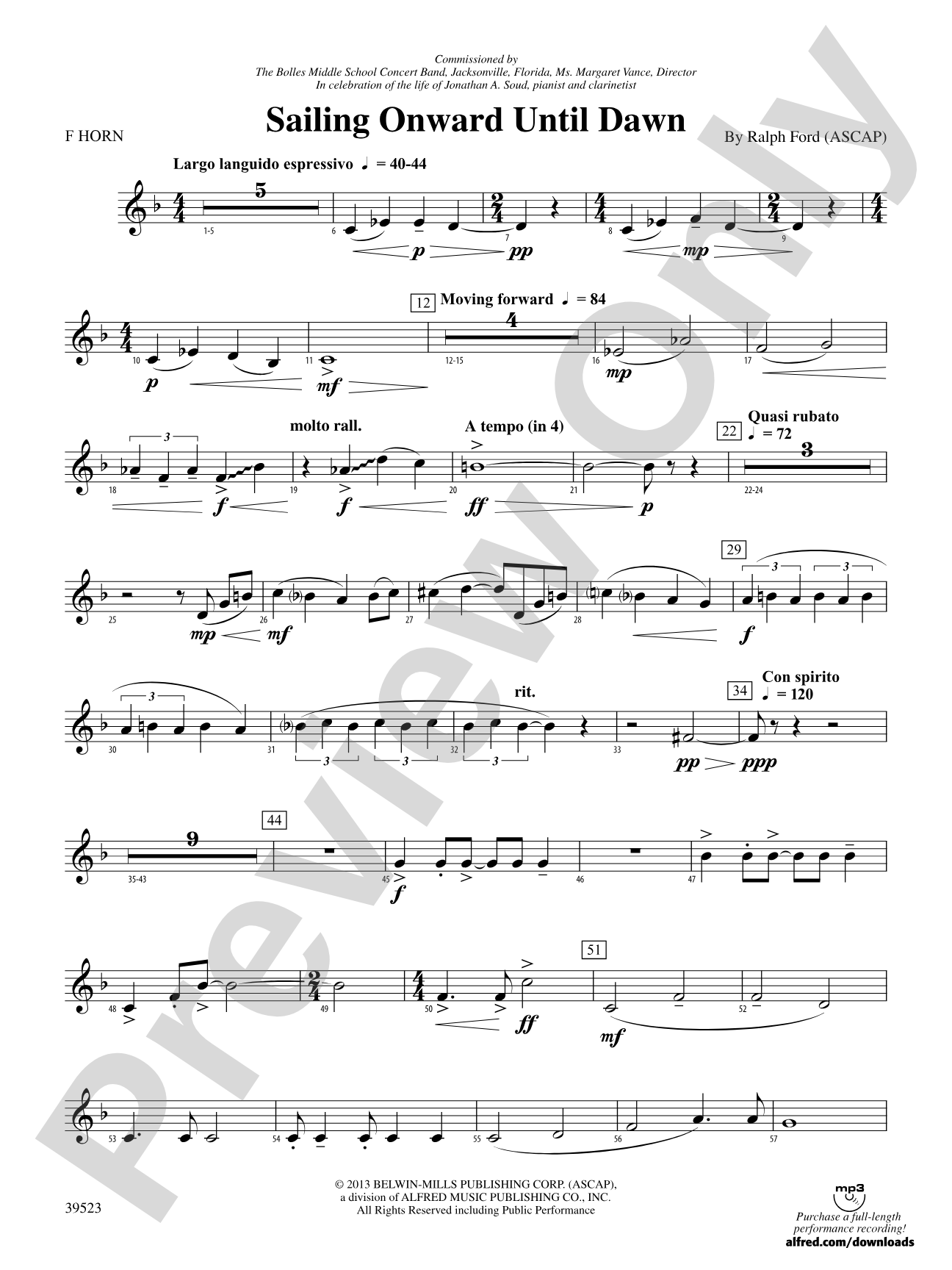

Sailing Onward Until Dawn: 1st F Horn
By Ralph Ford
Grade: 2.5 (Easy to Medium Easy)
Item: 00-PC-0015838_H1
$3.00
Pickup currently not available
Description
Commissioned in honor of an outstanding music student, this original composition opens with a stunning ballad and rapidly develops to a spirited musical celebration, building non-stop to a glorious musical conclusion. Integrating vivid dynamic contrasts with rhythmic intensity, the work is certain to capture the imagination of all. Suitable for all concert and contest performances, this distinctive work will engage each performer and every audience member. Stunning! (5:00)


Don't just read it, hear it, play along with it, and watch your students grow with it. In MakeMusic Cloud, Sailing Onward Until Dawn: 1st F Horn comes alive with professional accompaniment, adjustable tempo, and built-in practice tools that turn solo practice into real progress.
Open in the Player
Jump straight in and assign it today.
Start Your Free Trial
Open this title and explore the full library in minutes.
Sample Audio
1
Audio File
--:--
0:00
0:00
Sample Video
No sample videos found.
Additional Details
Series:
Belwin Young Band
Publisher:
Alfred Music
Page Count:
236
SKU:
00-PC-0015838_H1
More about this title
About the Composer: Ralph Ford

Ralph Ford brings three decades of university teaching and professional media experience to his role as an exclusive composer and arranger for Alfred Music's Belwin division. His catalog exceeds 250 published works spanning orchestra, concert band, jazz ensemble, and marching band, performed by school, military, university, and professional ensembles internationally. Ford's career began at age fifteen as a student arranger in Panama City, Florida, and accelerated during his time at Troy State University, where he directed the Jazz Ensemble I for fifteen years while also serving as staff arranger for the university band program.
Beyond composition, Ford has worked extensively in broadcast and media production, creating jingles, news packages for national networks, and original scores for radio, television, and video. He earned his Master of Science degree from Troy State University in 1988 while maintaining a full-time faculty position teaching orchestration, arranging, theory, and applied studies. His commissioned works and distinctive compositional voice have established him as a trusted resource for educators seeking engaging, well-crafted music for young musicians.
Why we love this
Ford's architecture here is masterful: the ballad opening gives conductors and students a genuine lyrical moment to establish ensemble cohesion before the piece pivots into infectious forward motion. The non-stop build to the finale rewards rehearsal focus while maintaining accessibility at the 2.5 grade level, making this ideal for bands hungry for a substantial concert work that feels substantial without requiring years of technical development.
What to expect
The ballad beginning offers grace and reflection, establishing an intimate space where the ensemble can connect with the melodic line. From there, the music builds with relentless energy, layering rhythmic intensity and dynamic shifts that propel listeners forward, culminating in a glorious, uncompromising statement of joy and accomplishment.
Who it's for
Concert bands at the high school or upper middle school level seeking a substantial original work that opens confidently with a lyrical moment and delivers the kind of forward momentum and celebratory energy that audiences remember. This piece rewards solid fundamentals without demanding advanced technique, making it accessible for developing ensembles while offering depth for more mature groups.
How to get the most out of it
- Shape the opening ballad with intentional breath and phrase direction; this section establishes the ensemble's musicality and makes the transition to spirited tempo changes more impactful.
- Mark the moment where the tempo accelerates in your score; clarity from the podium ensures the rhythm section locks before the band follows into the faster material.
- Balance the dynamic contrasts deliberately across rehearsals. Young players often play everything at full volume, so isolate passages where the ensemble pulls back and let that restraint make the fortissimo sections feel earned and powerful.
- Allow the final build time to breathe emotionally. This isn't about rushing the climax; it's about letting each section of the band feel their individual contribution to the culmination.
How to use it
Program this as your main concert work on a spring festival or concert performance. The five-minute duration and two-movement arc (ballad into celebration) makes it an ideal centerpiece that can anchor a program of lighter opener and encore pieces. Its contest-appropriate writing also qualifies it for festival competitions where you want to showcase ensemble musicianship rather than virtuosity.
Skills your students will build
- Phrasing and breath control in lyrical, ballad-style writing
- Executing rapid dynamic shifts from pianissimo to fortissimo
- Maintaining rhythmic accuracy through layered, driving sections
- Balancing individual part independence with ensemble unity during cumulative builds
- Reading and responding to clear conductor cues during tempo and texture changes