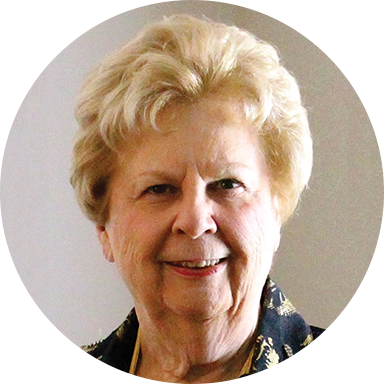
Elvina Pearce trained at the highest levels of American piano pedagogy, studying performance with Isabelle Vengerova in New York (whose studio produced Samuel Barber, Gary Graffman, and Leonard Bernstein) and teaching methodology with Frances Clark. She co-founded the New School for Music Study and the Frances Center for Keyboard Pedagogy in Princeton, New Jersey, and spent 14 years on the faculty at Northwestern University teaching both piano and pedagogy.
Pearce's career spans performance, scholarship, and composition. She has performed the Liszt Concerto in E-flat with the Chicago Symphony, given solo recitals at Carnegie Recital Hall and the National Gallery of Art, and led workshops across more than 40 states and internationally. As a composer, she has published over 25 collections of piano music. She served as Editor-in-Chief of Keyboard Companion Magazine from 2000 to 2006 and authored "The Success Factor in Piano Teaching: Making Practice Perfect." Her contributions to music education have been recognized with a 2008 MTNA Foundation nomination, the 2011 Lifetime Achievement Award from the National Conference on Keyboard Pedagogy, and induction into the Illinois Fox Valley Arts Hall of Fame in 2014.
Why we love this
Pearce writes from decades of classroom experience, and it shows. Her instructional pieces balance musical substance with genuinely progressive difficulty, so students develop real musicianship while they master new technical concepts. This piece rewards both teacher and student with content that sounds beautiful and musical from the first page, not a drill disguised as a composition.
What to expect
The piece evokes gentle motion and openness, with a sense of traveling somewhere beautiful. The writing emphasizes legato connection and lyrical singing, inviting students to experience how carefully chosen accompaniment patterns can support and enhance a melody rather than compete with it.
Who it's for
Early-intermediate pianists building fluency in melody and accompaniment coordination. This works well for students preparing for festivals, studio recitals, or those seeking substantial yet approachable repertoire that develops musicianship alongside technique.
How to get the most out of it
Shape the melodic line with slight rubato in the opening measures to establish the lyrical, flowing character before settling into a steady pulse.
Balance the accompaniment below the melody; this is where students often press too hard and lose the singing quality of the right-hand part.
Experiment with the tempo during practice to find the speed at which your students can comfortably manage the technical demands while still playing musically.
How to use it
Feature this on a studio recital to showcase a student's progress in balancing melody and accompaniment. It also pairs nicely on a program with other Pearce compositions or contemporary instructional works, creating a cohesive set that demonstrates growth across a specific technical or musical area.
Skills your students will build
Legato phrasing and sustained melodic line singing
Left-hand accompaniment patterns that support without overwhelming
Coordination between hands at moderate tempos
Dynamic shaping and musical expression within a tonal, accessible harmonic language
You May Also Like
Scan to Complete Your Purchase
Use your phone's camera to scan the code below
You'll log in on your phone and the order will be added to your account