
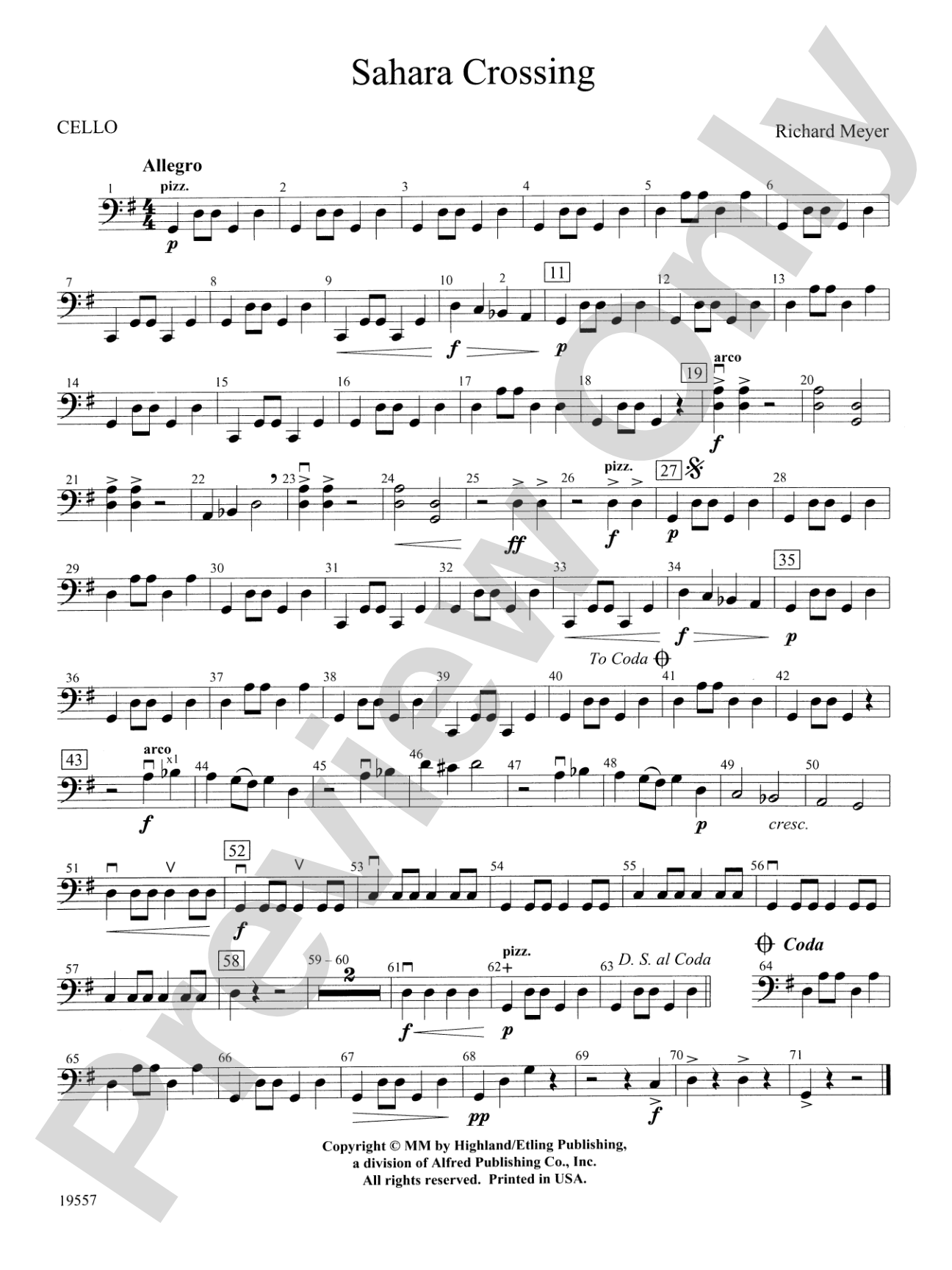

Sahara Crossing: Cello
By Richard Meyer
Grade: 1
Item: 00-PC-0000339_VC1
$5.99
Pickup currently not available
Description
Take your students on a desert caravan in this fun and exciting piece written to introduce low first-finger notes (E-flat and B-flat). All students-even your more advanced players-will love the Far Eastern harmonic minor sound, complete with bouncing cello/bass accompaniment and parts for tambourine and finger cymbals. Very mature sounding, yet simple. A great teaching piece! This title is available in MakeMusic Cloud.


Don't just read it, hear it, play along with it, and watch your students grow with it. In MakeMusic Cloud, Sahara Crossing: Cello comes alive with professional accompaniment, adjustable tempo, and built-in practice tools that turn solo practice into real progress.
Open in the Player
Jump straight in and assign it today.
Start Your Free Trial
Open this title and explore the full library in minutes.
Sample Audio
1
Audio File
--:--
0:00
0:00
Sample Video
No sample videos found.
Additional Details
Series:
Highland/Etling Strictly Strings
Publisher:
Alfred Music
Page Count:
74
SKU:
00-PC-0000339_VC1
More about this title
About the Composer: Richard Meyer

Richard Meyer spent 35 years teaching strings at all levels in public schools, including 22 years directing orchestras at Oak Avenue Intermediate School in Temple City, California. During his tenure there, he transformed the program from 29 students to 200, while also overseeing the district's elementary string curriculum. He conducted the Pasadena Youth Symphony Orchestra for 16 years, leading performances across North America, Europe, and Australia.
Beyond the podium, Meyer has shaped music education through innovation and prolific composition. In 2009 he launched the "Giving Bach" program, now nationally recognized for using interactive concerts to reach special needs and underserved students throughout Southern California. As a composer and arranger, he has nearly 200 works in print and spent 16 years as string editor for Alfred Publishing Company. He co-authored several method books, including the String Explorer Series and Sight-read It for Strings. Meyer has been a featured clinician at the A.S.T.A. National Conference, Texas Orchestra Directors' Association Conference, and state honor orchestra workshops.
Why we love this
Meyer captures the magic of first-position expansion without sacrificing musicality or engagement. Students immediately encounter mature harmonic language (Far Eastern harmonic minor) that sounds sophisticated while remaining technically accessible, which builds confidence and genuine musical pride. The percussion parts and bouncing bass line make every section feel essential, so your entire orchestra stays invested from start to finish.
What to expect
Sahara Crossing evokes a desert journey through shimmering minor-key harmonies and a swaying rhythmic foundation that feels both exotic and inviting. The bouncing cello and bass line creates motion and lightness, while the percussion colors transport listeners to a landscape of sand, spice, and adventure without ever losing its clarity or charm.
Who it's for
Beginning orchestras tackling first-position extension will find exactly what they need here. The piece works equally well for intermediate ensembles seeking accessible concert material with genuine artistic substance.
How to get the most out of it
- Give your cellos and basses room to establish that rhythmic foundation early in rehearsal. Their accompaniment pattern is the heartbeat of the whole piece, so lock that in before adding the melody lines.
- Balance your tambourine and finger cymbals carefully; they enhance the desert atmosphere but shouldn't overshadow the string lines. A light touch makes the effect shimmer rather than clatter.
- Spend time on the low first-finger notes (E-flat and B-flat) in isolation before running sections. Even strong players benefit from intonation work on these new positions when they're part of a melodic phrase.
- Lean into the programmatic element during rehearsals. Talking about the caravan imagery helps students understand phrasing choices and why certain moments need gentle motion versus rhythmic punctuation.
How to use it
This sits naturally in a concert celebrating diverse world music influences or as a spring performance opener that sets an adventurous tone. It pairs well with other character pieces at the Grade 1 level and provides a welcome showcase for rhythmic precision and intonation work in a musical context students genuinely enjoy playing.
Skills your students will build
- Low first-finger notes (E-flat and B-flat) in first position
- Reading and playing in minor tonality, specifically Far Eastern harmonic minor
- Rhythmic coordination with a bouncing, syncopated accompaniment pattern
- Balance and blend across string sections and with percussion colors
- Sustaining tone quality while playing newly introduced fingerings