Sahara: Bassoon Sheet Music Preview

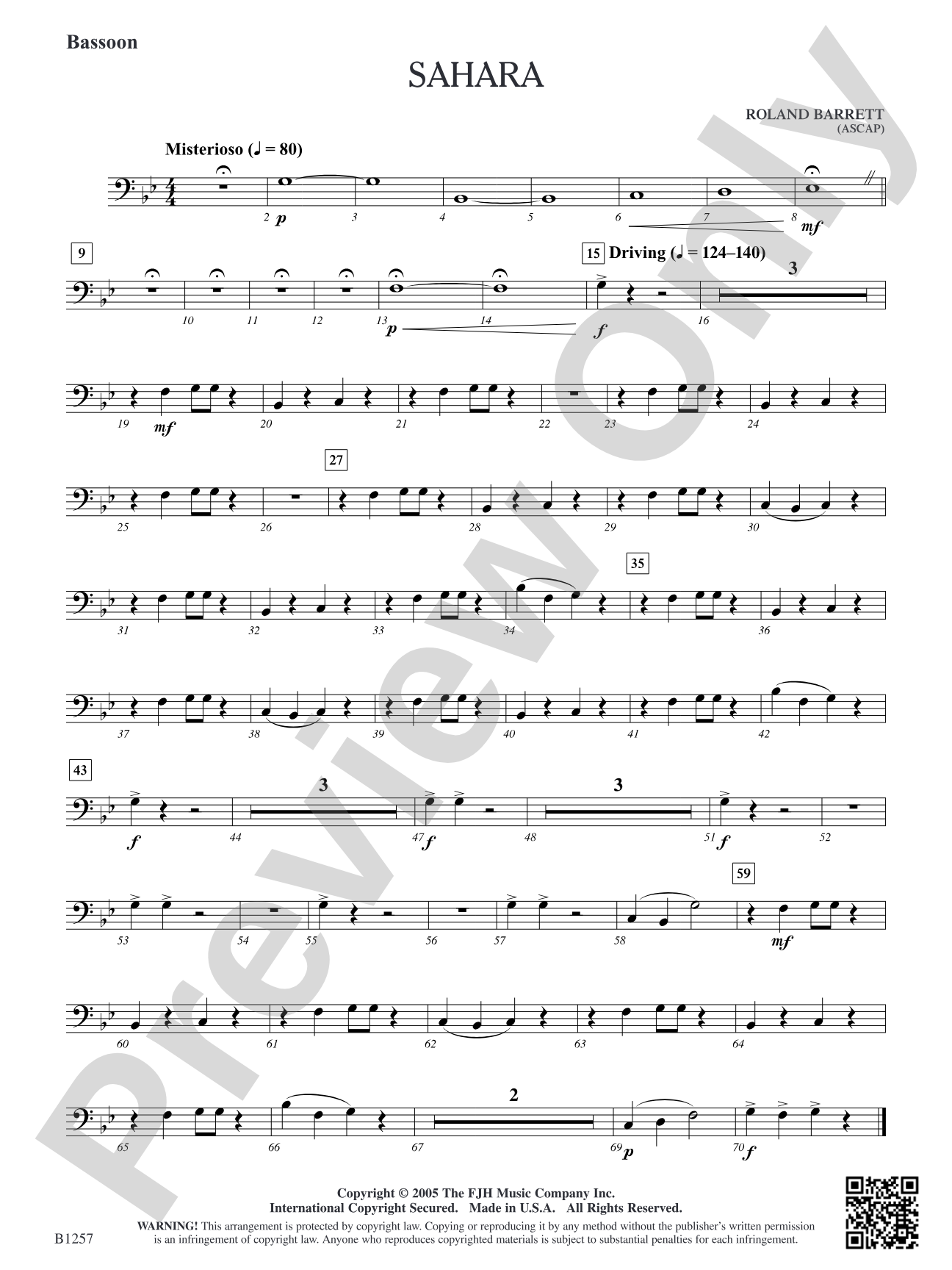
Sahara: Bassoon

By Roland Barrett

Grade: 1

Item: 98-PC-DB1257_B1

Digital Download
$7.00
Description
Take a trip across the desert with this new work from composer Roland Barrett. A mysterious introduction sets the mood for an interesting and highly educational aleatoric passage. Easily achieved, students freely improvise on a given set of pitches. As more and more instruments enter, the piece builds until it gives way to a rhythmically energized section beginning with percussion and an ostinato figure in the bass voices. Very easy!

Sahara: Bassoon isn't in MakeMusic Cloud just yet...but it could be. Let us know you'd like to see it, and you'll help shape what comes next. In the meantime, start a free trial and dive into thousands of interactive titles your students can play along with today.

Sample Audio
0:00
0:00
Sample Video
Additional Details
Series: FJH Beginning Band
Publisher: The FJH Music Company, Inc.
SKU: 98-PC-DB1257_B1

More about this title

About the Composer: Roland Barrett

Roland Barrett

Roland Barrett holds the position of music theory and composition faculty member at the University of Oklahoma, where he has taught since 2001. His academic background includes fifteen years as Assistant Director of Bands before joining the university. Barrett's teaching encompasses 20th century music topics at both undergraduate and graduate levels, with particular focus on theory and composition instruction.

As a composer and arranger, Barrett has established himself nationally with over two hundred published works for symphonic band, chamber ensembles, and marching band. His music has been performed by the Dallas Wind Symphony, All-State and All-Region honor bands, and broadcast on NPR and USA Network. He continues to arrange for the Pride of Oklahoma marching band and has received multiple ASCAPlus awards for his compositions.

Why we love this

Sahara introduces aleatoric writing in a way that feels genuinely musical rather than gimmicky. The controlled improvisation passage gives beginning students real agency in sound creation while remaining pedagogically secure, and the transition into the rhythmically driven second section rewards their careful listening with a tangible payoff.

What to expect

The piece evokes a desert landscape through its mysterious opening, then shifts into energetic forward motion as layers of rhythmic activity accumulate. Students experience both the restraint of a sparse, exploratory soundworld and the drive of a syncopated, percussion-anchored climax.

Who it's for

Grade 1 concert bands seeking approachable yet musically interesting repertoire. This work suits ensembles ready to explore contemporary techniques like controlled improvisation without requiring advanced technical facility.

How to get the most out of it

  • Set clear pitch boundaries before the aleatoric section. Have each section rehearse their available pitches in isolation, then listen to combinations in smaller groups before bringing the full band together.
  • Shape the entrance of instruments during the aleatoric passage so students hear the texture building gradually rather than everyone entering at once.
  • Lock the percussion ostinato and bass figure in the energized second section before layering in upper voices; this rhythmic foundation makes the remaining orchestration much easier to secure.
  • Use the score's visual cues during the free improvisation to help students understand when their section should be active versus resting, even though rhythm is flexible.

How to use it

Program Sahara on a festival or contest entry where judges appreciate pedagogical ambition alongside musicality. Its beginner accessibility and contemporary technique make it an effective demonstration of what Grade 1 bands can achieve beyond traditional march-and-chorale repertoire.

Skills your students will build

  • Controlled improvisation within pitch constraints
  • Listening to ensemble texture and balance during free sections
  • Rhythmic precision in ostinato and syncopated figures
  • Part independence and sectional coordination
  • Understanding aleatoric musical notation and conductor cues

You May Also Like