
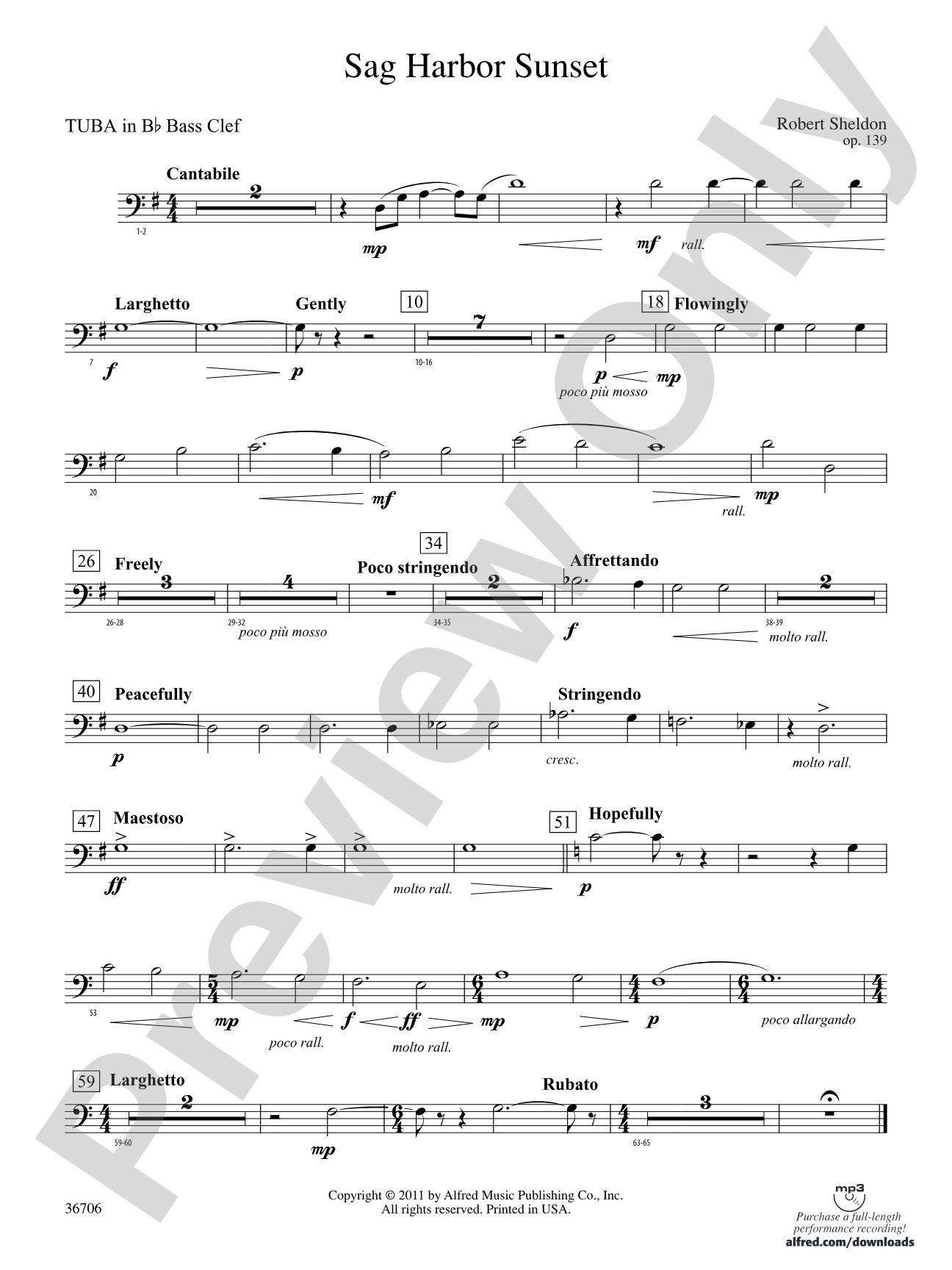

Sag Harbor Sunset: (wp) B-flat Tuba B.C.
By Robert Sheldon
Grade: 4 (Medium Difficult)
Item: 00-PC-0015134_wpTBBBC
$3.00
Pickup currently not available
Description
This thoughtful composition offers elements of musical reflection and artistic expression inspired by the beautiful sunsets along the shores of Long Island. Soft hues of color to brilliant rays of light are interspersed with the calm, yet exhilarating feelings one experiences when witnessing the power, beauty, and peace of the sun disappearing over the horizon, signaling the end of the day.
"The sounds of this piece strongly evoke the feelings of watching the different colors of a sunset disappearing over the horizon . . . The ending softly dies away to a pianissimo. This slow, reflective number is an ideal change of pace in a program.
--The Instrumentalist


"The sounds of this piece strongly evoke the feelings of watching the different colors of a sunset disappearing over the horizon . . . The ending softly dies away to a pianissimo. This slow, reflective number is an ideal change of pace in a program.
--The Instrumentalist
Don't just read it, hear it, play along with it, and watch your students grow with it. In MakeMusic Cloud, Sag Harbor Sunset: (wp) B-flat Tuba B.C. comes alive with professional accompaniment, adjustable tempo, and built-in practice tools that turn solo practice into real progress.
Open in the Player
Jump straight in and assign it today.
Start Your Free Trial
Open this title and explore the full library in minutes.
Sample Audio
1
Audio File
--:--
0:00
0:00
Sample Video
No sample videos found.
Additional Details
Series:
Alfred Concert Band
Publisher:
Alfred Music
Page Count:
132
SKU:
00-PC-0015134_wpTBBBC
More about this title
About the Composer: Robert Sheldon

Robert Sheldon's compositions occupy a unique position in the wind band repertoire: they are among the most frequently programmed works in schools and festivals worldwide, yet they consistently challenge ensembles musically and technically. His output is remarkable in both volume and quality. Each year he produces numerous new works while maintaining an active schedule as a guest conductor for All-State and Regional Honor Bands, a clinician at universities and state music education conferences, and a commissioned composer whose works have been premiered in some of the world's most prestigious venues.
Sheldon's recognition extends across the profession through major awards from the American School Band Director's Association, Phi Beta Mu, and ASCAP. His music has been performed at Carnegie Hall, Chicago's Orchestra Hall, Boston's Symphony Hall, the Sydney Opera House, and the Kennedy Center. Beyond his compositional work, Sheldon serves as lead author of Sound Innovations for Concert Band, a series that has shaped the pedagogical landscape of instrumental music education. In 2020, VanderCook College of Music honored him with a doctoral degree in recognition of his contributions to the field.
Why we love this
Sheldon writes with genuine understanding of what makes a piece meaningful to performers and audiences without sacrificing musical substance. Sag Harbor Sunset succeeds as both a concert moment and a contest selection because it builds from accessible musical ideas into deeply expressive territory. The reflection it demands from your band creates a palpable shift in energy during a program, and students consistently report that playing this music helps them understand how instrumental tone and phrasing can convey narrative and emotion.
What to expect
Sag Harbor Sunset unfolds like witnessing light transform across water. The piece opens in quiet contemplation, gradually building through warmer harmonies and fuller sonorities as the sun's rays intensify, then gradually releases its energy back into stillness. There is a sense of peace in watching something powerful fade naturally, and the music honors that paradox with restraint and genuine reflection rather than dramatics.
Who it's for
Grade 4 bands seeking repertoire that balances technical accessibility with genuine artistic depth. Sheldon crafts music for ensembles ready to move beyond mechanical accuracy into expressive playing, without requiring virtuosic soloists or unusual instrumentation.
How to get the most out of it
- Shape the dynamic contours as light itself rather than executing sudden shifts. The transitions from soft hues to brilliant rays work best when the band thinks of crescendos as gradual illumination, not mechanical swells.
- Balance the individual voices that carry thematic material against the harmonic foundation. At this grade level, young musicians benefit from hearing how a single melodic line can emerge from complex orchestration without drowning the ensemble's overall color.
- Give particular attention to the final measures where the piece dies away to pianissimo. This requires discipline and unified dynamic control. Rehearse these bars separately so players understand they are shaping silence as intentionally as they shape sound.
- Conduct with a sense of repose and reflective space. Your tempo choices and gestures set the tone for how the band will approach the emotional content. Avoid rushing the quiet passages.
How to use it
Program this as a deliberate change of pace in the middle of a concert, particularly after faster or more energetic selections. Its reflective character gives an audience permission to settle into listening more intently, making it an excellent bridge to other thematic material. It also performs well in contest settings where it can demonstrate your band's ability to execute subtle dynamic control and tonal color, not just technical facility.
Skills your students will build
- Dynamic control and sustained control of very soft volumes (pianissimo playing)
- Tonal blend and balance across the ensemble during exposed harmonic passages
- Expressive phrasing using rubato and breath at musically appropriate moments
- Listening to the larger arc of a piece rather than measure-to-measure execution
- Translating visual imagery (sunset, light, color) into instrumental sound and interpretation