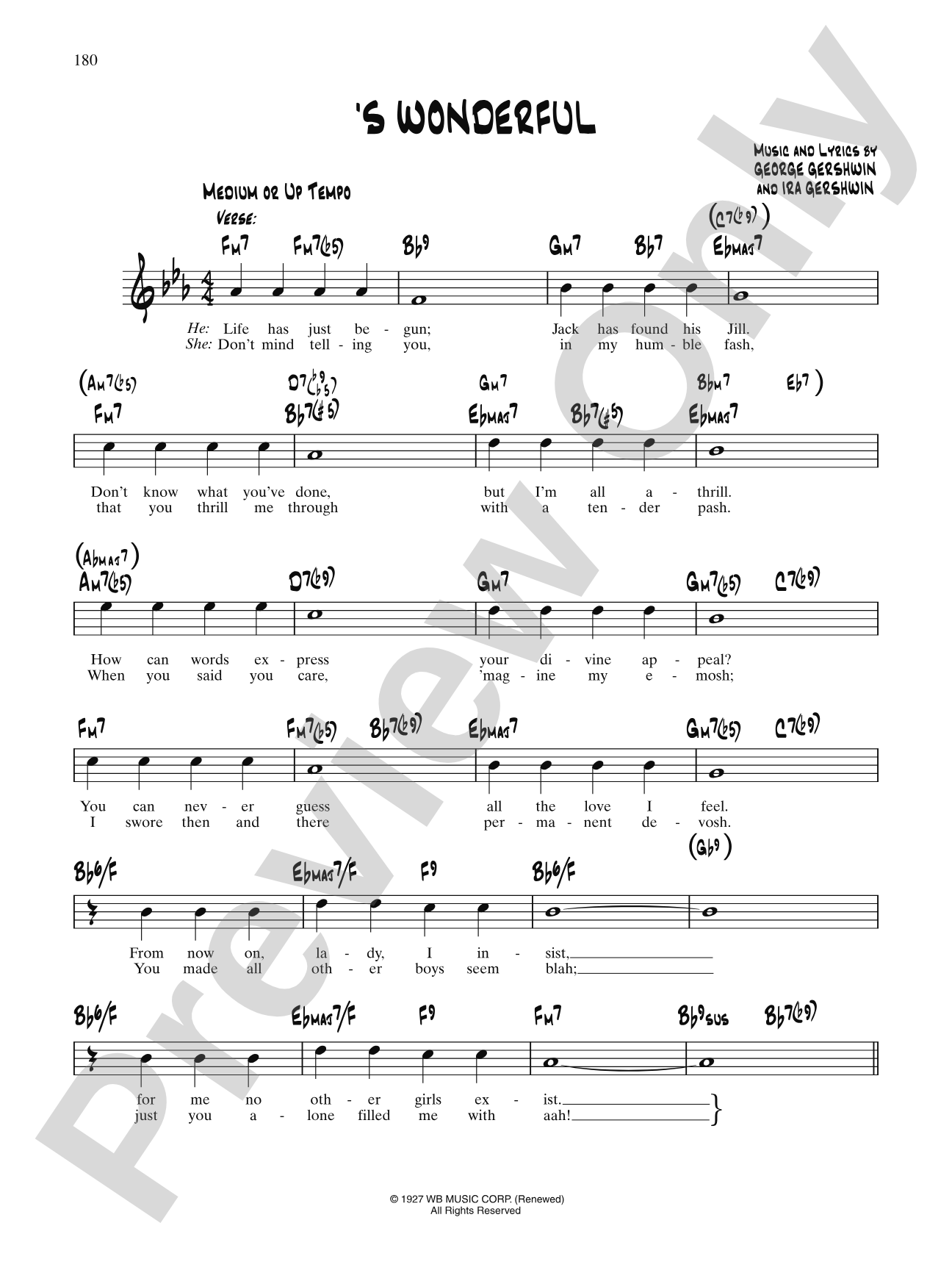
's Wonderful (From "Funny Face") Sheet Music Preview

's Wonderful (From "Funny Face"): Lead Sheet

Michael Feinstein

Item: 00-PSL-000299

Digital Download
$4.99

One moment…

Description
A collection of 21 well-known standards as recorded by Michael Feinstein, many of them refashioned in his own unique, intimate style. Titles include: Alexander's Ragtime Band * I Love a Piano * Isn't It a Pity * Isn't It Romantic * Love Is Here to Stay * New York, New York * Rhode Island Is Famous for You * 'S Wonderful * Too Marvelous for Words * The Very Thought of You. The folio includes Feinstein's special comments about the songs.

's Wonderful (From "Funny Face"): Lead Sheet isn't in MakeMusic Cloud just yet...but it could be. Let us know you'd like to see it, and you'll help shape what comes next. In the meantime, start a free trial and dive into thousands of interactive titles your students can play along with today.

Sample Audio
No sample audio found.
Sample Video
Additional Details
Publisher: Alfred Music
Page Count: 148
SKU: 00-PSL-000299

More about this title

About the Artist: George Gershwin

George Gershwin (1898–1937) bridged classical and popular music in ways that still feel revolutionary. His melodies became the soundtrack to the American twentieth century, shaped by jazz idioms, blues harmonies, and an instinct for what makes a song linger in memory long after the final note.

As a composer and pianist, Gershwin proved that standards and serious music could occupy the same space. His output across musical theater, concert works, and popular song established a vocabulary that jazz pianists, vocalists, and classical musicians have drawn from ever since. For music students, his work remains a masterclass in craft: how to write a melody that feels inevitable, how to harmonize with sophistication without losing warmth.

Why we love this

This lead sheet collection captures Gershwin's gift for melody in its purest form. The standards here work equally well for voice students developing interpretive maturity, pianists expanding their jazz and popular music literacy, and anyone studying how harmonic sophistication can coexist with emotional directness.

What to expect

These melodies settle into your hands and voice with immediate familiarity, yet the harmonies underneath offer constant discovery. Gershwin's gift was making sophisticated chord movement feel as natural as conversation, so playing through these standards feels both effortless and endlessly rewarding.

Who it's for

Pianists preparing for jazz standards repertoire, vocalists building a classic American songbook foundation, and music students analyzing how Gershwin's harmonic language shaped the Great American Songbook. This lead sheet format works for sight-readers who want chord changes at a glance and arrangers seeking to expand a standard in new directions.

How to get the most out of it

  • Study the recorded versions by Michael Feinstein included in the full collection to hear how rubato and space can transform a familiar melody; then find where your own interpretation diverges.
  • Treat the chord symbols as a starting point, not a ceiling. Experiment with voicings that shift the color of each phrase, especially in the bridge sections where Gershwin often moves to unexpected harmonic territory.
  • Let the lyrics guide your phrasing even if you're playing instrumental versions. These songs were written for singers, and the breath points matter.
  • Pay attention to the moments where Gershwin's melody sits high or moves into the upper register; these often signal emotional peaks that deserve a touch more space or dynamic lift.

How to use it

Use individual songs from this collection to build a jazz standards set for a recital, or program them alongside other American songbook classics from your school's vocal or piano repertoire. Single pieces work well in chamber settings with piano and small ensemble, or as supplementary material for students studying American musical theater and popular song composition.

Skills your students will build

  • Reading lead sheets with melody, lyrics, and chord symbols
  • Interpreting jazz and pop harmonies beyond written accompaniment
  • Understanding melodic construction in the American standard form
  • Balancing accuracy with interpretive flexibility in iconic songs
  • Voice leading through chromatic and diatonic chord progressions

You May Also Like