
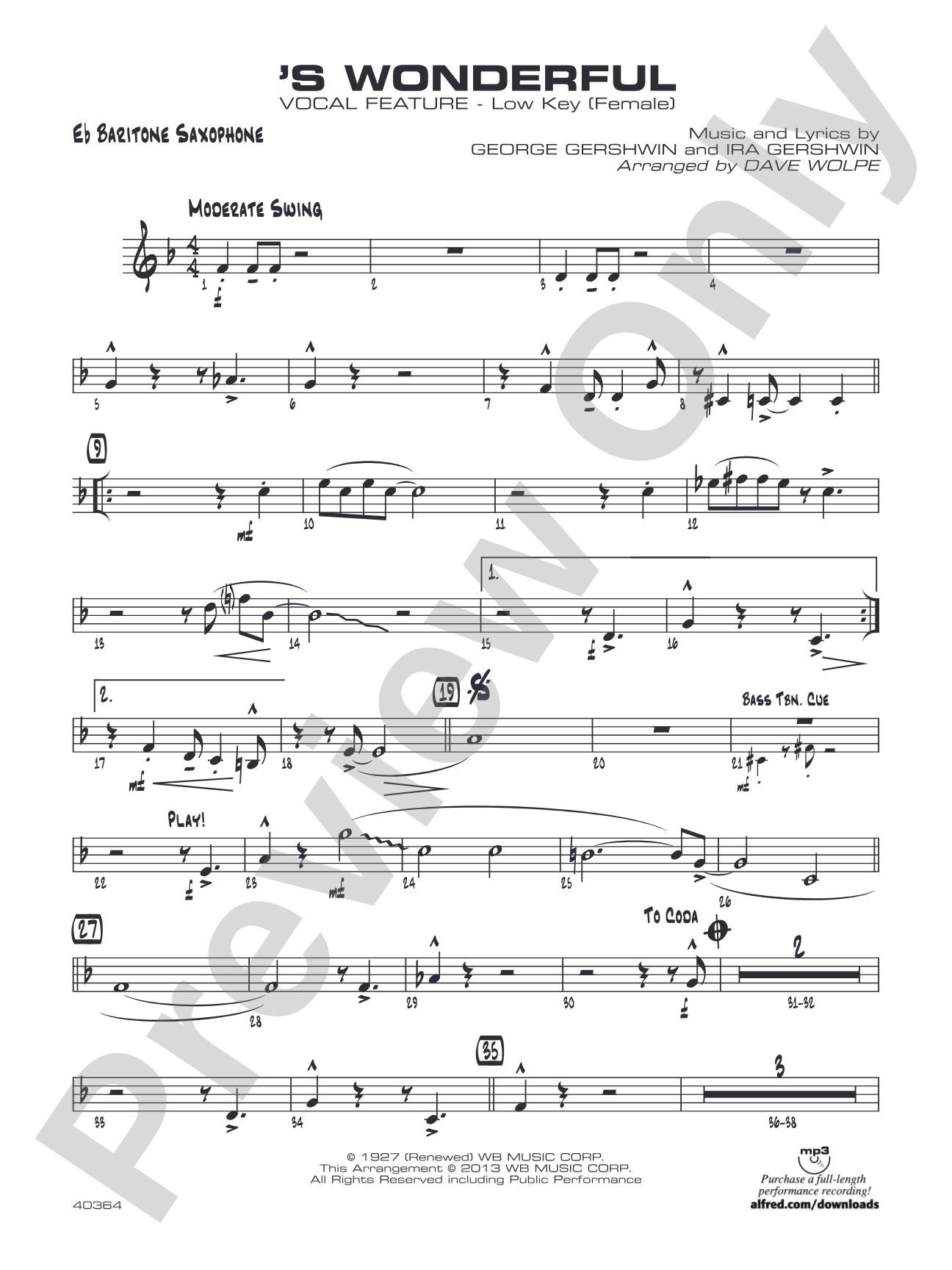

'S Wonderful: E-flat Baritone Saxophone
Music and lyrics by George Gershwin and Ira Gershwin / arr. Dave Wolpe
Grade: 3 (Medium)
Item: 00-PC-0017258_BTX
$3.00
Pickup currently not available
Description
An excellent medium-swing vocal chart arranged in two keys, high and low to accommodate all vocalists. The low key is A-flat with vocal range from A-flat below middle C to 3rd line B-flat, and the high key is E-flat, with vocal range from E-flat first line to top line F, treble clef. Lead trumpet range to written high C. Includes a written-out tenor sax solo and a substitute tenor sax solo part in lieu of the vocal. This title is available in MakeMusic Cloud.


Don't just read it, hear it, play along with it, and watch your students grow with it. In MakeMusic Cloud, 'S Wonderful: E-flat Baritone Saxophone comes alive with professional accompaniment, adjustable tempo, and built-in practice tools that turn solo practice into real progress.
Open in the Player
Jump straight in and assign it today.
Start Your Free Trial
Open this title and explore the full library in minutes.
Sample Audio
1
Audio File
--:--
0:00
0:00
Sample Video
No sample videos found.
Additional Details
Series:
Jazz Vocal Series
Publisher:
Alfred Music
Page Count:
82
SKU:
00-PC-0017258_BTX
More about this title
About the Composer: George Gershwin
George Gershwin (1898-1937) bridged classical and popular music in ways that still feel revolutionary. His gift for melody, harmonic sophistication, and rhythmic vitality made him one of the most performed American composers in music education. Works like Rhapsody in Blue and An American in Paris appear regularly in concert halls and classrooms because they capture something essential about American musical identity.
Gershwin's theater songs, written with his brother Ira as lyricist, became jazz standards precisely because they were written by a composer who understood both concert hall craft and popular song structure. His melodies are memorable yet harmonically rich, making them ideal vehicles for jazz arrangers and vocalists who want to dig into sophisticated harmony without abandoning accessibility.
Why we love this
Dave Wolpe's arrangement gives this beloved standard a workable jazz ensemble vehicle that actually serves the vocalist instead of burying them. The inclusion of two keys (A-flat and E-flat) and both a written tenor sax solo and a substitute part means you can cast this across your section and still keep the arrangement fresh night to night. It's the kind of professional-level chart that sounds ambitious without requiring your ensemble to be seasoned pros.
What to expect
Optimistic and suave in equal measure. The melody lifts with genuine joy ('S wonderful, 's marvelous) while the harmonic sophistication keeps the arrangement grounded and adult. Gershwin's gift for melody shines throughout; the tune is instantly singable yet never simple, and the medium-swing groove gives it forward momentum without rushing.
Who it's for
Vocalists with solid jazz phrasing who can navigate a melody that rewards both straightforward delivery and interpretive flexibility. Jazz ensembles that want to expand their vocal programming beyond rock or contemporary styles into classic American song repertoire. Directors looking for a chart that gives advanced high school or college singers an opportunity to perform in a full ensemble context without requiring expensive orchestrations.
How to get the most out of it
- Balance the vocalist's volume against the ensemble; in swing tunes, the voice should sit slightly forward of the rhythm section but never seem amplified relative to the horns. Let the drummer hear where the vocalist lands rhythmically.
- Lock the tenor sax soloist into the same swing feel as the rhythm section before adding the vocal line. The solo and vocal inhabit the same harmonic space, so transition between them should feel inevitable, not like two separate charts.
- Take the two keys seriously as a casting tool. Rather than defaulting to high key for sopranos and low key for lower voices, hear both keys in rehearsal and choose based on where each vocalist's voice sits most comfortably and projects best in your room.
- Communicate the style clearly in your first rehearsal run-through. Medium swing has a specific lilt that's neither straight eighths nor deeply laid-back; your rhythm section sets this, and the horns follow.
How to use it
Pair this with other Gershwin standards or American songbook material to build a concert set around a single composer or era. It works equally well as an opening number that sets a sophisticated, accessible tone or as a moment of contrast in a program mixing original compositions with standards. The chart's flexibility across keys makes it a reliable choice when you're uncertain which vocalist will ultimately be available.
Skills your students will build
- Swing eighth-note articulation and feel in an ensemble context
- Balancing solo vocal line against full jazz ensemble sonority
- Interpretation of classic songbook melody with jazz harmonic vocabulary
- Sectional independence in jazz ensemble arrangement (tenor sax line vs. ensemble figures)
- Rhythmic communication between vocalist and rhythm section (drummer, bassist)