'S Wonderful Sheet Music Preview

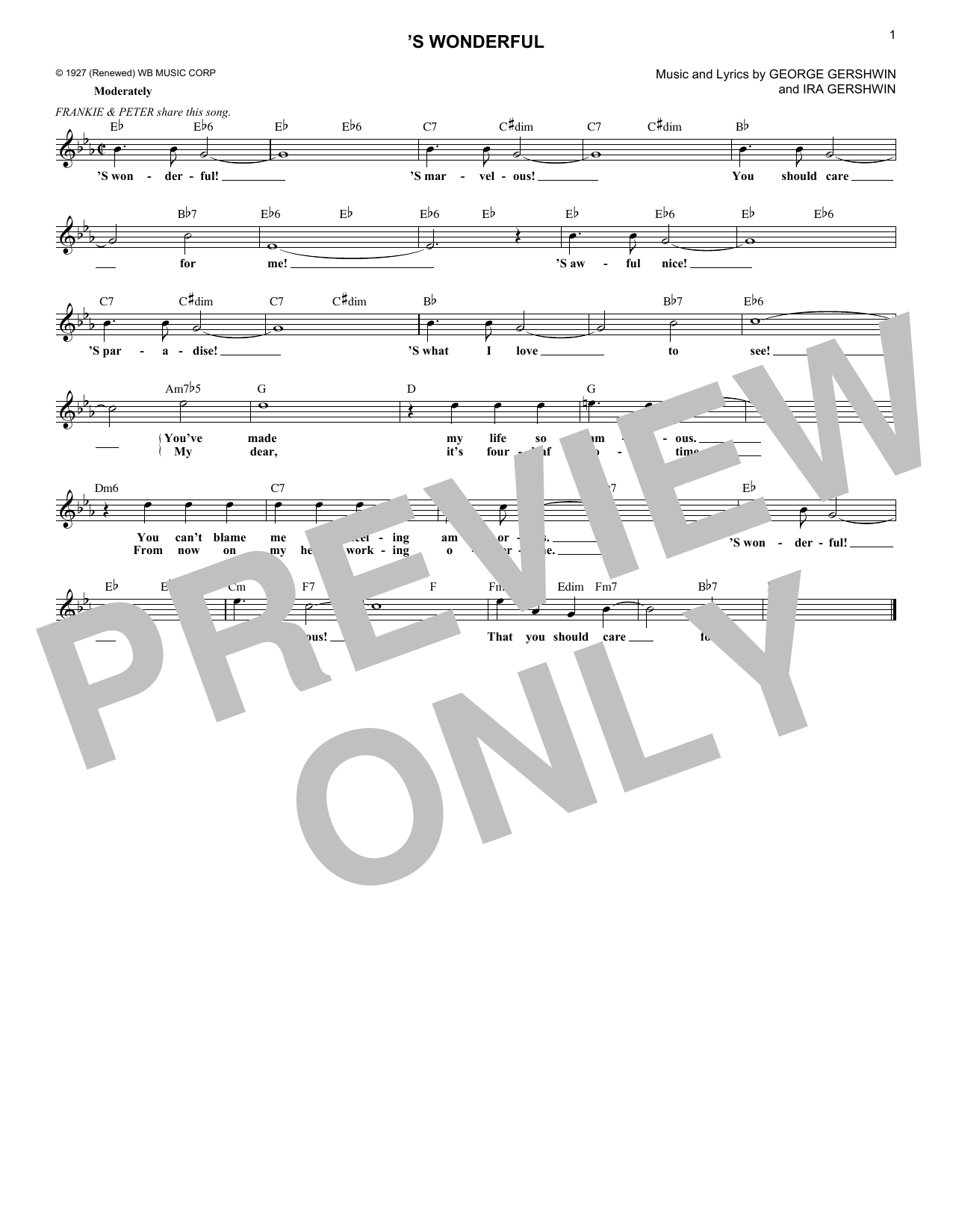
'S Wonderful: Lead Sheet / Fake Book

Item: 35-DS00411443

Digital Download
$3.99

One moment…

Description

'S Wonderful: Lead Sheet / Fake Book isn't in MakeMusic Cloud just yet...but it could be. Let us know you'd like to see it, and you'll help shape what comes next. In the meantime, start a free trial and dive into thousands of interactive titles your students can play along with today.

Sample Audio
No sample audio found.
Sample Video
Additional Details
Publisher: Hal Leonard
Page Count: 1
SKU: 35-DS00411443

More about this title

About the Creator: George Gershwin, Ira Gershwin

George Gershwin and Ira Gershwin created some of Broadway's most enduring music during the 1920s and 1930s, with a gift for marrying sophisticated harmony to instantly memorable melodies. 'S Wonderful comes from their 1927 musical "Funny Face," a show that helped establish Gershwin as a composer who could work fluidly across concert hall and popular stage. The song became a standard almost immediately, recorded countless times and adapted across nearly every instrumental combination imaginable.

Why we love this

This lead sheet captures one of the most elegant love songs in the American songbook, offering singers and pianists a chance to explore the interplay between a lyrical vocal line and the kind of sophisticated jazz harmony that defined Gershwin's sound. The straightforward format lets musicians focus on phrasing and interpretation rather than managing busy notation, making it ideal for both rehearsal and performance.

What to expect

Warm, unhurried, and genuinely affectionate. The melody floats above gentle harmonic motion, never insistent, always intimate. There's a lightness to this song that comes from perfect confidence, like someone who knows exactly what they want to say and takes their time saying it.

Who it's for

Pianists accompanying jazz singers, voice students working on American songbook standards, and ensemble musicians preparing for a Broadway or jazz repertoire evening. This is equally valuable for jazz pianists sharpening their comping skills and for classical pianists curious about how to navigate lead sheet notation and harmonic freedom.

How to get the most out of it

  • Shape the vocal line through the title phrase, resisting the urge to sit on each note equally; the understatement in the lyric works best when phrasing curves naturally into the next thought
  • Let the chord symbols breathe in the piano voicing rather than cluttering every beat; space and silence between harmonic moments often feel more sophisticated than constant accompaniment
  • Anchor the tempo around a walking pace that honors the languid mood; rushing this song flattens its charm

How to use it

Nest this into a showcase of standards, pairing it with other Gershwin songs or Broadway material from the same era. It also works beautifully as a solo feature for a jazz vocalist in a mixed concert, offering contrast between higher-energy numbers by giving the audience a moment to settle into something genuinely lyrical.

Skills your students will build

  • Reading and interpreting lead sheet notation
  • Voicing chords with independence and taste rather than mechanically
  • Sustaining a legato vocal line across wide intervallic leaps
  • Accompanying flexibly, adjusting dynamics and texture to support a vocalist's phrasing
  • Understanding how jazz harmony functions within a tuneful, accessible melody

You May Also Like