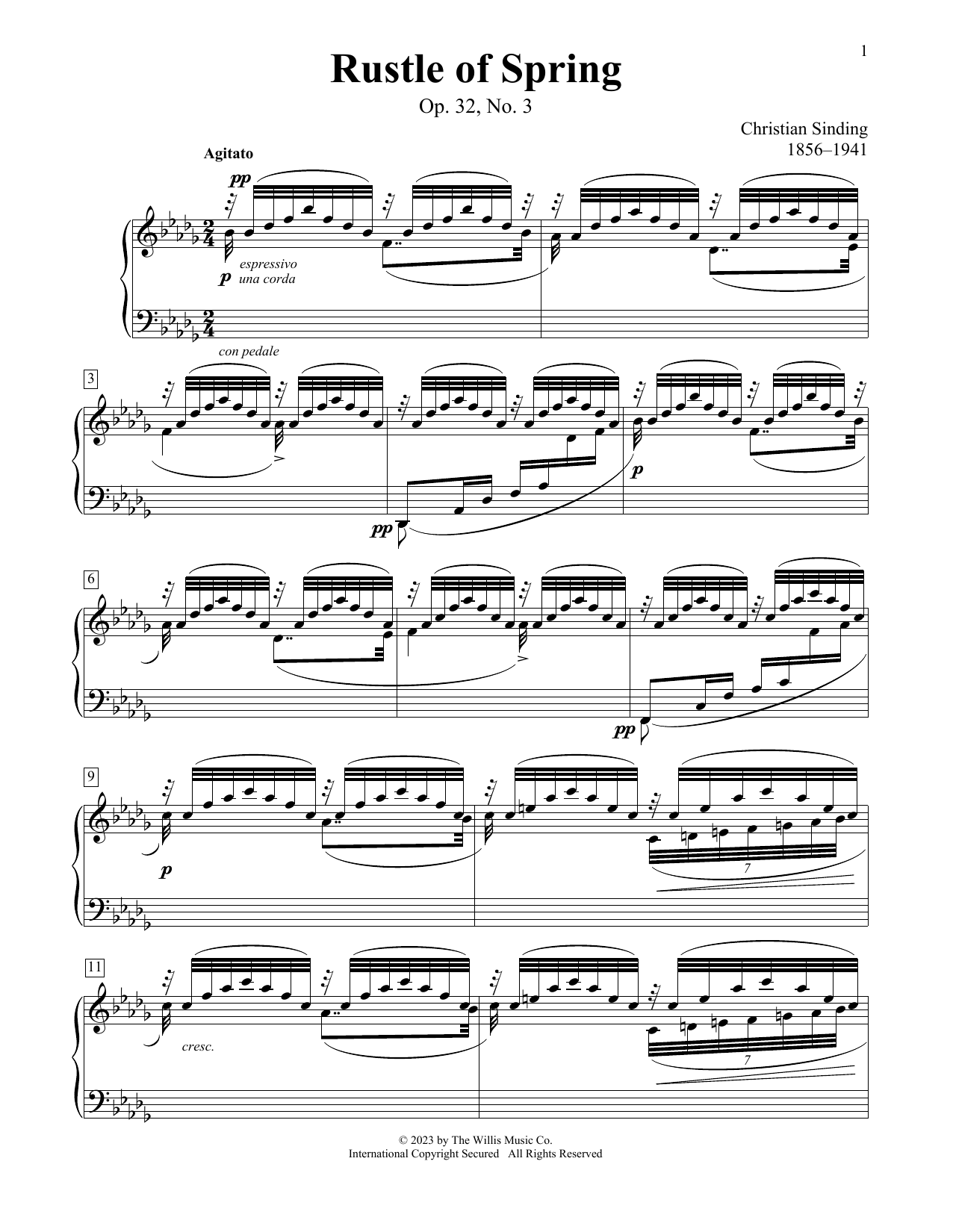
Rustle Of Spring, Op. 32, No. 3 Sheet Music Preview

Rustle Of Spring, Op. 32, No. 3: Educational Piano

Edited by Charmaine Siagian / Edited by Sonya Schumann

Item: 35-DS01340310

Digital Download
$4.99
One moment…
Description

Discover MakeMusic Cloud: thousands of interactive titles your students can play along with today.

Sample Audio
No sample audio found.
Sample Video
Additional Details
Publisher: Hal Leonard
Page Count: 8
SKU: 35-DS01340310

More about this title

About the Creator: Christian Sinding

Christian Sinding (1856-1941) was a Norwegian composer whose gift for melodic writing and harmonic sophistication made him a fixture in the salon music repertoire of the late Romantic era. Though his output spanned symphonies and chamber works, his piano miniatures secured his lasting place in music education, valued for their lyrical beauty and carefully calibrated technical demands.

Sinding's ability to craft pieces that satisfied both artistic ambition and pedagogical purpose accounts for the enduring classroom presence of works like Rustle of Spring. His compositional language balances Romantic sentiment with clear formal structures, making his pieces ideally suited to students ready to move beyond early intermediate studies.

Why we love this

This piece succeeds because it introduces students to genuinely beautiful music without requiring virtuosic technical command. The primary right-hand melodic material sings naturally under the fingers while the accompanying figures in the left hand develop accompaniment patterns that feel musical rather than merely mechanical, making it rewarding to practice and perform.

What to expect

The music evokes the delicate rustling of leaves or spring breezes through its shimmering, flowing texture and graceful melodic contours. Woven throughout is a lyrical quality that connects to the Romantic era's fascination with nature imagery, creating an intimate and contemplative mood that rewards attentive listening.

Who it's for

Students in the late elementary to early intermediate level will find this piece accessible while still offering genuine musical satisfaction. It works beautifully for those developing control over longer melodic lines and beginning to understand the relationship between melody and accompaniment in Classical and Romantic forms.

How to get the most out of it

  • Listen carefully to the shape of the main melody and allow it to breathe through slight tempo flexibility in phrase endings; the piece's impressionistic title invites a touch of rubato that brings out its character without sacrificing rhythmic integrity
  • Balance the left-hand figuration so it remains clearly subordinate to the melody without becoming so quiet that it loses definition; aim for transparency rather than colorlessness
  • Allow the key relationships and harmonic progressions to guide your interpretation; notice where the piece modulates and use these moments to create gentle shifts in color and intensity

How to use it

Feature this as a recital staple that appeals to audiences while giving students a piece they genuinely enjoy performing. It pairs naturally with other Scandinavian Romantic miniatures or serves as an ideal bridge between classical forms and the more impressionistic textures students encounter in twentieth-century literature.

Skills your students will build

  • Sustaining lyrical melodic lines across longer phrases
  • Controlling left-hand accompaniment patterns with rhythmic precision and dynamic balance
  • Interpreting harmonic movement and key relationships as structural signposts
  • Developing touch differentiation between melody and accompaniment
  • Building confidence in moderate-tempo performance with expressive phrasing

You May Also Like