
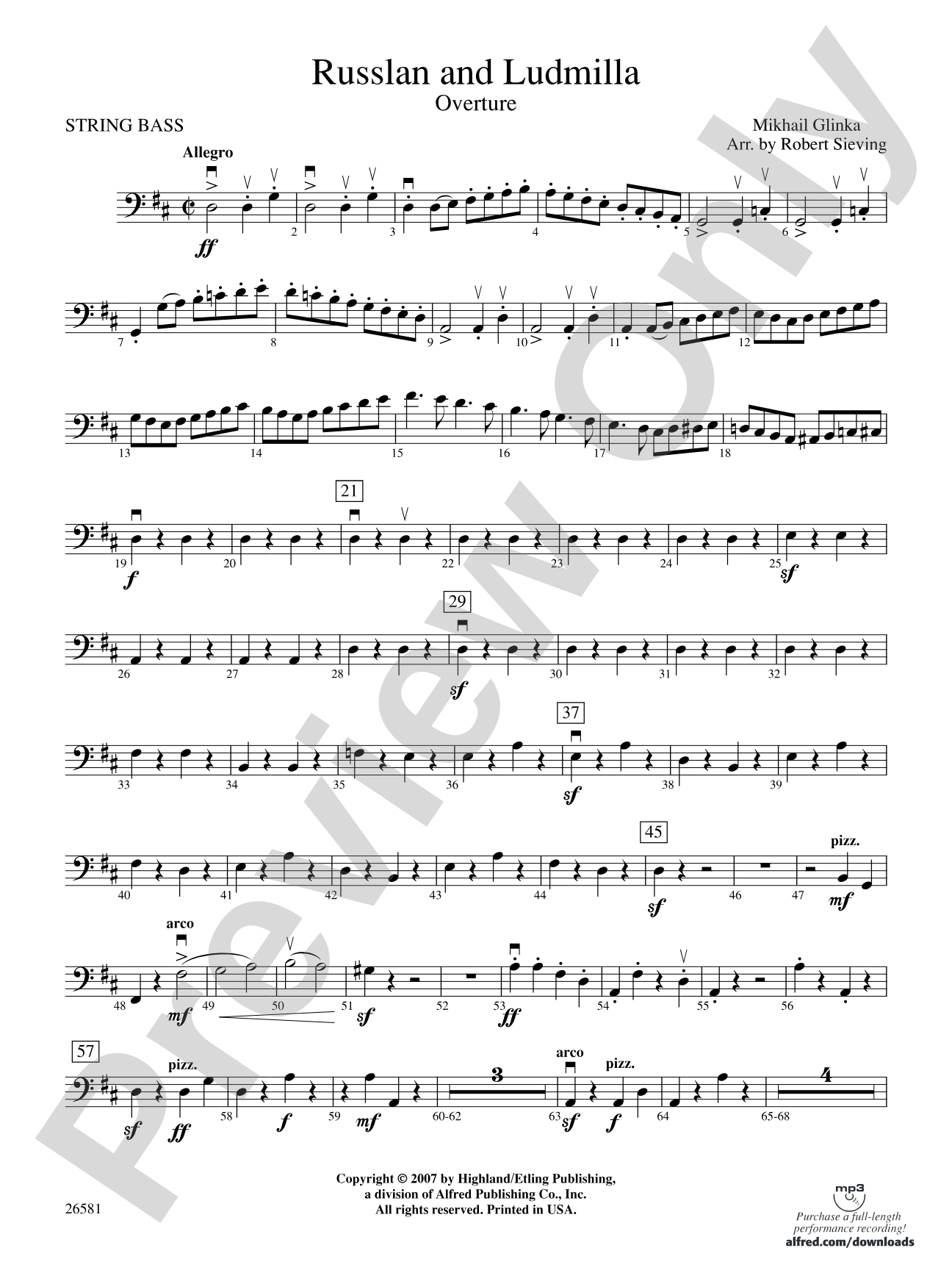

Russlan and Ludmilla: String Bass
By Mikhail Glinka / arr. Robert Sieving
Grade: 4
Item: 00-PC-0001097_SB
$5.99
Pickup currently not available
Description
The Russlan overture is emblematic of the founding of the Russian nationalist school of composition. Arranged for your young string orchestra, careful attention has been paid to retain the original wind materials and string articulations, while all parts are playable in first and third positions. The practical application of scale exercises abounds in this orchestral masterwork! This title is available in MakeMusic Cloud.


Don't just read it, hear it, play along with it, and watch your students grow with it. In MakeMusic Cloud, Russlan and Ludmilla: String Bass comes alive with professional accompaniment, adjustable tempo, and built-in practice tools that turn solo practice into real progress.
Open in the Player
Jump straight in and assign it today.
Start Your Free Trial
Open this title and explore the full library in minutes.
Sample Audio
1
Audio File
--:--
0:00
0:00
Sample Video
No sample videos found.
Additional Details
Series:
Highland/Etling String Orchestra
Publisher:
Alfred Music
Page Count:
208
SKU:
00-PC-0001097_SB
More about this title
About the Composer: Mikhail Glinka
Mikhail Glinka (1804-1857) stands as the architect of Russian nationalist music. Before Glinka, Russian composers largely followed Western European models; his life's work established a distinctly Russian musical voice by weaving folk melodies, exotic harmonies, and dramatic orchestration into large-scale forms. He spent years traveling across Europe and the Middle East, absorbing musical influences that he transformed into a uniquely Russian aesthetic.
Ruslan and Ludmilla, his second and final opera, premiered in 1842 and became the cornerstone work of the nationalist school. The overture captures everything Glinka pioneered: brilliant orchestration, rhythmic vitality, and melodies rooted in Russian song. His influence rippled through generations of Russian composers, from the Five to Rimsky-Korsakov, who directly built upon the foundation Glinka laid.
Why we love this
This arrangement captures the visceral energy of Glinka's original without overwhelming a young string section. The careful voicing and positional constraints (first and third positions) mean your students engage with genuinely sophisticated orchestral writing while staying within their technical reach. It's the rare grade 4 piece that builds real musical maturity rather than mere busyness.
What to expect
Heroic and spirited, with moments of genuine lyricism woven through. The opening announces itself with confident swagger, then shifts into passages of Russian charm and exotic color. There's propulsive rhythmic energy throughout, balanced by sections where melody takes center stage. The whole thing feels like a musical journey, not just a concert opener.
Who it's for
Conductors of young string orchestras (grades 4-5) who want to program genuine masterwork repertoire without compromising accessibility. Students are ready for orchestra music that demands musicality and rhythmic precision, not just note-reading. This piece rewards careful ensemble work and gives your students a direct connection to a foundational voice in the classical repertoire.
How to get the most out of it
- Shape the opening melody with clarity and sing through the lyrical passages. Glinka's gift was memorable melody; let it breathe rather than rushing through phrases.
- Balance the retained wind materials carefully in rehearsal (if you have woodwinds doubling certain lines). The string articulations should come through distinctly without drowning out those color moments.
- Lock the rhythm section early, especially through the faster passages where scale work dominates. Once the pulse is secure, the melodic lines will sit naturally on top.
- Attend to the character shifts within the overture. Contrast the heroic sections with moments of Russian charm. These dynamic and textural shifts are what make the piece memorable.
How to use it
Program this as a centerpiece work on a concert celebrating national schools of composition or Russian music history. It pairs well with lighter contemporary pieces or folk-inspired arrangements that can follow its dramatic arc. The piece also works effectively as a contest or festival selection, where the combination of technical challenge and musical substance will impress adjudicators.
Skills your students will build
- Reading scalar passages across multiple registers and positions
- Coordinating articulation and style across an ensemble
- Sustaining lyrical phrasing while maintaining rhythmic precision
- Transitioning between contrasting musical characters
- Balancing melodic lines with accompaniment patterns
- Performing with confidence in first and third positions across the full range