Russian Sailors' Dance: 1st B-flat Clarinet Sheet Music Preview

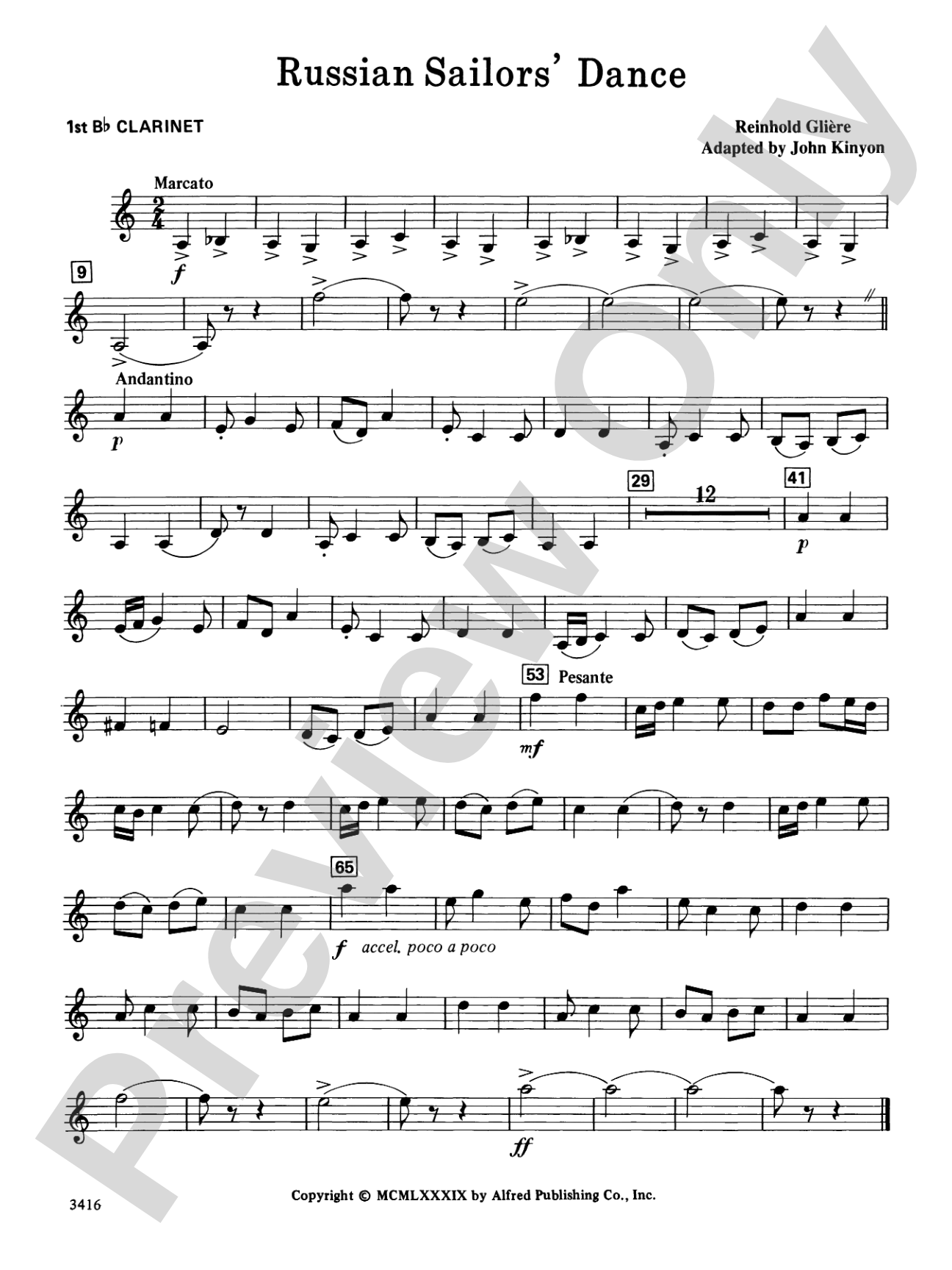
Russian Sailors' Dance: 1st B-flat Clarinet

By Reinhold Glière / arr. John Kinyon

Grade: 1 (Very Easy)

Item: 00-PC-0014618_C1

Digital Download
$3.00
Description
A marcato opening announces this dramatic Russian theme. An active percussion part, tempo changes, and syncopated rhythms make this easy work an interesting challenge for young beginners. Each section of the band has a turn to shine while the arrangement builds to a dramatic 'accelerando poco a poco' closing. (Grade 1)

Don't just read it, hear it, play along with it, and watch your students grow with it. In MakeMusic Cloud, Russian Sailors' Dance: 1st B-flat Clarinet comes alive with professional accompaniment, adjustable tempo, and built-in practice tools that turn solo practice into real progress.

Sample Audio
No sample audio found.
Sample Video
Additional Details
Series: Mini Score Series
Publisher: Alfred Music
Page Count: 102
SKU: 00-PC-0014618_C1

More about this title

About the Composer: Reinhold Glière

Reinhold Glière (1874–1956) was a Russian composer and conductor whose prolific output spanned symphonies, ballets, and orchestral works that earned him international recognition. His music bridges Romantic lyricism with early twentieth-century orchestration, and his gift for crafting memorable melodic lines has made his works staples of music education and concert repertoire alike.

Why we love this

This arrangement captures everything that makes Glière's melodies sing while giving every section of a young band meaningful material. The marcato opening immediately commands attention, and the gradual layering of parts means students hear themselves grow from supporting voices into the melodic foreground. The accelerando closing is exactly the kind of kinetic payoff that builds confidence and reminds players why they rehearse.

What to expect

Bold and energetic. The marcato opening cuts through the room with character, and the Russian melody has a folk-like directness that carries harmonic warmth beneath it. By the time the accelerando kicks in, the whole band feels the momentum gathering, pushing toward a finish that leaves both players and audience breathless.

Who it's for

Grade 1 bands ready to move beyond static pieces into music with real dramatic arc. This works whether your group is early in the school year or seasoned enough to handle tempo changes and section independence without losing cohesion.

How to get the most out of it

  • Establish the marcato articulation crisply in the opening. Young players often soften marcato under tempo pressure; a few focused warm-up reps on scale passages will lock it in cleanly.
  • Balance the syncopated rhythms by having the section that carries the main theme play just slightly above the supporting parts. This keeps the melody clear without drowning out the harmonic foundation.
  • Mark the tempo changes prominently in student parts and conduct them deliberately. Younger ensembles respond well to clear visual cues at transitions.
  • Build the accelerando poco a poco gradually through sectional rehearsal. Have woodwinds and brass practice the acceleration separately first, then bring them together to ensure the effect feels unified rather than chaotic.

How to use it

Program this early in a concert when energy is fresh, or save it as a closer that leaves the audience with propulsive excitement. It pairs well on the same program as lyrical works, since its rhythmic drive provides natural contrast. This is also strong repertoire for festivals and contests where a Grade 1 piece with personality stands out.

Skills your students will build

  • Marcato articulation and consistency across sections
  • Reading and executing tempo changes
  • Syncopated rhythm accuracy in ensemble context
  • Balancing melody and harmony as a unified band
  • Accelerando technique (gradual tempo increase while maintaining precision)

You May Also Like