Russian Riddle: Violin 2 Sheet Music Preview

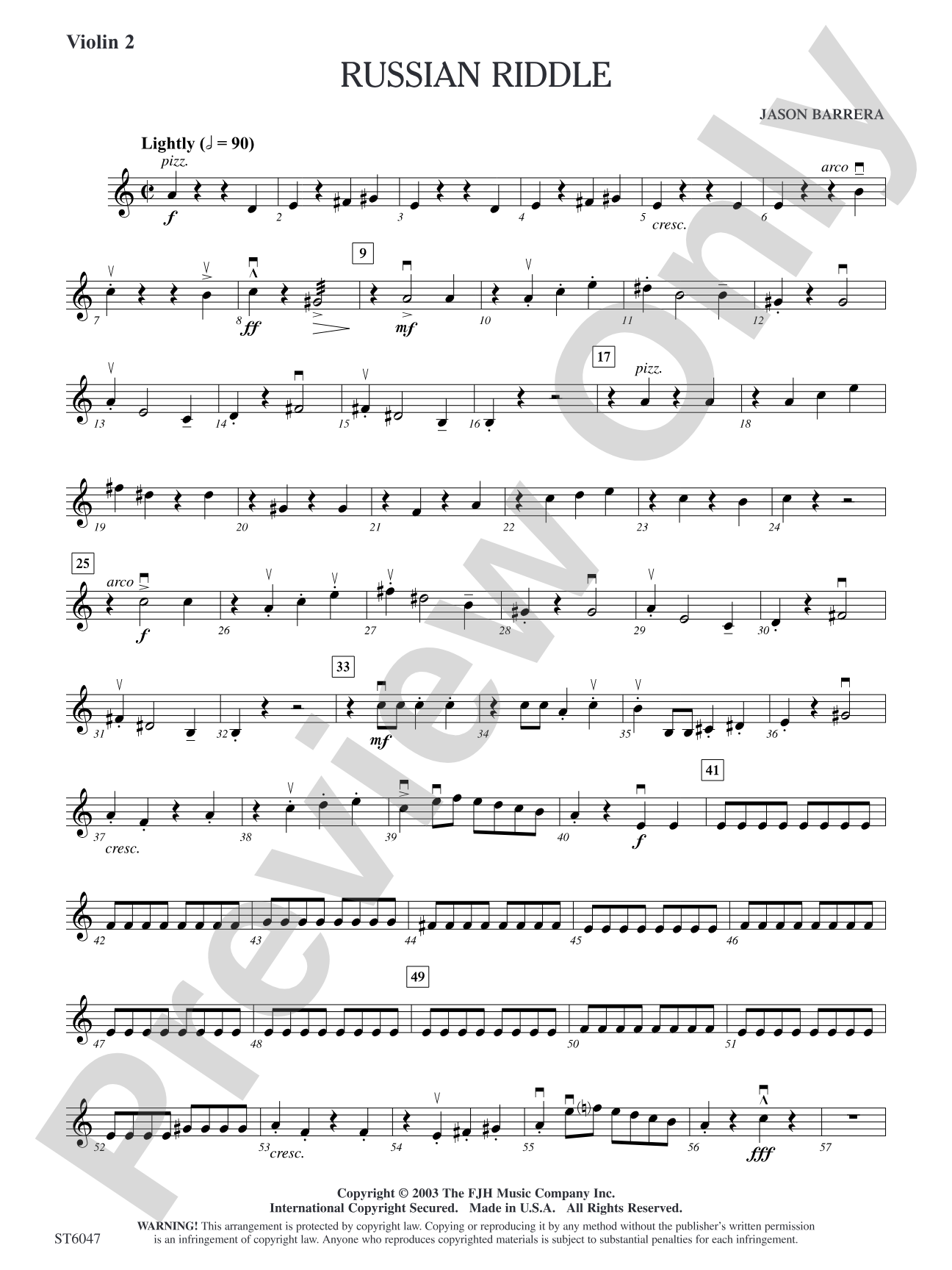
Russian Riddle: Violin 2

By Jason Barrera

Grade: 3

Item: 98-PC-DST6047_VN2

Digital Download
$7.00
Description
This clever and comical selection was inspired by the music of Sergei Prokofiev and other 20th century Russian composers. Written almost as a gallop, the witty tongue-in-cheek melody will provide a nice contrast on your concert program and will no doubt entertain your audience and musicians. A second melody in the same tempo offers a nice contrast to the opening material while the underlying voices maintain the style of the opening. You will surely want to consider this fine work!

Russian Riddle: Violin 2 isn't in MakeMusic Cloud just yet...but it could be. Let us know you'd like to see it, and you'll help shape what comes next. In the meantime, start a free trial and dive into thousands of interactive titles your students can play along with today.

Sample Audio
0:00
0:00
Sample Video
Additional Details
Series: FJH String Orchestra
Publisher: The FJH Music Company, Inc.
SKU: 98-PC-DST6047_VN2

More about this title

Why we love this

Barrera captures the playful irreverence of early 20th-century Russian modernism without requiring the technical fireworks that make Prokofiev challenging at the Grade 3 level. The piece balances genuine musical substance with immediate entertainment value, so your students get to experience sophisticated compositional ideas while your audience enjoys the humor.

What to expect

Imagine a character sketch in music: wry, quick-witted, and full of unexpected turns. There's intelligence in the humor here, the kind that makes musicians grin while they're playing because they understand the joke. It's sprightly and never overstays its welcome.

Who it's for

This works for Grade 3 string orchestras ready to explore twentieth-century idioms without getting bogged down in difficulty. It's equally useful for festival programming or a concert that needs an energizing palate cleanser between heavier works.

How to get the most out of it

  • Keep the gallop rhythm crisp and forward-moving; resist the temptation to broaden it, which deflates the comedic timing.
  • The contrast between the two melodies works best when you highlight the character shift clearly. The second melody should feel like a witty response, not a restatement.
  • Let the underlying harmonic voices breathe on their own. They're doing more than accompanying, so texture matters as much as tuning.

How to use it

Place this after something substantial but somber. It resets the room's energy while proving to your audience that your students can navigate twentieth-century compositional language with style. The piece also stands well as a festival or contest selection where you want memorable but substantive programming.

Skills your students will build

  • Stylistic interpretation of twentieth-century music
  • Rhythmic precision in gallop rhythms with varied accompaniment textures
  • Voice independence and clarity within ensemble textures
  • Musical character development and contrast between thematic sections

You May Also Like