
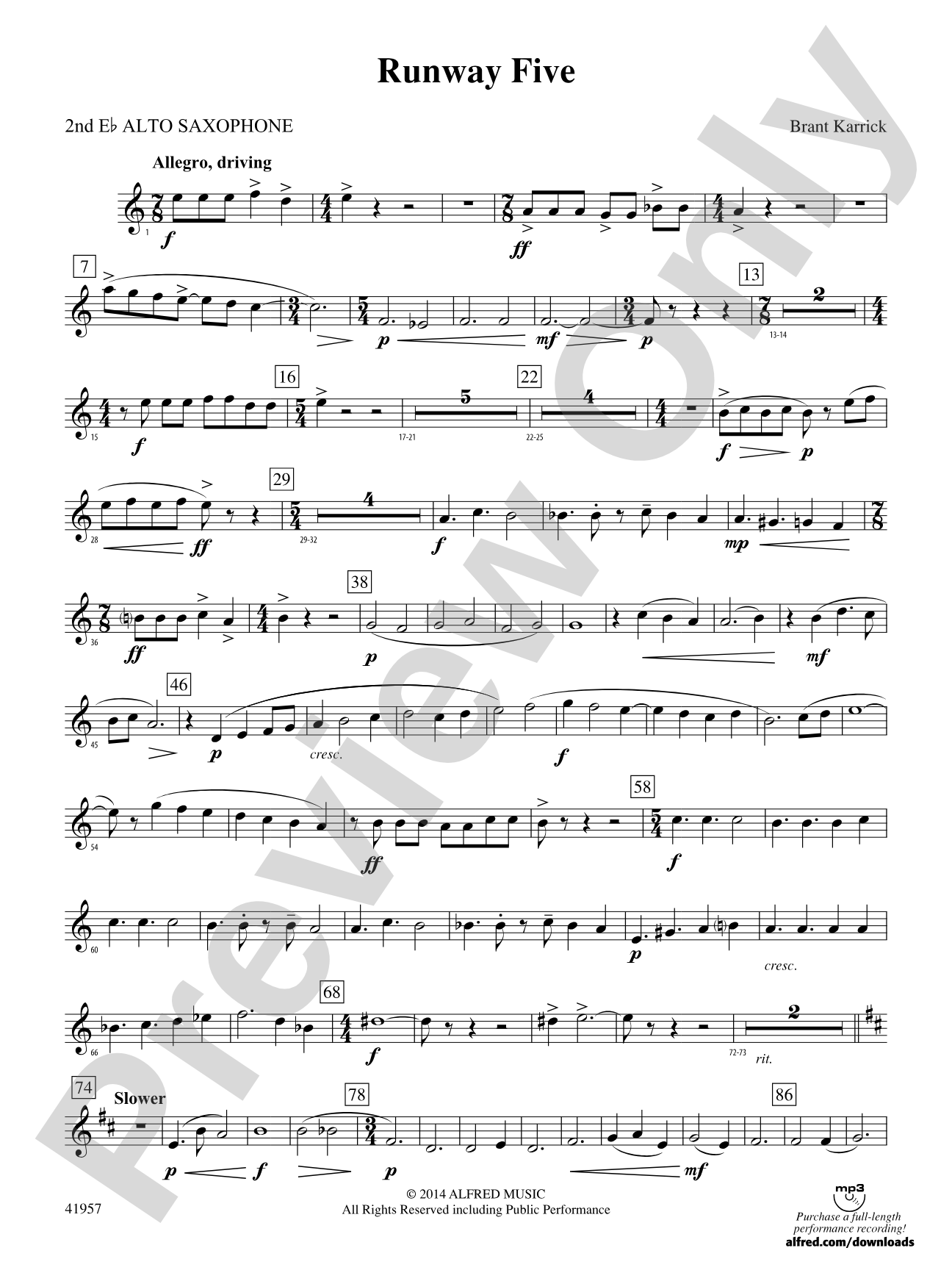

Runway Five: 2nd E-flat Alto Saxophone
By Brant Karrick
Grade: 4 (Medium Difficult)
Item: 00-PC-0016439_AX2
$3.00
Pickup currently not available
Description
This piece pays homage to the tenacity of the human spirit and mankind's achievements of flight and space exploration. With main themes presented in minor keys, the asymmetric and odd meters---especially the 5/4---intend to give thrust and momentum to the music. The many changing meters of the piece are intended to give the listener a similar feeling that a pilot has while attempting to control an aircraft during a turbulent and bumpy flight. (6:00)


Don't just read it, hear it, play along with it, and watch your students grow with it. In MakeMusic Cloud, Runway Five: 2nd E-flat Alto Saxophone comes alive with professional accompaniment, adjustable tempo, and built-in practice tools that turn solo practice into real progress.
Open in the Player
Jump straight in and assign it today.
Start Your Free Trial
Open this title and explore the full library in minutes.
Sample Audio
1
Audio File
--:--
0:00
0:00
Sample Video
No sample videos found.
Additional Details
Series:
Alfred Concert Band
Publisher:
Alfred Music
Page Count:
300
SKU:
00-PC-0016439_AX2
More about this title
About the Composer: Brant Karrick

Brant Karrick has shaped band programs across three decades as a conductor, educator, and composer. His path includes nine years at the University of Toledo, seven years in Kentucky public schools, and since 2003 his leadership of the entire band program at Northern Kentucky University, where he directs the Symphonic Winds, Concert Band, and Chamber Winds while teaching conducting, instrumental methods, and orchestration. His doctoral work in music education from Louisiana State University (1994) and degrees from the University of Louisville and Western Kentucky University built a foundation for his comprehensive approach to musician and teacher development.
As a composer and arranger, Karrick maintains an active presence in the international concert band world. His works have been performed across the United States, Canada, Europe, South Africa, South America, Japan, and Australia. He remains engaged as a guest conductor, clinician, and adjudicator while maintaining membership in NAFME, CBDNA, and ASCAP. His musical education included trumpet study with Leon Rapier and composition training with David Livingston, Steve Beck, and Cecil Karrick.
Why we love this
Karrick constructs a genuinely sophisticated exploration of meter and momentum rather than treating odd time as mere novelty. The intentional use of shifting meters to mirror flight turbulence gives your band a concrete dramatic purpose, and the minor-key harmonic language prevents the piece from becoming gimmicky. At Grade 4, it demands real rhythmic literacy and control from your ensemble, rewarding serious preparation with genuine musical impact.
What to expect
Runway Five unfolds like a flight simulation where turbulence and control alternate unpredictably. Minor-key themes drive forward with urgency while shifting meters create the physical sensation of an aircraft responding to wind shear and atmospheric pressure. The result feels propulsive and slightly destabilized, capturing both human determination and the raw power of machines pushing against natural forces.
Who it's for
Experienced Grade 4 bands with solid rhythmic foundation and the stamina to sustain six minutes of thematically driven music. This is ideal for ensembles that have tackled simple odd meters and are ready to integrate them as structural tools rather than technical hurdles. Conductors seeking concert or contest material that combines accessibility with musical substance will find a piece that respects both the players and the audience.
How to get the most out of it
- Map the meter changes visually on a study score before rehearsal so you can feel the pulse continuity across transitions. The 5/4 sections are easier to conduct and execute when you understand how they connect to adjacent measures rather than treating them as interruptions.
- Balance the minor-key themes so they register as urgent without becoming dark or sluggish. The asymmetric meters already provide textural interest, so let the harmonic gravity do its work.
- Use the full six-minute runtime to build narrative shape. Mark your score with dramatic and textural peaks so the band understands when they're in the turbulent sections versus moments of controlled flight.
- Address the independence required across sections early. Parts will diverge rhythmically; sectional rehearsals focused on how your section fits into the larger meter pattern prevent the piece from sounding fragmented.
How to use it
Position this as a centerpiece for a concert built around innovation, exploration, or human achievement themes. Its six-minute length makes it substantial enough to anchor a program half, and its contest appeal means it works equally well for festival competition or concert performance. The minor-key, energetic character contrasts effectively with lyrical or traditional arrangements, making it a strong bridge between contrasting program sections.
Skills your students will build
- Reading and executing mixed meters, especially 5/4 within a shifting metric framework
- Maintaining pulse and ensemble cohesion across frequent time signature changes
- Interpreting thematic material in minor keys with stylistic consistency
- Developing sensitivity to dramatic narrative and program music storytelling
- Balancing individual part independence with ensemble unity in asymmetric rhythmic contexts