
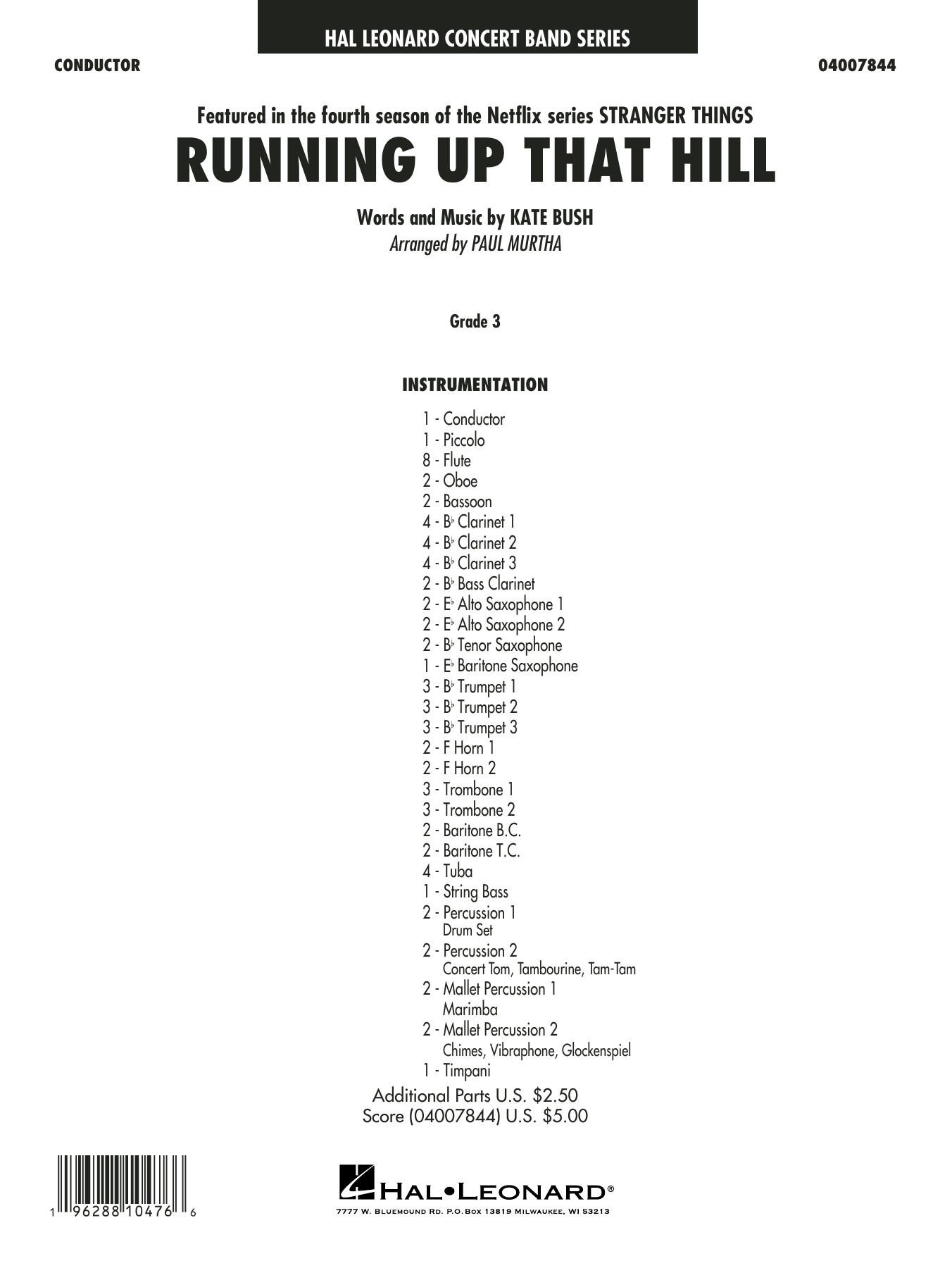

Running Up That Hill (from Stranger Things) (arr. Paul Murtha): Concert Band Conductor Score & Parts
As performed by Kate Bush / Arranged by Paul Murtha
Grade: 3
Item: 35-PK01128783
$65.00
Pickup currently not available
Buy Extra Parts (Digital PDF Download)
Parts Added to Cart!
Description
Featured as a recurring theme in season 4 of the popular series "Stranger Things," Kate Bush's classic rock hit from 1985 is again taking the pop world by storm. Here is a powerful setting for the concert stage.


Discover MakeMusic Cloud: thousands of interactive titles your students can play along with today.
Sample Audio
No sample audio found.
Sample Video
Additional Details
Publisher:
Hal Leonard
SKU:
35-PK01128783
More about this title
About the Artist: Kate Bush
Kate Bush emerged as one of rock's most inventive songwriters in the late 1970s, bringing theatrical sensibility and unconventional arrangements to the concert band repertoire through her original compositions. Her 1985 album "Hounds of Love" established her as an artist willing to experiment with production, texture, and narrative structure in ways that challenged pop conventions and continue to influence composers and arrangers today.
Why we love this
Murtha's setting captures the propulsive energy and orchestral sweep of the original without sacrificing the song's emotional core. Students connect immediately to material they already know from popular culture, which makes learning the chart feel purposeful rather than obligatory. The Grade 3 difficulty strikes a genuine balance: the arrangement demands musicianship and precision without becoming a technical obstacle.
What to expect
Urgent and soaring, built on hypnotic repetition that gradually opens into something larger and more anthemic. The arrangement moves with kinetic energy while maintaining the original's sense of yearning, creating a performance that feels both intimate and grand.
Who it's for
Concert bands at the Grade 3 level looking for contemporary repertoire with genuine appeal to students and audiences alike. Directors seeking a piece that bridges the gap between classroom learning and cultural relevance, sparking genuine enthusiasm without compromising musical standards.
How to get the most out of it
- Emphasize the rhythmic drive in the opening. This arrangement thrives on forward momentum, so lock the steady pulse with your rhythm section before layering in melodic voices.
- Balance the melody between sections rather than stacking it all in one voice. Murtha's voicing distributes the tune thoughtfully; resist the urge to double it and lose transparency.
- Find the dynamic shape of the whole piece, not just individual phrases. The arc from opening to climax should feel inevitable, not like a series of loud and soft moments.
- Attend to the sustaining harmonies in woodwinds and lower brass. They provide essential color and support that can disappear if players aren't listening for blend.
How to use it
Include this on a pops or contemporary concert alongside traditional band repertoire to demonstrate the full range of what your students can accomplish. It works equally well as a closer that leaves audiences energized or as a centerpiece demonstrating your band's versatility and musical breadth.
Skills your students will build
- Maintaining rhythmic precision in repetitive figures across multiple instruments
- Blending and balancing melody with sustaining harmonic voices
- Reading and executing dynamic shapes that span entire phrases rather than measure by measure
- Translating familiar melodic material into their own instrumental parts
- Responding to a contemporary arrangement style with mature ensemble awareness