
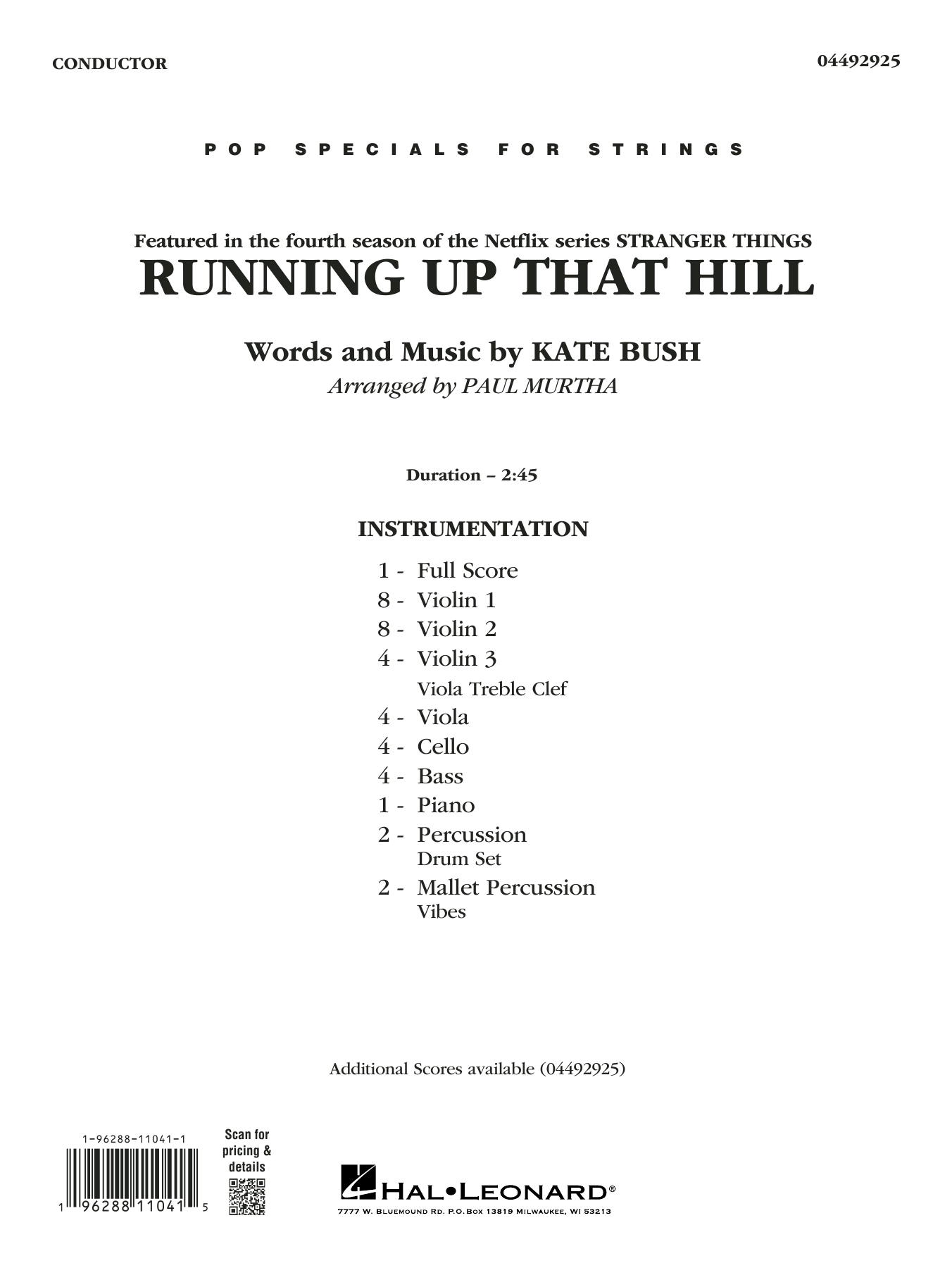

Running Up That Hill (arr. Paul Murtha): String Orchestra Conductor Score & Parts
As performed by Kate Bush / Arranged by Paul Murtha
Grade: 3-4
Item: 35-PK01293779
$55.00
Pickup currently not available
Buy Extra Parts (Digital PDF Download)
Parts Added to Cart!
Description
Due to its use in Stranger Things, the resurgence of this 1985 hit gives a new generation of musicians a chance to experience the power and emotion of Kate Bush's "Running Up That Hill" in this arrangement for string orchestra by Paul Murtha. With its driving rhythms and evocative atmosphere, "Running Up That Hill" will leave a lasting impact on performers and audiences alike. Elevate your repertoire with this powerful arrangement and create a memorable performance for performers and audience alike!


Running Up That Hill (arr. Paul Murtha): String Orchestra Conductor Score & Parts isn't in MakeMusic Cloud just yet...but it could be. Let us know you'd like to see it, and you'll help shape what comes next. In the meantime, start a free trial and dive into thousands of interactive titles your students can play along with today.
Request This Title
Tell us you want it.
Start Your Free Trial
Explore everything that's ready to play right now.
Sample Audio
No sample audio found.
Sample Video
No sample videos found.
Additional Details
Publisher:
Hal Leonard
SKU:
35-PK01293779
More about this title
About the Artist: Kate Bush
Kate Bush emerged as one of pop music's most innovative voices in the 1980s, crafting intricate arrangements and unconventional song structures that challenged mainstream radio expectations. Her 1985 album Hounds of Love produced "Running Up That Hill," a track that showcased her gift for layering synth textures with compelling vocal melodies and rhythmic complexity. For music educators, Bush's work represents a valuable entry point into how popular music can sustain artistic ambition and emotional depth without sacrificing accessibility.
Why we love this
Paul Murtha's orchestration captures what made the original compelling: the relentless forward momentum, the haunting melodic hooks, and the emotional vulnerability beneath the driving beat. Students connect immediately to material they recognize, but they're also learning how a skilled arranger translates synthesizer textures and production choices into string writing that feels both respectful and fresh. This is the kind of piece that reminds orchestras why they play.
What to expect
The arrangement captures the original's hypnotic quality: a constant rhythmic forward motion underneath soaring, yearning melodic lines. There's urgency here paired with introspection, the sense of striving for something just out of reach. Students will feel the intensity and emotion rather than simply reading notes on a page.
Who it's for
String orchestras working at the intermediate level (grades 3 to 4) who want to program contemporary music that resonates with students and audiences alike. This works equally well for directors seeking repertoire that bridges classical training with popular music literacy, or for ensembles looking to expand beyond traditional orchestra literature.
How to get the most out of it
- Establish the pulse early in sectional rehearsals. The rhythm underpins everything, and if that wavers, the entire arrangement loses its propulsive energy.
- Shape the dynamics around the vocal line's arc rather than playing mechanically from marking to marking. The strings should breathe with the emotional content, not against it.
- Balance the melodic material between first and second violins so neither section dominates. Both carry essential voices in this arrangement.
- Allow rubato in the exposed passages but lock in rigidly during the driving sections. That contrast between freedom and precision mirrors the song's emotional landscape.
How to use it
Consider programming this as a standout moment in a concert built around contemporary arrangements or popular music transcriptions. It works as a concert opener that immediately engages the audience or as a finale that sends people out with a memorable, singable melody. The emotional arc also makes it suitable for concerts exploring themes of perseverance or determination.
Skills your students will build
- Sustained rhythmic precision in driving, repetitive figures
- Dynamic control and shaping of orchestral lines
- Balancing principal melodic material across multiple voices
- Responding to harmonic color changes in contemporary arrangements
- Connecting to emotional content in non-traditional orchestral repertoire