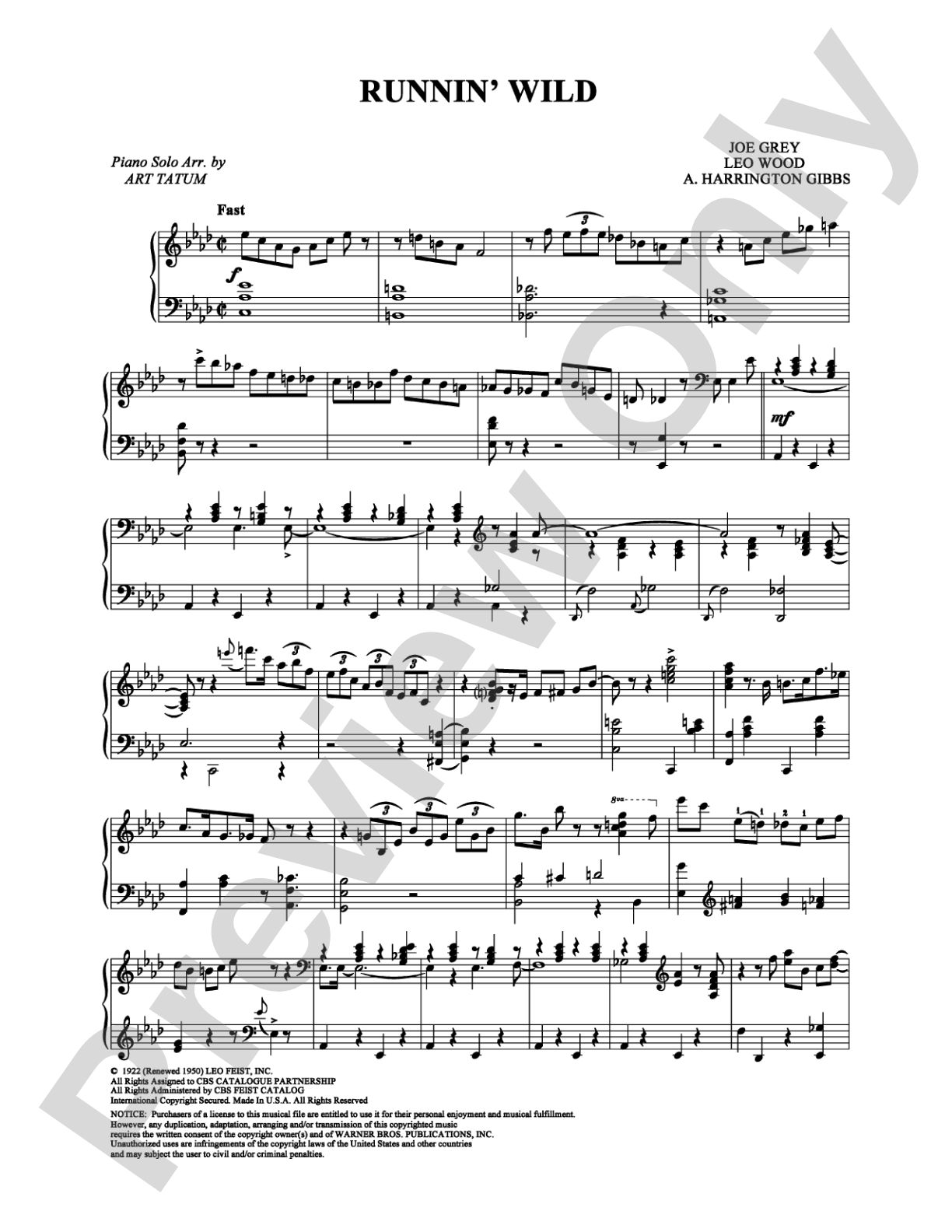
Runnin' Wild: Piano Digital Sheet Music

Runnin' Wild: Piano Digital Sheet Music

Art Tatum, Leo Wood, A. Harrington Gibbs, Joe Grey

Item: 00-PS-0009089

Digital Download
$3.99
Description

Runnin' Wild: Piano Digital Sheet Music isn't in MakeMusic Cloud just yet...but it could be. Let us know you'd like to see it, and you'll help shape what comes next. In the meantime, start a free trial and dive into thousands of interactive titles your students can play along with today.

Sample Audio
No sample audio found.
Sample Video
Additional Details
SKU: 00-PS-0009089

More about this title

About the Artist: Art Tatum

Art Tatum (1909-1956) remains one of the most technically brilliant and harmonically adventurous pianists in jazz history. His virtuosic command of the keyboard and fearless harmonic reharmonization transformed jazz piano from a supportive role into a solo art form, influencing generations of musicians across jazz, classical, and popular idioms.

Tatum's approach to standards like "Runnin' Wild" exemplifies his gift for reimagining familiar melodies through complex chord substitutions, rapid runs, and unexpected key areas. His recordings serve as masterclasses in swing-era jazz pianism and remain essential listening for anyone serious about understanding jazz vocabulary.

Why we love this

Tatum's interpretation of this standard is a masterclass in jazz sophistication. The piece demands serious keyboard chops and harmonic literacy, making it ideal for advanced pianists who want to study how a master musician reshapes a familiar tune through improvisation and reharmonization.

What to expect

Exhilarating and intellectually engaging. Tatum's version of "Runnin' Wild" crackles with harmonic sophistication and technical brilliance, moving through unexpected chord territories while maintaining the essential swagger and swing of the original melody. It feels less like a performance and more like a high-speed conversation between a master musician and the instrument.

Who it's for

This transcription is for advanced jazz pianists with strong classical technique and intermediate harmonic knowledge. It works well as a solo recital piece for serious students or as a model for studying jazz arranging and improvisation strategies at the collegiate level.

How to get the most out of it

  • Approach the rapid passagework with control rather than velocity alone. Tatum's speed serves the harmonic ideas, not the other way around; each run should articulate the underlying chord changes clearly.
  • Listen closely to Tatum's recordings multiple times before attempting to recreate his voicings. His chord substitutions often occur in unexpected places, and transcribing by ear trains your harmonic ear far better than reading notation alone.
  • Work through the more complex sections hands separately first, then gradually build coordination. The left hand's rhythmic independence and harmonic movement require independent facility.
  • Pay attention to Tatum's use of space and silence. Even within passages of tremendous technical density, he creates breathing room that makes the piece swing rather than rush.

How to use it

Feature this as a solo piece in a jazz recital or in a program celebrating jazz pianists and the evolution of swing-era interpretation. It pairs naturally with other Tatum transcriptions or with classical-period works that share similar keyboard virtuosity, creating a thematic conversation about technical mastery and musical intelligence.

Skills your students will build

  • Reading complex harmonic substitutions and reharmonized chord progressions
  • Developing independence between hands in rapid passagework and syncopated rhythms
  • Understanding jazz swing feel and articulation through transcription study
  • Building left-hand facility with walking bass lines and sophisticated voicings
  • Analyzing and internalizing how a soloist reimagines standard melody through improvisation

You May Also Like