

Run, Run to Bethlehem: SATB Choral Octavo
Music by Jay Althouse
Item: 00-PO-0004258
$2.25
Minimum order quantity: 20 copies
Pickup currently not available
Description
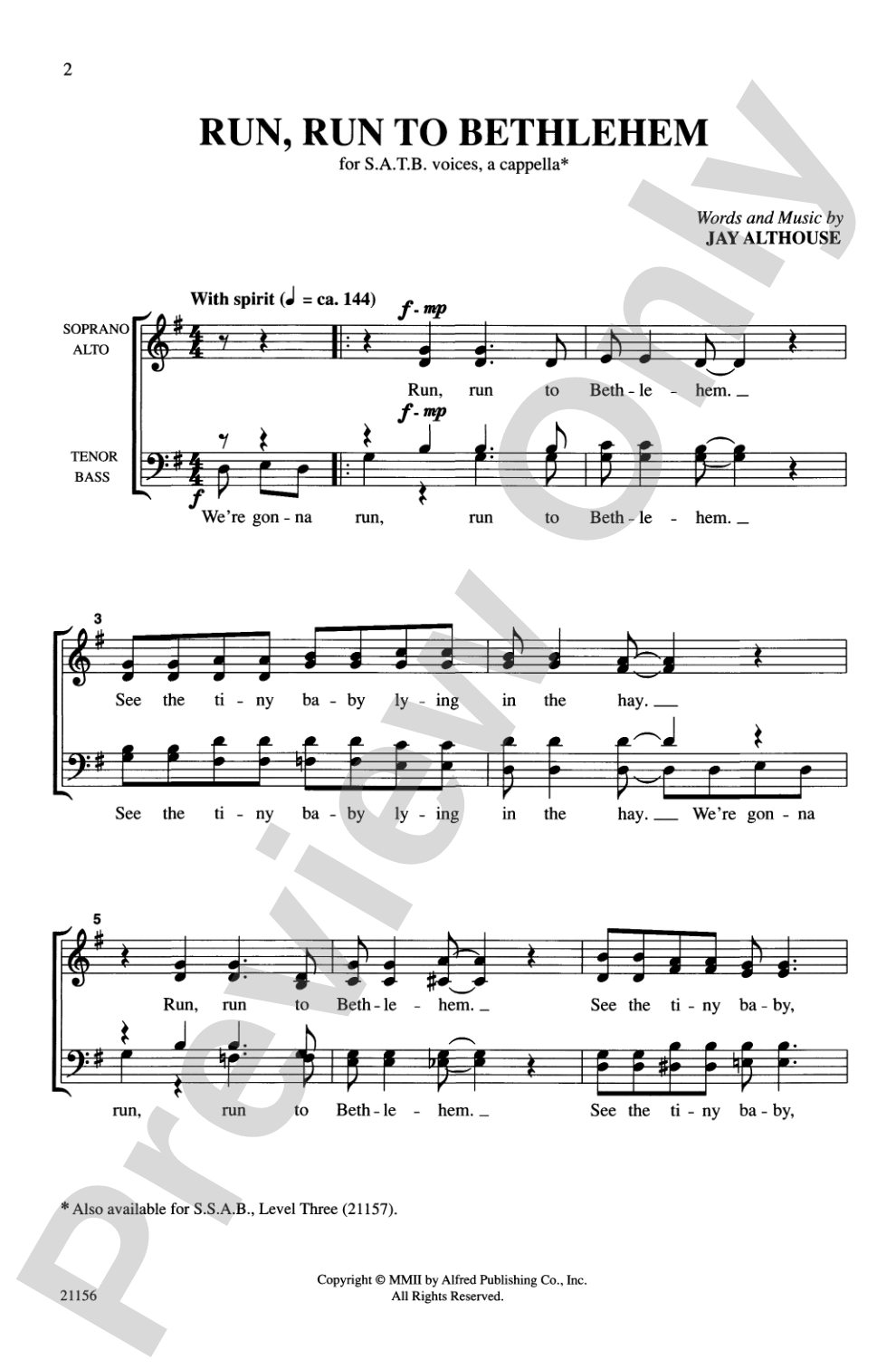
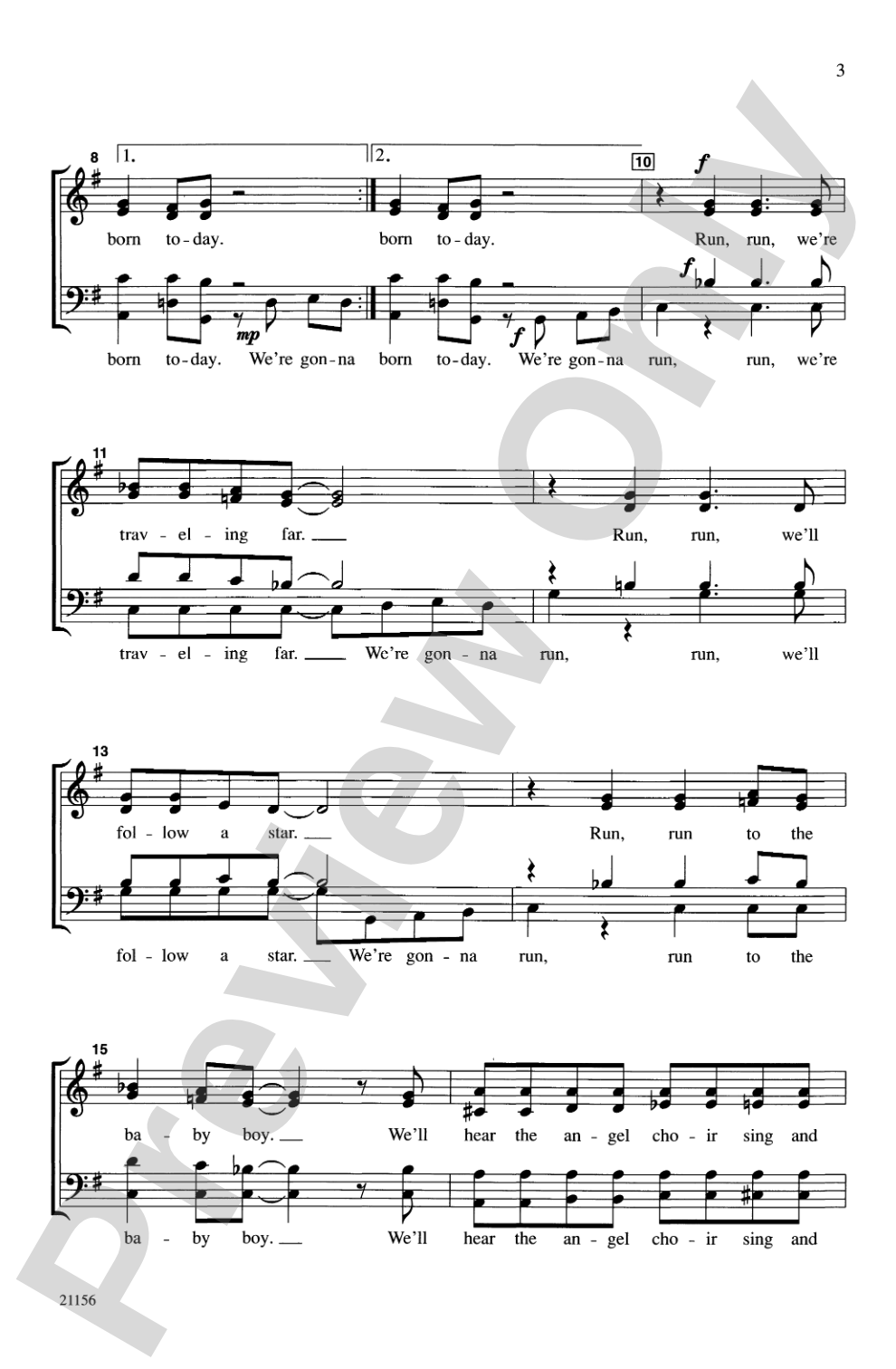
Another brilliant Christmas spiritual from Jay Althouse. "Run, run to Bethlehem. See the tiny baby lying in the hay." The melody practically sings itself, the steady, even rhythms drive the piece forward, and dynamic changes add excitement. A contrasting middle section adds a different dimension before a return to the opening melody and a closing section in which each voice is added on to the men's melody. "Baby born today!"


Run, Run to Bethlehem: SATB Choral Octavo isn't in MakeMusic Cloud just yet...but it could be. Let us know you'd like to see it, and you'll help shape what comes next. In the meantime, start a free trial and dive into thousands of interactive titles your students can play along with today.
Request This Title
Tell us you want it.
Start Your Free Trial
Explore everything that's ready to play right now.
Sample Audio
1
Audio File
--:--
0:00
0:00
Sample Video
No sample videos found.
Additional Details
Series:
Alfred Archive Edition: Alfred Choral Designs
Publisher:
Alfred Music
Page Count:
12
SKU:
00-PO-0004258
More about this title
About the Composer: Jay Althouse

Jay Althouse holds degrees in Music Education and Music from Indiana University of Pennsylvania, where he was honored as a Distinguished Alumnus. Early in his career, he spent eight years managing rights and licenses for a major educational music publisher, during which he served on the Executive Board of the Music Publishers Association of America. Today, his catalog includes more than 800 choral compositions performed internationally, and he is a writer member of ASCAP, consistently recognized with the ASCAP Special Award.
Beyond composing, Althouse has co-written children's musicals with his wife Sally K. Albrecht, curated and arranged vocal solo collections including Folk Songs for Solo Singers, and authored or co-authored influential resources for music teachers: The Complete Choral Warm-up Book, Accent on Composers, Ready to Read Music, Sixty Music Quizzes, and One-Page Composer Bios. He collaborated with Albrecht on I Hear America Singing, performed by the San Francisco Girls and Boys Choirs at President Barack Obama's 2009 Inauguration. Based in Wake Forest, North Carolina, he has been active in the North Carolina Master Chorale and currently serves on the National Advisory Board of the Folk Art Society of America.
Why we love this
Althouse understands what makes a Christmas spiritual work in rehearsal and concert: a melody that doesn't fight your singers, rhythmic drive that maintains momentum, and strategic dynamics that build energy naturally. The contrasting middle section prevents this from feeling one-dimensional, while the layered ending (voices added over the men's melody) gives your ensemble a satisfying moment of collective sound without requiring complex independence.
What to expect
The piece radiates the simple joy of the nativity story told through an accessible, singable melody that feels inevitable once you know it. The steady rhythms and bright text create forward momentum, while the dynamic and sectional contrasts ensure the piece remains engaging across its arc rather than settling into a single emotional register.
Who it's for
This arrangement fits well in the hands of intermediate to advanced choral ensembles comfortable with SATB voicing and looking for fresh Christmas material that doesn't rely on oversaturated arrangements. Directors seeking a spiritual with clear melodic accessibility and genuine musical interest will find this particularly useful for mixed choirs aiming to balance warmth and sophistication in their holiday programming.
How to get the most out of it
- Keep the steady rhythm crisp and forward-moving through the opening section; the piece's momentum comes from rhythmic clarity, not tempo acceleration.
- Shape the dynamic changes as markers of musical architecture rather than emotional peaks; let the shifts between sections define form.
- In the closing section, balance each voice part as it enters over the men's melody so the layering builds texture without muddying the foundational line.
- Encourage singers to connect with the text's simplicity and directness; the childlike imagery benefits from genuine, unforced delivery.
How to use it
This works beautifully as an anchor piece in a Christmas concert, particularly when programmed alongside carols or other spirituals to showcase variety within the genre. The twelve-page length and intermediate accessibility make it suitable for mid-year holiday concerts without overcommitting rehearsal time, and its appeal to both singers and audiences makes it an excellent choice for community performances or interfaith holiday events.
Skills your students will build
- Maintaining steady pulse and rhythmic independence in SATB texture
- Blending four-part harmony with clear voice leading
- Responding to dynamic marking changes and shaping phrase energy accordingly
- Layering independent melodic lines (the closing section technique)