
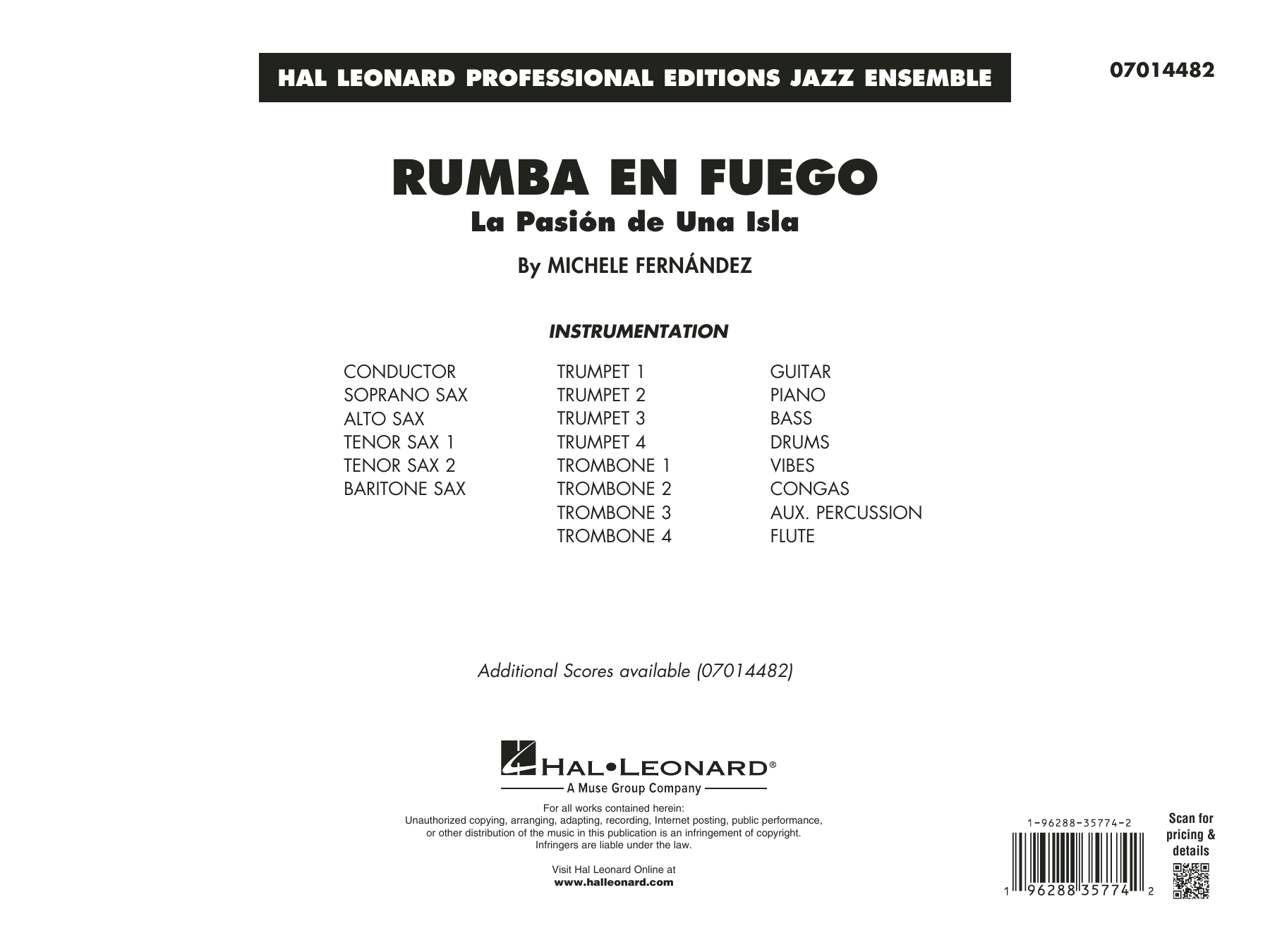

Rumba En Fuego: Jazz Ensemble Conductor Score & Parts
By Michele Fernández
Grade: 5-6
Item: 35-PK01713714
$65.00
Pickup currently not available
Buy Extra Parts (Digital PDF Download)
| Product | Price | Quantity |
|---|---|---|
| Rumba En Fuego - Conductor Score (Full Score) | $7.50 | |
| Rumba En Fuego - Soprano Sax | $6.00 | |
| Rumba En Fuego - Alto Sax | $6.00 | |
| Rumba En Fuego - Tenor Sax 1 | $6.00 | |
| Rumba En Fuego - Tenor Sax 2 | $6.00 | |
| Rumba En Fuego - Baritone Sax | $6.00 | |
| Rumba En Fuego - Trumpet 1 | $6.00 | |
| Rumba En Fuego - Trumpet 2 | $6.00 | |
| Rumba En Fuego - Trumpet 3 | $6.00 | |
| Rumba En Fuego - Trumpet 4 | $6.00 | |
| Rumba En Fuego - Trombone 1 | $6.00 | |
| Rumba En Fuego - Trombone 2 | $6.00 | |
| Rumba En Fuego - Trombone 3 | $6.00 | |
| Rumba En Fuego - Trombone 4 | $6.00 | |
| Rumba En Fuego - Guitar | $6.00 | |
| Rumba En Fuego - Piano | $6.00 | |
| Rumba En Fuego - Bass | $6.00 | |
| Rumba En Fuego - Drums | $6.00 | |
| Rumba En Fuego - Vibes | $6.00 | |
| Rumba En Fuego - Congas | $6.00 | |
| Rumba En Fuego - Aux Percussion | $6.00 | |
| Rumba En Fuego - Flute | $6.00 |
Parts Added to Cart!
Description
The Rumba is one of the most iconic and infectious forms of Afro-Cuban music, and this incendiary chart packs an intense punch on both ends of an elegant and era-nostalgic woodwind feature. As always, the composer offers a carefully notated rhythm section with concise and helpful notes to help players achieve the kind of authentic performance that will leave the audience unable to sit still. The recording is courtesy of the GiraSoul Studio Jazz Orchestra, directed by the composer.


Rumba En Fuego: Jazz Ensemble Conductor Score & Parts isn't in MakeMusic Cloud just yet...but it could be. Let us know you'd like to see it, and you'll help shape what comes next. In the meantime, start a free trial and dive into thousands of interactive titles your students can play along with today.
Request This Title
Tell us you want it.
Start Your Free Trial
Explore everything that's ready to play right now.
Sample Audio
No sample audio found.
Sample Video
No sample videos found.
Additional Details
Publisher:
Hal Leonard
SKU:
35-PK01713714
More about this title
About the Composer: Michele Fernández
Michele Fernández is a composer and arranger with deep roots in Latin jazz and Afro-Cuban music traditions. His work consistently demonstrates a commitment to authentic rhythmic notation and accessible pedagogy, making complex Cuban forms learnable for student ensembles without sacrificing musical integrity.
Why we love this
Fernández writes with genuine respect for the rumba form, which means your students aren't just playing jazz with Latin flavor—they're learning the real thing. The woodwind feature sits perfectly for high school players, and his detailed rhythm section notes remove the guesswork that usually derails Latin ensemble performances.
What to expect
Propulsive and celebratory. The rumba's characteristic clave pattern gives the piece a buoyant, almost irresistible forward motion, while the elegant woodwind writing adds sophistication to what could otherwise feel purely rhythmic.
Who it's for
Grade 5 and 6 jazz ensembles ready for Latin repertoire that demands more from the rhythm section than typical swing charts. This works for concert programming, jazz festival competition, and directors who want their students to develop cultural competency alongside technical skill.
How to get the most out of it
- Study the rhythm section notes before rehearsal begins. Fernández provides specific guidance on feel and articulation that transforms how the drums, bass, and piano lock together.
- Lock the clave early. Get your ensemble comfortable with the underlying rhythmic foundation before layering the woodwind melodies, which will sit much more naturally once that anchor is solid.
- Balance the woodwind feature against the rhythm section energy. This chart has plenty of punch in the accompaniment; bring the saxes and trombones forward without drowning out the percussion.
- Record the ensemble frequently. Playback reveals timing issues and feel that sound fine in the room but flatten on tape. Use the GiraSoul Studio recording as an ear-training reference.
How to use it
Pair this as a second-half centerpiece on a jazz concert, where it can anchor a set of Latin-inspired repertoire or stand alone as a showstopper between swing-era standards. It's equally effective as a festival selection that stands apart from typical big band fare.
Skills your students will build
- Understanding clave-based rhythm and its role as a structural anchor
- Performing authentic Afro-Cuban rhythmic feels with precision
- Balancing written melody against complex underlying grooves
- Reading and executing carefully notated syncopated ensemble lines
- Listening to rhythm section parts as a unified layer rather than individual voices