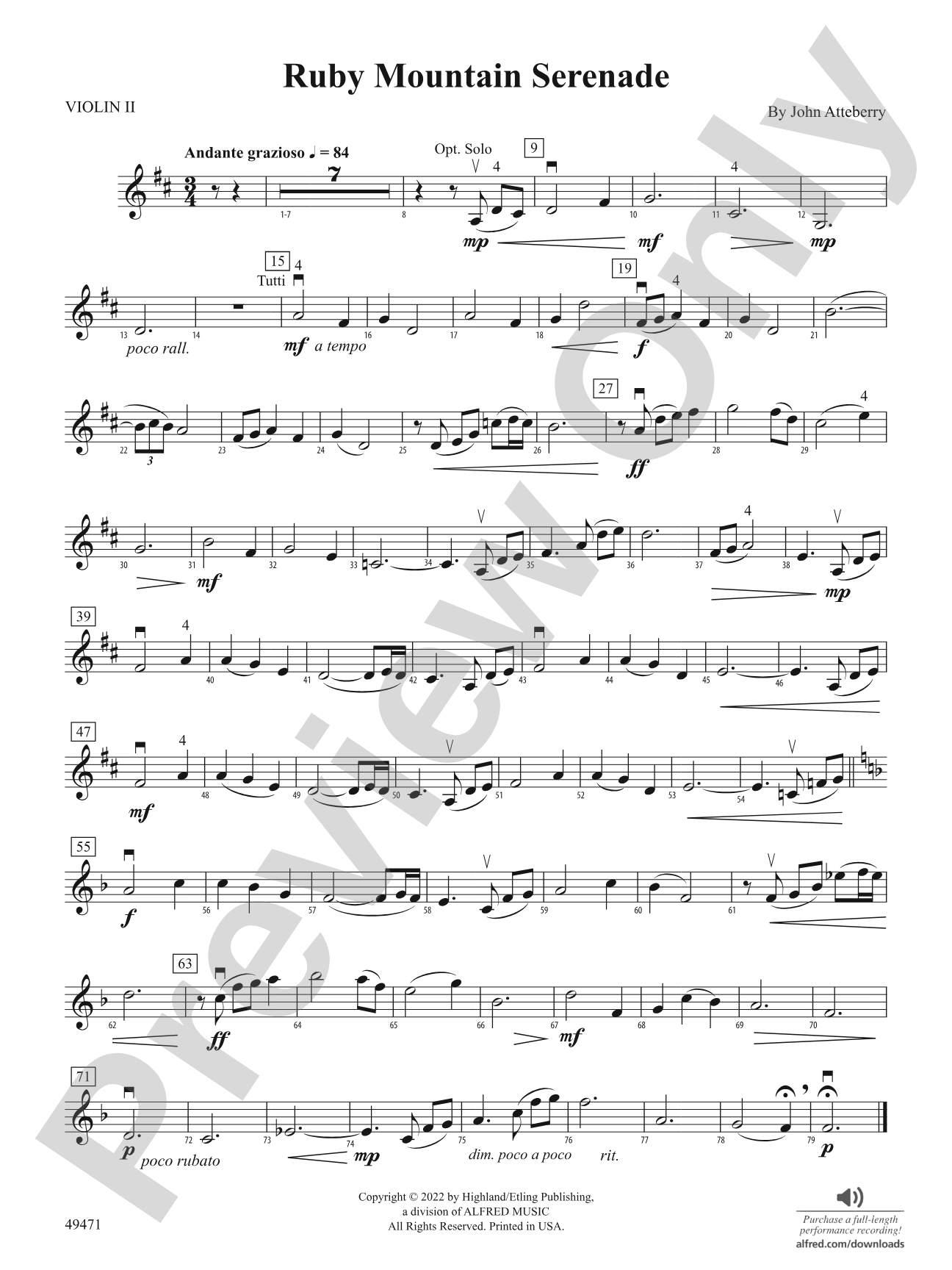
Ruby Mountain Serenade: 2nd Violin Sheet Music Preview

Ruby Mountain Serenade: 2nd Violin

By John Atteberry

Grade: 3

Item: 00-PC-0018789_VN2

Digital Download
$3.00
Description
The folk-like tune of Ruby Mountain Serenade may seem familiar but is in fact an original tune from composer John Atteberry. Beginning in D major, this graceful tone poems opens intimately, with optional soloists from each section. Following the introduction, all sections of the orchestra work to guide the music through statements of the primary and secondary themes, leading to a smooth modulation to F major and an emotional climax. A great opportunity for young musicians to explore programmatic music. (3:00) This title is available in MakeMusic Cloud.

Don't just read it, hear it, play along with it, and watch your students grow with it. In MakeMusic Cloud, Ruby Mountain Serenade: 2nd Violin comes alive with professional accompaniment, adjustable tempo, and built-in practice tools that turn solo practice into real progress.

Sample Audio
0:00
0:00
Sample Video
Additional Details
Series: Highland String Orchestra (HSO)
Publisher: Alfred Music
SKU: 00-PC-0018789_VN2

More about this title

About the Composer: John Atteberry

John Atteberry has established himself as a composer and arranger deeply invested in expanding the string orchestra repertoire for student musicians. His works balance accessibility with musical substance, creating pieces that challenge young players while remaining genuinely enjoyable to perform.

Why we love this

Atteberry's gift for melody shines here, and the optional solos create natural leadership opportunities across your string sections without requiring advanced technique. The programmatic arc from intimacy through modulation to climax gives young orchestras a real compositional structure to follow, making this ideal for developing musical maturity at Grade 3.

What to expect

Ruby Mountain Serenade unfolds like a gentle story, opening with intimate voices before the full orchestra joins to develop and expand the musical narrative. The melodic language feels timeless and graceful, grounded in folk idiom yet distinctly original, while the emotional trajectory builds naturally from quiet reflection to a satisfying peak.

Who it's for

String orchestras at the Grade 3 level looking for repertoire that balances accessibility with musical substance. Directors seeking a piece that teaches programmatic thinking and offers solo opportunities without singling out advanced players will find this especially valuable.

How to get the most out of it

  • Shape the opening section with care. The optional soloists should play with confidence and warmth, setting the tone for the full orchestra entrance that follows.
  • Mark the modulation to F major clearly in rehearsal. Young musicians often lose awareness of key changes; highlight this moment so the shift feels intentional rather than accidental.
  • Balance the secondary theme against the primary theme during their statements. Both deserve clarity, but avoid letting the energy flatten when material repeats.
  • Build gradually toward the emotional climax. This requires conductor leadership and sectional awareness of the overall arc, not just note-to-note execution.

How to use it

This works beautifully as a middle concert piece where it can breathe between faster or more energetic selections. Its three-minute length and programmatic character make it ideal for a spring or fall festival program, and the optional solo features give section leaders a moment in the spotlight without requiring a full concerto.

Skills your students will build

  • Responding to programmatic structure and emotional arc in orchestral writing
  • Managing key changes and modulations within a lyrical context
  • Balance and blend when multiple sections carry thematic material simultaneously
  • Solo responsibility and leadership (for section soloists in the optional passages)

You May Also Like