Ruby, Don't Take Your Love To Town Sheet Music Preview

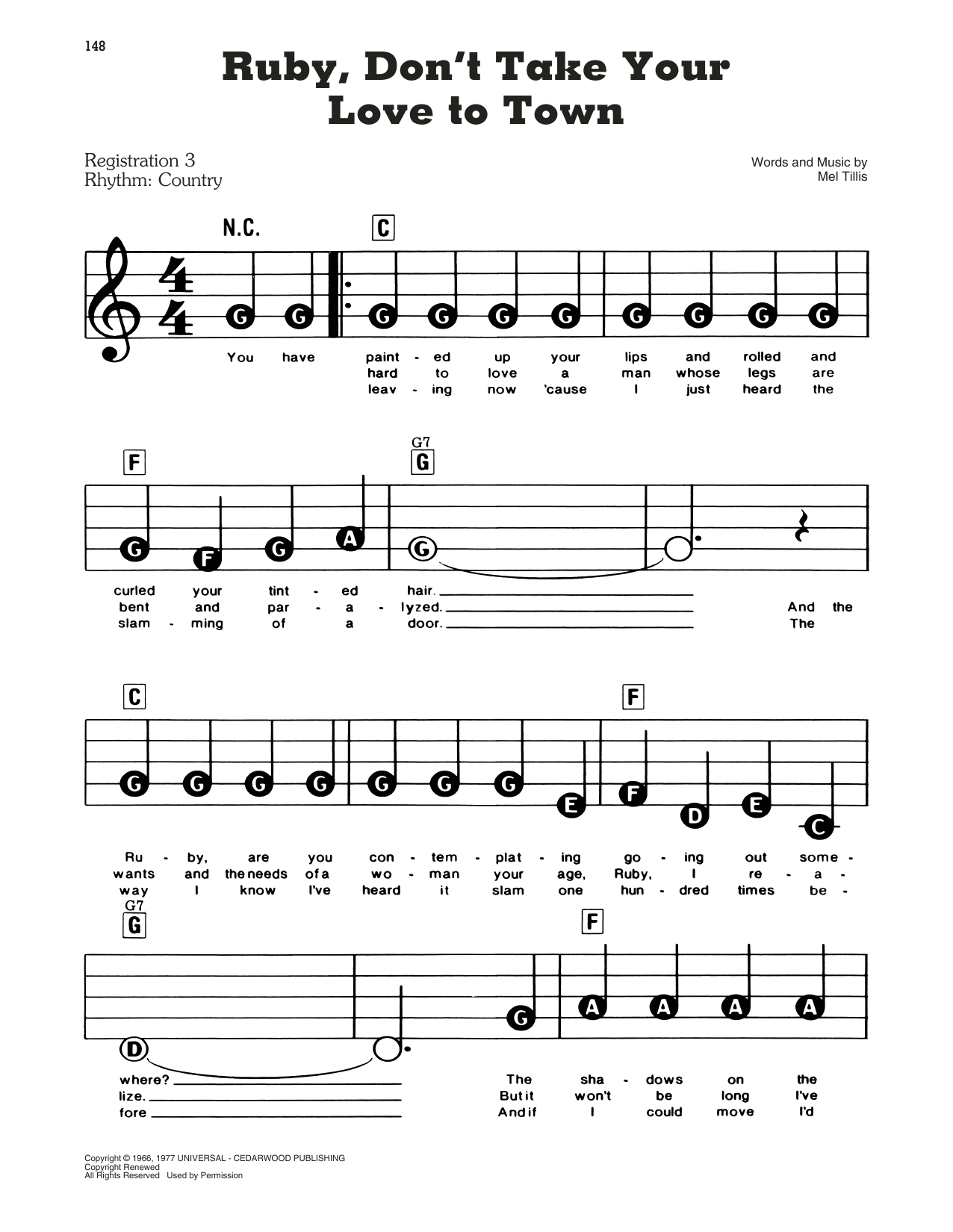
Ruby, Don't Take Your Love To Town: E-Z Play Today

As performed by Kenny Rogers

Item: 35-DS00460540

Digital Download
$4.99
Description

Ruby, Don't Take Your Love To Town: E-Z Play Today isn't in MakeMusic Cloud just yet...but it could be. Let us know you'd like to see it, and you'll help shape what comes next. In the meantime, start a free trial and dive into thousands of interactive titles your students can play along with today.

Sample Audio
No sample audio found.
Sample Video
Additional Details
Publisher: Hal Leonard
Page Count: 4
SKU: 35-DS00460540

More about this title

About the Artist: Kenny Rogers

Kenny Rogers became one of the most recognizable voices in American music by blending country, pop, and folk sensibilities into deeply human storytelling. His career spanning five decades produced some of the most covered songs in popular music, with "Ruby, Don't Take Your Love To Town" standing as a narrative masterpiece that showcases his gift for emotional authenticity and lyrical depth.

Rogers' influence on music education extends beyond his chart success; his songs teach students how to serve a story through phrasing, dynamics, and restraint. His interpretive choices demonstrate that technical mastery matters far less than understanding the emotional weight of every line.

Why we love this

This arrangement captures the quiet heartbreak of Rogers' original without requiring a full band setup. The straightforward piano voicings give students room to shape the melody and really inhabit the character of the song, making it an excellent choice for teaching how to convey narrative and emotion through instrumental performance.

What to expect

Tender and achingly human. The arrangement holds space for regret and resignation without becoming maudlin, inviting players and listeners into the interior world of someone facing the end of love with quiet dignity. There's a gentleness here that makes the song's sadness feel even more real.

Who it's for

This works beautifully for intermediate pianists who want to explore storytelling through accompaniment, or for vocalists seeking a piano arrangement that respects the emotional core of the song. It's equally valuable for music theory students studying how a simple harmonic progression can support profound lyrical content.

How to get the most out of it

  • Allow rubato in the vocal melody line; the storytelling matters more than metronomic precision, particularly in the verses where the character's vulnerability is most exposed.
  • Voice the piano part with attention to bass note clarity, since the left hand often carries the harmonic foundation that would normally come from a fuller arrangement.
  • Let silence breathe between phrases. This isn't a song that benefits from filling every space with sound.
  • Balance dynamic restraint with intention; the power here comes from knowing when not to play, not from overwhelming volume.

How to use it

Consider programming this in a concert or recital exploring American songwriting across genres, where it can stand beside art songs and traditional repertoire. It also serves as an excellent teaching piece for intermediate piano students working on expressive playing and song arrangement, or as an accompaniment vehicle for vocalists developing their interpretive skills.

Skills your students will build

  • Expressive phrasing and rubato in a contemporary context
  • Balancing melody and accompaniment
  • Interpreting narrative song structure
  • Dynamic control and use of silence
  • Translating lyrical meaning into instrumental performance

You May Also Like