
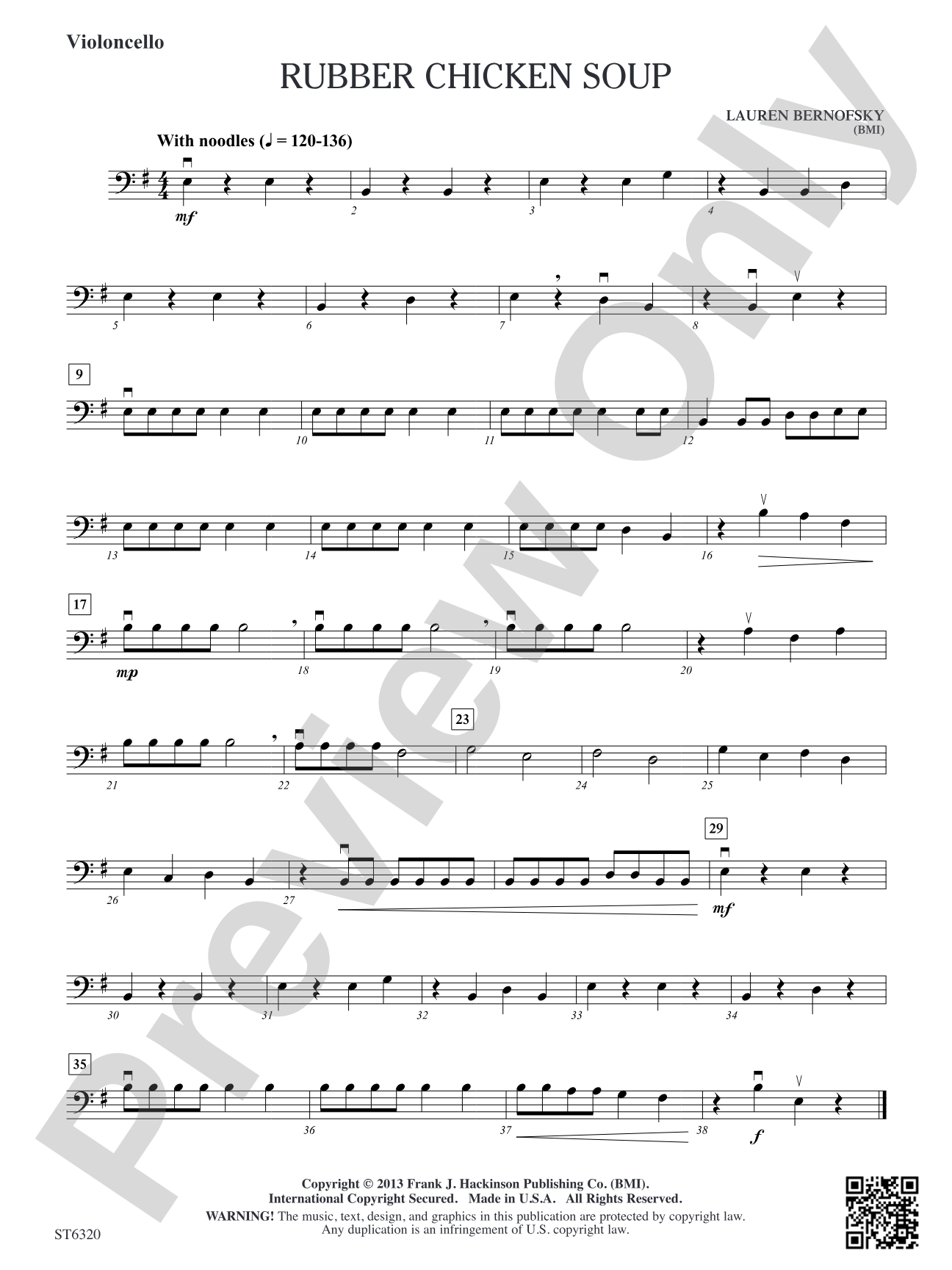

Rubber Chicken Soup: Violoncello
By Lauren Bernofsky
Grade: 1
Item: 98-PC-DST6320_VC1
$7.00
Pickup currently not available
Description
Based on the rhythm of the words "Rubber Chicken Soup" (four eighth notes and a quarter note), this delightful novelty has a wealth of teaching and musical applications. This piece is not only ideal to teach eighth notes-it also features many opportunities to practice retakes. Note: no rubber chickens were harmed in the creation of this piece.


Rubber Chicken Soup: Violoncello isn't in MakeMusic Cloud just yet...but it could be. Let us know you'd like to see it, and you'll help shape what comes next. In the meantime, start a free trial and dive into thousands of interactive titles your students can play along with today.
Request This Title
Tell us you want it.
Start Your Free Trial
Explore everything that's ready to play right now.
Sample Audio
1
Audio File
--:--
0:00
0:00
Sample Video
No sample videos found.
Additional Details
Series:
FJH Beginning Strings
Publisher:
The FJH Music Company, Inc.
SKU:
98-PC-DST6320_VC1
More about this title
About the Composer: Lauren Bernofsky

Lauren Bernofsky has composed over a hundred works across solo, chamber, orchestral, operatic, and ballet repertoire. Lukas Foss called her "a master composer," and her music consistently balances emotional depth with intellectual rigor, blending technical and lyrical elements of contemporary composition. Her Sonatine won the National Flute Association's Newly Published Music Competition, and her opera Mooch the Magnificent earned the Opera Puppets Award at Boston Metro Opera. Her choral work Prayer of Shantideva, winner of the Dalai Lama Composition Contest, premiered at a service honoring the Dalai Lama, who reportedly was "enchanted" with the piece.
Bernofsky holds degrees from The Hartt School (Bachelor's in violin and composition), New England Conservatory (Master's in composition), and Boston University (Doctor of Musical Arts in composition). She has taught at the Peabody Institute and Interlochen Center for the Arts, and her works have been commissioned by orchestras, ballets, and chamber ensembles across the country. Her string quartet Anacostia Journal appeared on PBS's NOW with Bill Moyers, and her Concerto for Trumpet and Orchestra has been featured in the International Trumpet Guild journal.
Why we love this
Bernofsky turns a simple rhythmic phrase into a springboard for genuine teaching moments. The piece delivers exactly what Grade 1 orchestras need to solidify eighth-note reading and practice coordinated ensemble entrances, all wrapped in a fun, memorable package that keeps rehearsals light without sacrificing musical substance.
What to expect
Bouncy and whimsical, with an infectious energy that comes from the four tight eighth notes landing on the quarter-note pulse. The repetition feels playful rather than tedious, and there's genuine charm in a melody built entirely around a silly phrase that students won't forget.
Who it's for
Beginning string orchestras at the Grade 1 level who are solidifying their grasp of eighth-note patterns and building the habit of responding to conductor cues for ensemble attacks and releases. It works equally well for teachers seeking a concert piece that reinforces core rhythmic and technical fundamentals without feeling like drill work.
How to get the most out of it
- Isolate the "Rubber Chicken Soup" rhythm as a warm-up before each rehearsal. Have your orchestra speak the syllables as written, then play the rhythm in unison to build automaticity before addressing parts.
- Use the multiple retake opportunities as chances to reinforce conductor independence. Rather than stopping the group, conduct a clear cutoff and restart from a specific measure to build awareness of your stick technique.
- Balance the playfulness with intonation work during the sustained quarter-note arrivals. These moments give the strings time to settle into pitch, so don't rush through them.
- Rehearse the transitions between phrases with focus on bow placement and weight distribution. The novelty appeal comes through when the ensemble moves together cleanly, not tentatively.
How to use it
Open a concert with this to set a warm, approachable tone, or place it mid-program as a palate-cleanser between more serious repertoire. Its novelty appeal makes it an excellent opening rehearsal piece at the start of the school year when the ensemble is still building confidence.
Skills your students will build
- Reading and executing eighth-note rhythms in a musical context
- Responding to conductor cues for ensemble entrances and cutoffs
- Coordinating rhythmic attacks across the string section
- Sustaining tone quality and intonation on longer note values
- Building rhythmic independence and confidence in an ensemble setting