
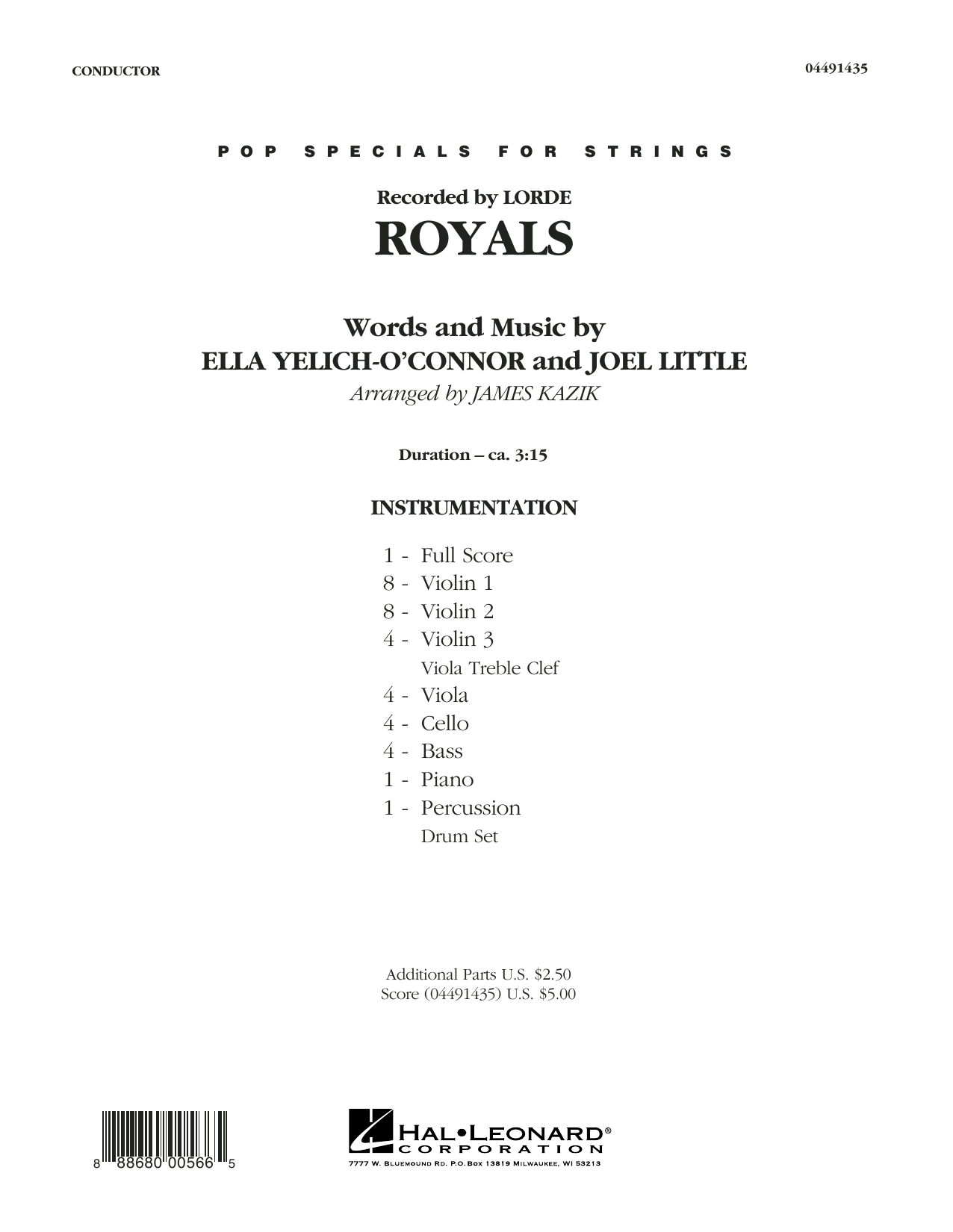

Royals: String Orchestra Conductor Score & Parts
As performed by Lorde / As performed by Joel Little / As performed by Ella Yelich-O'Connor / Arranged by James Kazik
Grade: 3-4
Item: 35-PK00308695
$55.00
Pickup currently not available
Buy Extra Parts (Digital PDF Download)
| Product | Price | Quantity |
|---|---|---|
| Royals - Conductor Score (Full Score) | $6.00 | |
| Royals - Violin 1 | $7.00 | |
| Royals - Violin 2 | $7.00 | |
| Royals - Violin 3 (Viola Treble Clef) | $7.00 | |
| Royals - Viola | $7.00 | |
| Royals - Cello | $7.00 | |
| Royals - Bass | $7.00 | |
| Royals - Piano | $7.00 | |
| Royals - Percussion | $7.00 |
Parts Added to Cart!
Description
The Grammy-winning hit from pop music's fresh new artist, Lorde. James Kazik's solid arrangement is designed for accessibility for most any group. The contemporary modal harmony and easy, pop-style rhythms make it a super hit for today's students.
Dur: 3:15


Royals: String Orchestra Conductor Score & Parts isn't in MakeMusic Cloud just yet...but it could be. Let us know you'd like to see it, and you'll help shape what comes next. In the meantime, start a free trial and dive into thousands of interactive titles your students can play along with today.
Request This Title
Tell us you want it.
Start Your Free Trial
Explore everything that's ready to play right now.
Sample Audio
No sample audio found.
Sample Video
No sample videos found.
Additional Details
Publisher:
Hal Leonard
SKU:
35-PK00308695
More about this title
About the Artist: Lorde
Ella Yelich-O'Connor, known professionally as Lorde, emerged as a defining voice of her generation with her 2013 debut album Pure Heroine. Her production approach, developed alongside collaborator Joel Little, blends minimalist production with introspective lyrics and innovative pop songwriting. Working with Kazik's arrangement, her original composition becomes an accessible entry point for young string players into contemporary music.
Lorde's influence on popular music education extends beyond her commercial success. Her willingness to work with arrangers like James Kazik has made her catalog a resource for directors seeking music that resonates with today's students while maintaining musical integrity.
Why we love this
This arrangement captures what makes Lorde's songwriting so effective for young ensembles: restrained, sophisticated harmony married to unfussy rhythmic grooves. James Kazik understood exactly where to ask for simplicity and where to let the strings shine, resulting in a piece that sounds contemporary without demanding virtuosity. Your students will feel the coolness of the original while building genuine musical literacy around modal harmony and ensemble balance.
What to expect
Cool, sparse, and haunting. The modal harmony creates an almost ethereal quality, floating above minimal rhythmic movement. At three minutes and fifteen seconds, it pulses with the confidence of a hit single while maintaining an introspective, measured attitude that feels both current and timeless.
Who it's for
String orchestras at the intermediate level (grades 3 and above) seeking contemporary repertoire that excites students without exceeding technical capacity. Teachers who want to bridge the gap between classical training and the music their students actually listen to will find this invaluable.
How to get the most out of it
- Keep the modal harmony transparent. The open, empty quality of the piece depends on clean voice leading, not lush thickness. Encourage careful intonation in the suspended sonorities.
- Establish the groove early in rehearsal. The pop-style rhythmic feel requires relaxed precision rather than classical rigidity. Listen to the original recording to calibrate the pocket.
- Shape phrases in long arcs despite the short duration. Avoid choppy articulation; let the melodic lines breathe across bar lines and harmonic shifts.
- Balance melody and texture layers carefully. Make sure inner voices (typically violas and second violins) don't disappear or overshadow the primary line.
How to use it
Place this on a concert where it can anchor a "contemporary voices" or "music of today" segment, pairing it with other pop or film music arrangements to show range. The accessible difficulty makes it ideal for a mid-year or spring performance when students have built foundational ensemble skills but before major concerto or symphony repertoire. A single contemporary piece can reshape how an audience perceives what string orchestras can do.
Skills your students will build
- Reading and performing modal harmony (particularly minor chords built on degrees other than the root)
- Maintaining consistent rhythmic groove under sustained harmonic changes
- Balancing transparent voice leading across multiple string sections
- Connecting classical string technique to contemporary popular music contexts
- Ensemble intonation in minimal textured settings where inaccuracy is immediately audible