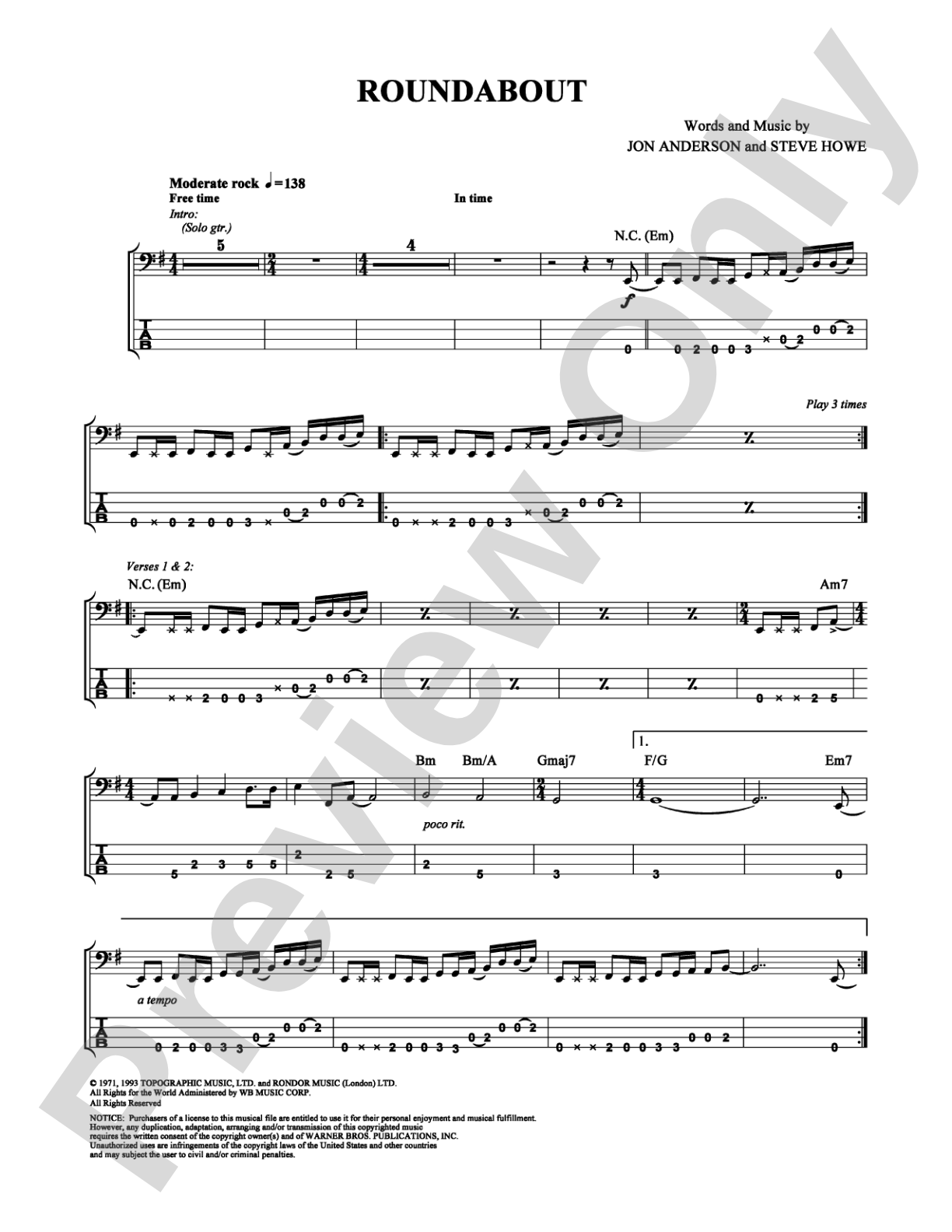
Roundabout: Bass TAB Digital Sheet Music

Roundabout: Bass TAB Digital Sheet Music

Jon Anderson, Yes, Steve Howe

Item: 00-PS-0002293

Digital Download
$2.99
Description

Roundabout: Bass TAB Digital Sheet Music isn't in MakeMusic Cloud just yet...but it could be. Let us know you'd like to see it, and you'll help shape what comes next. In the meantime, start a free trial and dive into thousands of interactive titles your students can play along with today.

Sample Audio
No sample audio found.
Sample Video
Additional Details
SKU: 00-PS-0002293

More about this title

About the Artist: Yes

Yes emerged from the British progressive rock scene in the late 1960s and became one of the defining bands of the genre. Their intricate arrangements, layered harmonies, and virtuosic instrumental work set a new standard for complexity in rock music. The band's impact on bass playing specifically, through Chris Squire's innovative technique and tone, helped establish the bass guitar as a lead melodic voice rather than merely a rhythm section anchor.

Why we love this

This track offers bass players a masterclass in serving complex harmony while maintaining groove. The TAB format makes the famous Jon Anderson vocal melody and the intricate chord changes accessible to players learning through tablature, opening a gateway to progressive rock's architectural approach to bass lines.

What to expect

Buoyant and architectural. The bass line balances melodic interest with harmonic responsibility, creating a sense of forward motion that never feels rushed. There's an elegance to the phrasing, as if the instrument is conversing with the keyboards and strings rather than anchoring them.

Who it's for

Bass players tackling progressive rock for the first time, or intermediate players ready to explore how bass interacts with complex harmonic structures. This transcription bridges the gap between rock repertoire and the rhythmic and harmonic literacy that progressive music demands.

How to get the most out of it

  • Study the recorded version to internalize the tempo and phrasing; the bass line breathes with the arrangement rather than driving it mechanically
  • Lock the opening riff's timing precisely, as it establishes the harmonic foundation for everything that follows
  • Pay attention to dynamic shaping in the chorus sections; subtle variations in attack keep the line conversational rather than monotonous across repeated cycles
  • Use the key signature and chord changes as guideposts rather than relying on TAB alone; understanding the harmonic movement strengthens your musical interpretation

How to use it

Include this in a contemporary or popular music ensemble concert to show audiences how bass playing evolved within rock. It works well alongside other 1970s rock selections or as a stepping stone for students exploring the intersection of rock and progressive music.

Skills your students will build

  • Reading TAB notation alongside standard notation
  • Playing syncopated bass lines that interact with complex chord changes
  • Maintaining steady pulse while navigating harmonic movement across multiple octaves
  • Interpreting dynamic and tonal nuance in a recorded rock arrangement
  • Recognizing melodic contour in bass lines beyond simple root movement

You May Also Like