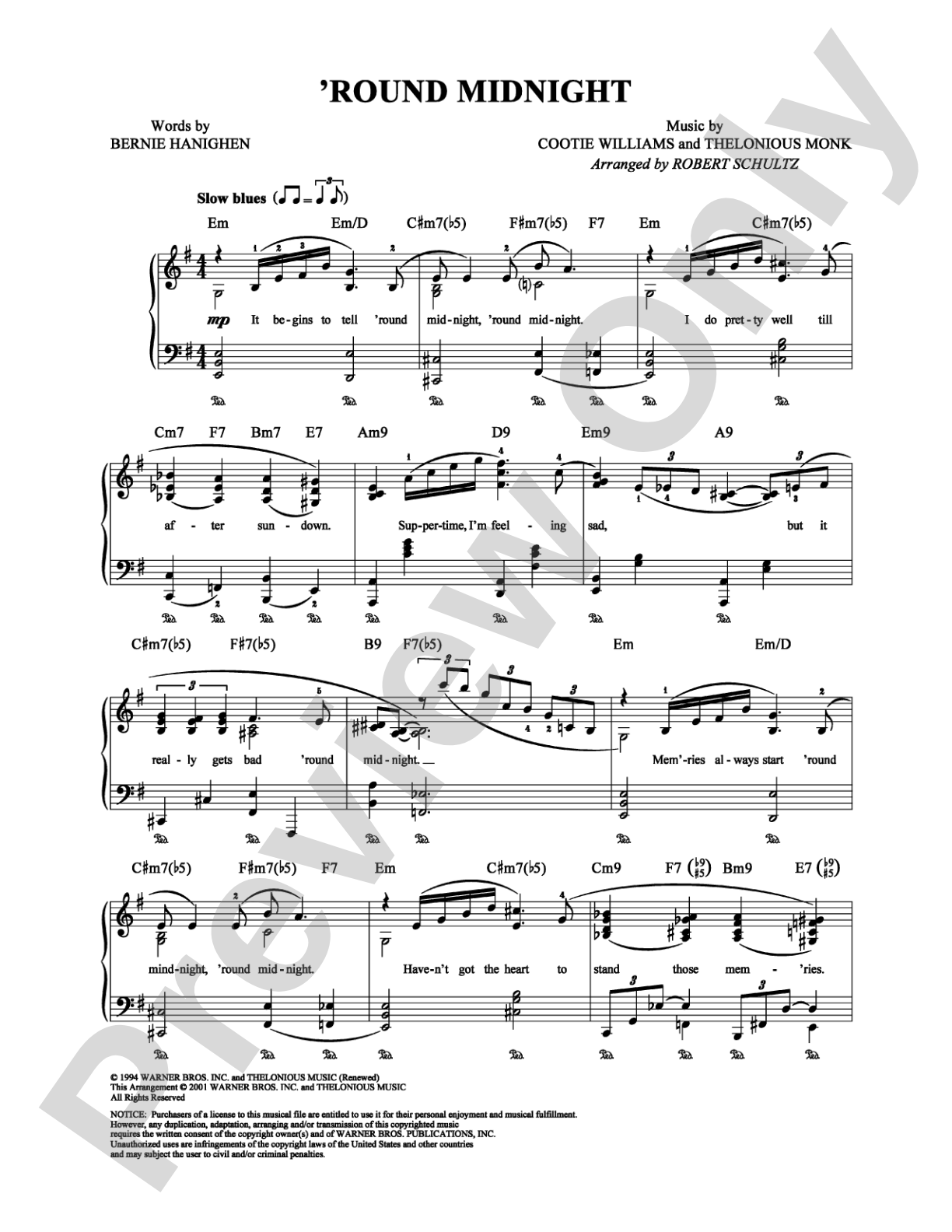
Round Midnight: Piano/Vocal/Chords Digital Sheet Music

Round Midnight: Piano/Vocal/Chords Digital Sheet Music

Cootie Williams, Thelonious Monk

Item: 00-PS-0002269

Digital Download
$3.99
Description

Round Midnight: Piano/Vocal/Chords Digital Sheet Music isn't in MakeMusic Cloud just yet...but it could be. Let us know you'd like to see it, and you'll help shape what comes next. In the meantime, start a free trial and dive into thousands of interactive titles your students can play along with today.

Sample Audio
No sample audio found.
Sample Video
Additional Details
SKU: 00-PS-0002269

More about this title

About the Creator: Thelonious Monk

Thelonious Monk stands as one of jazz's most original and uncompromising voices. His compositions defied convention, twisting harmony and melody into shapes that seemed impossible until he played them, and then became inevitable. 'Round Midnight' emerged from his early years as a bandleader and remains his most recorded composition, recorded by everyone from Miles Davis to Herbie Hancock, yet it always sounds distinctly like Monk's vision.

Why we love this

This standard rewards singers who can navigate intricate harmonic changes and pianists comfortable with sophisticated jazz voicings. The chord notation gives accompanists real interpretive freedom while keeping the lead line clear for vocalists working on jazz phrasing and rubato.

What to expect

Intimate and reflective, with the kind of sophisticated harmony that rewards close listening. The piece has a contemplative quality that invites both performer and listener into a quieter, more introspective space.

Who it's for

Jazz singers developing interpretive skills and intermediate to advanced pianists comfortable with jazz harmony and accompaniment. This pairing works well in studios, jazz ensembles, and recital settings where nuanced interaction between vocalist and instrumentalist matters.

How to get the most out of it

  • Explore the harmonic rhythm in the piano part; the chords don't always align with vocal phrases, creating intentional space for the singer to breathe and shape the melody.
  • Treat the melody as a conversation with the changes rather than a strict melodic line. Jazz standards reward flexibility in timing and dynamics.
  • Use the chord symbols to experiment with different voicings and textures. A sparse, minimal approach can sound just as authentic as fuller harmonies.

How to use it

Pair this with other jazz standards in a recital to showcase your vocalist's maturity and range. It also works beautifully as a feature in a jazz ensemble concert or as a transition piece in a mixed-genre program that bridges classical and jazz repertoire.

Skills your students will build

  • Reading and interpreting chord symbols in jazz context
  • Negotiating rubato and swing phrasing over complex harmonic progressions
  • Collaborative listening between vocalist and pianist
  • Voice leading through chromatic and extended harmonies
  • Stylistically appropriate interpretation of a jazz standard

You May Also Like