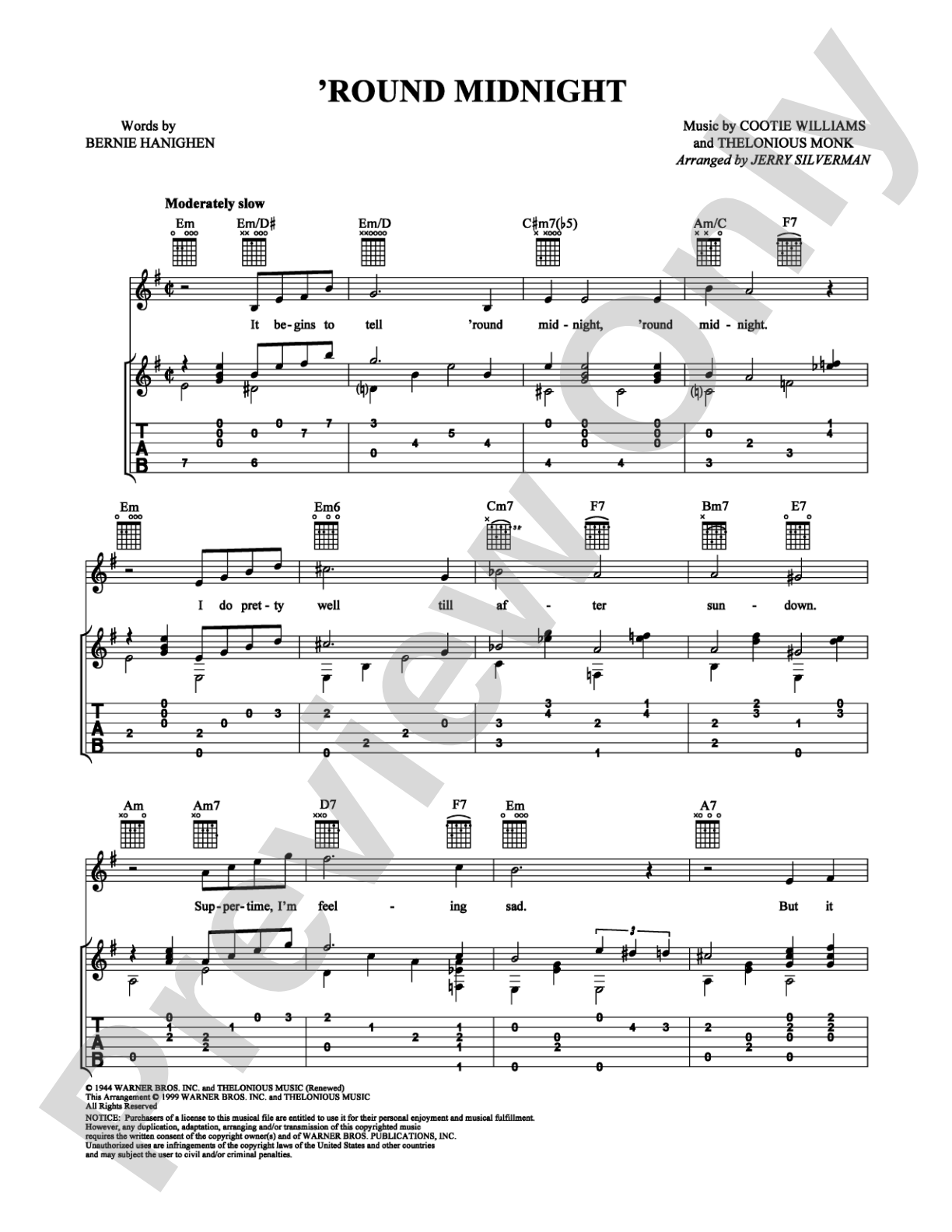
Round Midnight: Guitar TAB Digital Sheet Music

Round Midnight: Guitar TAB Digital Sheet Music

Cootie Williams, Thelonious Monk, Charlie Parker

Item: 00-PS-0002266

Digital Download
$2.99
Description

Round Midnight: Guitar TAB Digital Sheet Music isn't in MakeMusic Cloud just yet...but it could be. Let us know you'd like to see it, and you'll help shape what comes next. In the meantime, start a free trial and dive into thousands of interactive titles your students can play along with today.

Sample Audio
No sample audio found.
Sample Video
Additional Details
SKU: 00-PS-0002266

More about this title

About the Artist: Charlie Parker

Charlie Parker revolutionized jazz in the 1940s by developing bebop alongside Dizzy Gillespie and other innovators. His harmonic sophistication, lightning-fast scalar passages, and inventive melodic lines over complex chord changes became the foundation for modern jazz language. Though Parker was primarily an alto saxophonist, his compositions and improvisational concepts have been transcribed and adapted for every instrument, influencing generations of musicians across all jazz styles.

Thelonious Monk was a pianist and composer whose angular melodies, unexpected harmonic substitutions, and unconventional approach to rhythm challenged jazz orthodoxy. "Round Midnight," one of his most enduring compositions, exemplifies his ability to write deceptively simple-sounding themes that contain profound harmonic and intervallic complexity. The piece has become a jazz standard recorded by countless artists and remains essential listening for anyone studying modern jazz composition.

Why we love this

This tune demands real jazz literacy. The harmonic movement and implied chord changes will push guitar players beyond melody-only reading into actual jazz comping and substitution thinking. Having the melody in TAB format makes the material accessible while keeping the intellectual rigor intact.

What to expect

"Round Midnight" breathes mystery and sophistication. The melody circles around altered extensions and blue notes, creating phrasing that feels introspective and searching rather than declarative. The harmonies shift beneath you in unexpected ways, reflecting Monk's singular compositional voice.

Who it's for

Jazz guitarists working toward jazz fluency and improvisers who need the melody clearly in front of them without being locked into standard notation. This suits intermediate to advanced players preparing for combo performance, jam session participation, or transcription-based study.

How to get the most out of it

  • Study the harmonic framework underneath the melody. Understand which chord tones and passing tones make up each phrase so you can comp effectively and improvise authentically.
  • Practice the rhythmic phrasing over a metronome in half-time first, then gradually increase to the standard tempo. The syncopation and rests are as crucial as the notes.
  • Listen to multiple recorded versions (Parker's original and Monk's rendition are essential) and notice how different players phrase the head and handle the form.
  • Work on voice leading when playing comping chords underneath the melody. Clean chord transitions will shape the overall sound much more than speed.

How to use it

Feature this in a jazz ensemble context where guitarists can comp for a melody section or soloist. It also works as a small-group recital piece for advanced students working in jazz idioms, paired with standards that share similar harmonic density.

Skills your students will build

  • Reading jazz melody from TAB while understanding harmonic implications
  • Recognizing and executing chromatic approach notes and passing tones
  • Navigating syncopated rhythmic phrasing characteristic of bebop-era composition
  • Building chord comping vocabulary for altered and extended harmony
  • Transcribing and internalizing Monk's distinctive intervallic language

You May Also Like