
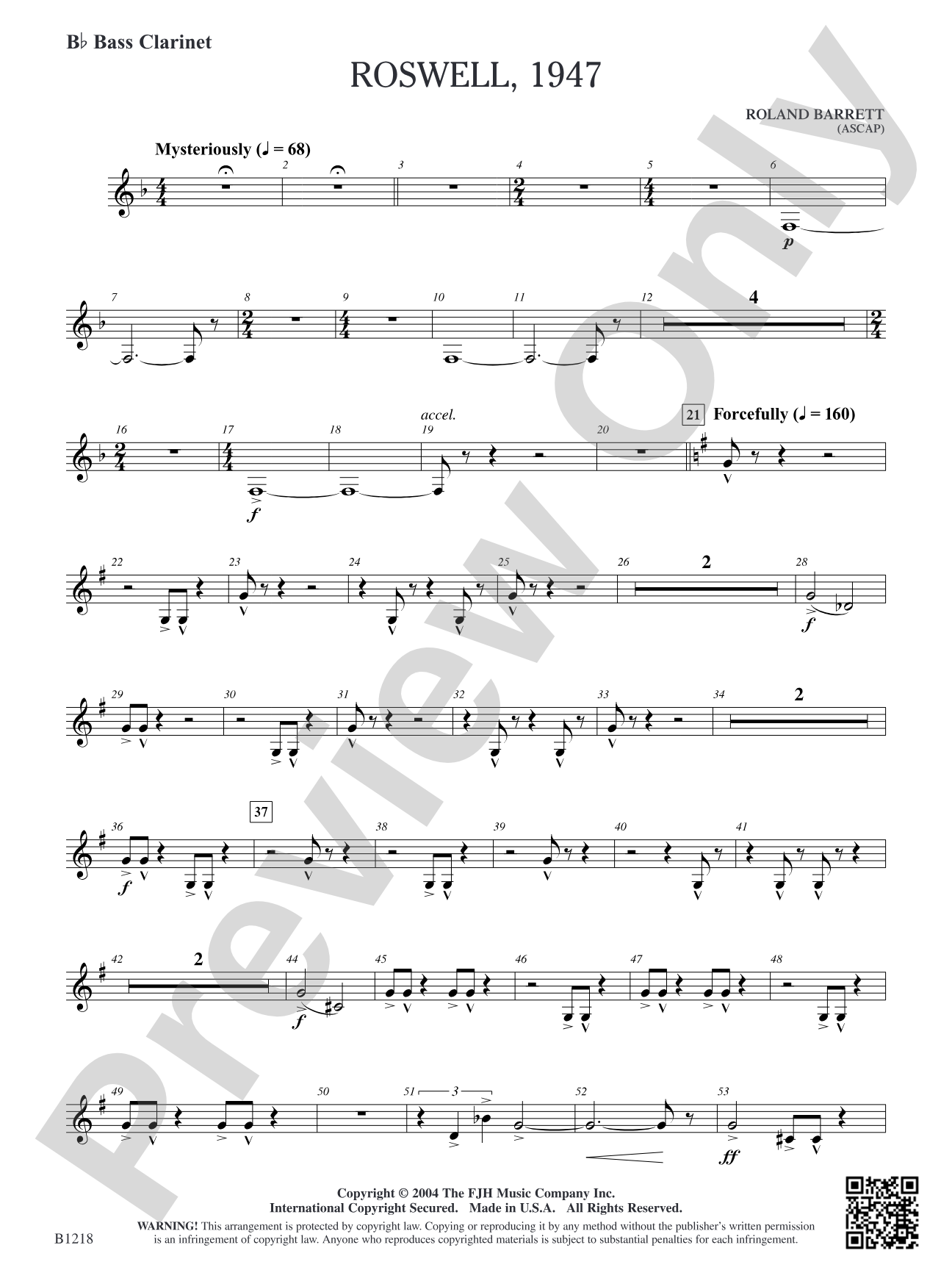

Roswell, 1947: B-flat Bass Clarinet
By Roland Barrett
Grade: 3
Item: 98-PC-DB1218_BC
$7.00
Pickup currently not available
Description
This great effects piece will transport your audience back to 1947, the year of the infamous Roswell Incident, when dozens of UFO sightings were reported over a large area of the western United States.


Roswell, 1947: B-flat Bass Clarinet isn't in MakeMusic Cloud just yet...but it could be. Let us know you'd like to see it, and you'll help shape what comes next. In the meantime, start a free trial and dive into thousands of interactive titles your students can play along with today.
Request This Title
Tell us you want it.
Start Your Free Trial
Explore everything that's ready to play right now.
Sample Audio
1
Audio File
--:--
0:00
0:00
Sample Video
No sample videos found.
Additional Details
Series:
FJH Concert Band
Publisher:
The FJH Music Company, Inc.
SKU:
98-PC-DB1218_BC
More about this title
About the Composer: Roland Barrett

Roland Barrett has shaped generations of composers and arrangers through his work at the University of Oklahoma, where he joined the theory and composition faculty in 2001. Before stepping into the classroom, he spent fifteen years as Assistant Director of Bands, grounding his teaching in practical ensemble experience. His scholarly focus centers on twentieth century music, and he teaches both undergraduate and graduate students in theory and composition.
Barrett's creative output spans over two hundred published works for symphonic band, chamber ensembles, and marching band. His arrangements drive the Pride of Oklahoma's sound on the field, while his original compositions have earned performances by the Dallas Wind Symphony and countless All-State and All-Region ensembles. His accolades include multiple ASCAPlus awards and recognition at major national conferences including the Midwest Band & Orchestra Convention and the International Trumpet Guild.
Why we love this
Barrett's ability to craft vivid programmatic narratives shines here. The Roswell Incident provides irresistible subject matter for high school students, and the Grade 3 scoring makes this accessible enough for developing bands while maintaining the sophisticated effects and atmosphere that make it genuinely theatrical. This is the kind of piece that generates buzz before rehearsals even begin.
What to expect
Unsettling and cinematic, with the kind of sound design that makes you feel transported. The piece evokes mystery and wonder rather than outright fear, letting listeners inhabit that moment of collective uncertainty when the unexplained fills the sky above a small town.
Who it's for
Concert bands at the Grade 3 level looking for repertoire with contemporary appeal and theatrical substance. Students respond to the dramatic premise, and the technical demands remain manageable for developing musicians while keeping the piece musically substantive.
How to get the most out of it
- Establish the soundscape early. The success of this effects piece depends on your ensemble committing fully to whatever sonic atmosphere Barrett creates in the opening; don't rush into stable tonality if ambiguity is the intention.
- Balance the narrative arc with technical clarity. Each section should feel like a scene shift; mark your score to identify where the emotional temperature changes so your players understand they're advancing a story, not just executing passages.
- Shape dynamics across phrases, not just within them. This kind of programmatic writing often benefits from slight rallentando or accelerando that mirrors the drama, so experiment with subtle tempo flexibility during rehearsals.
- Layer in the percussion effects deliberately. If the piece calls for non-traditional sounds or implements, give those players rehearsal time alone so their cues land with precision and impact rather than surprise.
How to use it
Program this as a centerpiece for a concert built around twentieth and twenty-first century American themes, or position it as the opener of a second half to reset audience energy with something unexpected. Its novelty factor also makes it strong for contest festivals where programming impact matters.
Skills your students will build
- Executing effects and extended techniques (unpitched percussion, unconventional sounds)
- Sustaining atmosphere through ensemble blend and dynamic control
- Responding to programmatic cues and narrative structure in music
- Sectional balance when melody and supporting lines shift unexpectedly
- Precision in timing and cutoffs when effects pieces shift between scenes