
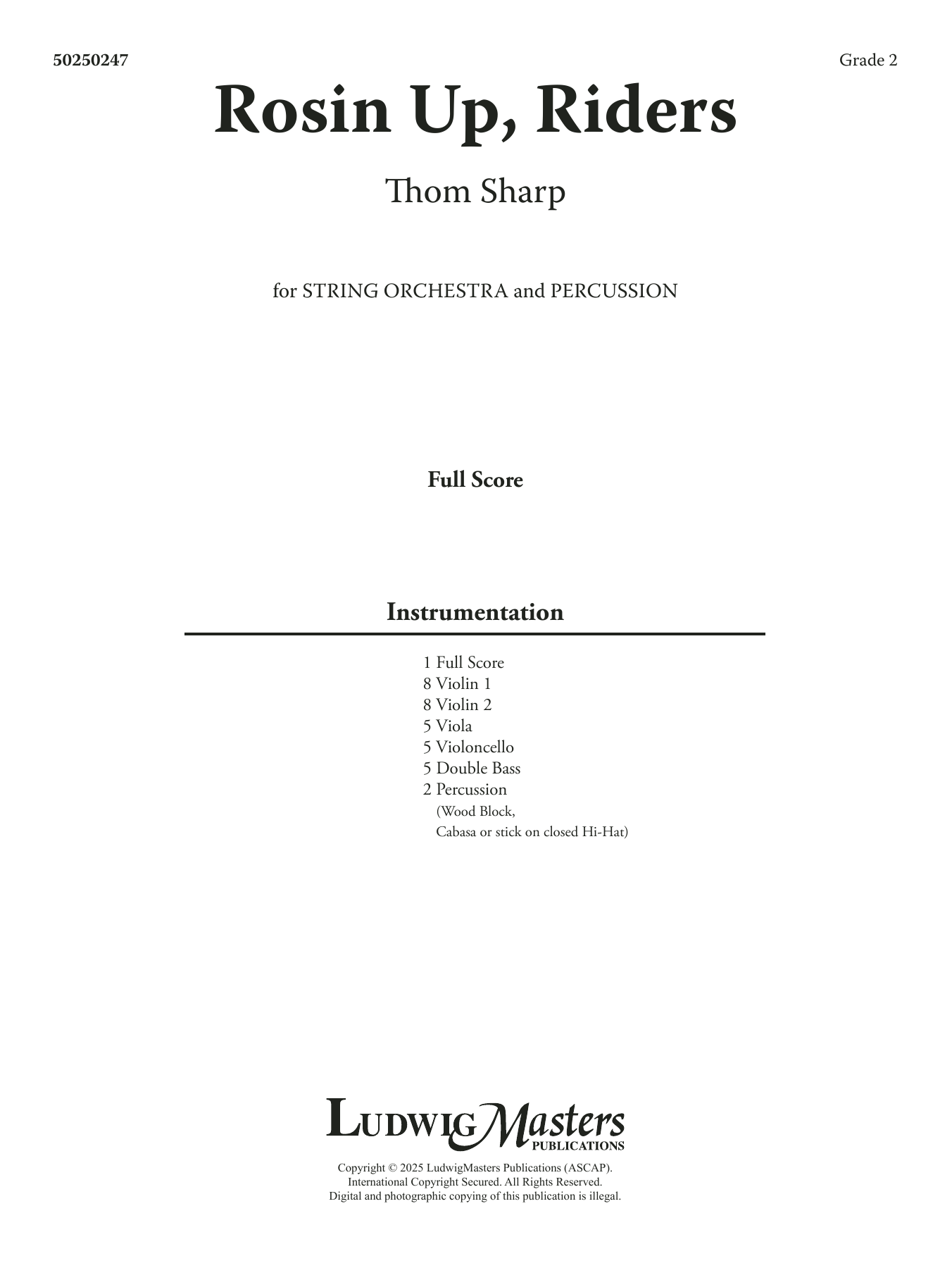

Rosin Up, Riders: String Orchestra Conductor Score & Parts
By Thom Sharp
Grade: 2
Item: 35-PK01699217
$50.00
Pickup currently not available
Buy Extra Parts (Digital PDF Download)
| Product | Price | Quantity |
|---|---|---|
| Rosin Up, Riders - Full Score | $8.00 | |
| Rosin Up, Riders - Violin 1 | $2.50 | |
| Rosin Up, Riders - Violin 2 | $2.50 | |
| Rosin Up, Riders - Viola | $2.50 | |
| Rosin Up, Riders - Cello | $2.50 | |
| Rosin Up, Riders - Bass | $2.50 | |
| Rosin Up, Riders - Percussion | $2.50 |
Parts Added to Cart!
Description
Ride tall in the saddle as you play this delightful cowboy two-beat piece in G major. Feel the gentle trot of your trusty steed as an eighth note "duk-a-Dak-a" rhythm is traded about by all sections but the basses. While mostly diatonic, the basses do have a passing D# in the A section, and there are a few E flats and F naturals in the moodier B section. Legato passages that contrast the clipclop rhythm come and go as you progress through the work, conjuring images of the open prairie in this highly evocative piece.


Discover MakeMusic Cloud: thousands of interactive titles your students can play along with today.
Sample Audio
No sample audio found.
Sample Video
No sample videos found.
Additional Details
Publisher:
Hal Leonard
SKU:
35-PK01699217
More about this title
Why we love this
Sharp captures authentic cowboy character without resorting to obvious melodic clichés. The rhythmic conversation between sections keeps every player engaged, while the strategic use of accidentals in the B section provides just enough harmonic color to prevent the piece from feeling too simple for second-year players.
What to expect
Sunlight on open land. The steady, predictable trot of the rhythm becomes almost hypnotic, while the legato passages open windows onto wider horizons. The piece captures the character of the Old West without sentimentality, offering genuine musical personality.
Who it's for
Grade 2 orchestras with solid rhythmic foundation and basic intonation control. Players need enough confidence to handle section-specific rhythmic patterns without constant conductor cueing, but the technical demands remain modest.
How to get the most out of it
- Lock the "duk-a-Dak-a" articulation across all sections. Have players speak the syllables in rhythm before playing to nail the uniform attack and release that makes the trotting rhythm shine.
- Shape the legato passages with clear phrase direction so they register as genuine melodic moments rather than breaks in texture. These sections need musical purpose, not just technical variety.
- Balance the bass line carefully during the A section. That passing D# should arrive as a subtle inflection, not a jarring moment. Underground rehearsal of the bass parts in isolation helps them understand the harmonic function.
- Allow the prairie imagery to inform your pacing. A tempo that feels like an actual horse's gait (not rushed) gives the piece room to breathe and lets the rhythmic patterns speak for themselves.
How to use it
Pair this with other American-flavored works to build a thematic concert around landscape and regional music. It also works beautifully as a second-half opener after intermission, resetting the audience's energy with its infectious rhythmic groove.
Skills your students will build
- Rhythmic independence within ensemble texture (sustained notes against moving lines)
- Diatonic harmony with chromatic voice leading (D# passing tone, E flats and F naturals in B section)
- Section-specific rhythmic accuracy without relying on conductor pulse
- Legato phrasing that contrasts with rhythmic patterns
- G major tonality and the technical demands of string-specific articulation