
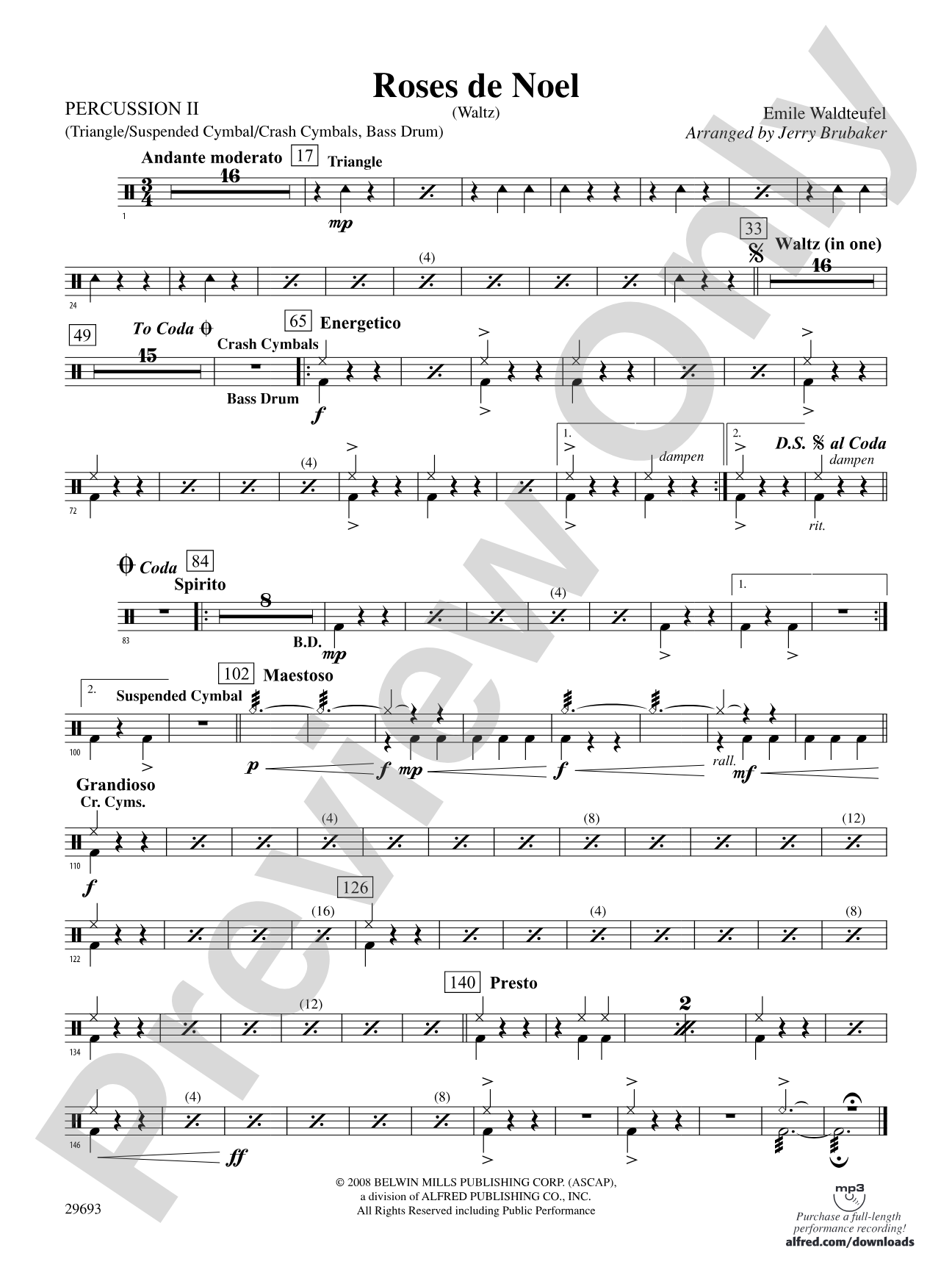

Roses de Noel (Waltz): 2nd Percussion
By Emile Waldteufel / arr. Jerry Brubaker
Grade: 4
Item: 00-PC-0001560_PC2
$5.99
Pickup currently not available
Description
A fabulous new find for the holidays, perfect for the upper level full orchestra! This beautiful piece explores varied waltz styles and tempi in the true 19th century tradition. Few holiday selections are in 3/4 time so here is a chance to add variety to your holiday program. (4:00)


Don't just read it, hear it, play along with it, and watch your students grow with it. In MakeMusic Cloud, Roses de Noel (Waltz): 2nd Percussion comes alive with professional accompaniment, adjustable tempo, and built-in practice tools that turn solo practice into real progress.
Open in the Player
Jump straight in and assign it today.
Start Your Free Trial
Open this title and explore the full library in minutes.
Sample Audio
1
Audio File
--:--
0:00
0:00
Sample Video
No sample videos found.
Additional Details
Series:
Belwin Concert Full Orchestra
Publisher:
Alfred Music
Page Count:
176
SKU:
00-PC-0001560_PC2
More about this title
About the Composer: Emile Waldteufel
Emile Waldteufel (1837-1915) was a French composer and conductor who became one of the most celebrated waltz composers of the 19th century, rivaling even Strauss in popularity across European concert halls. His gift for elegant melody, sophisticated orchestration, and rhythmic vitality made him a favorite of both audiences and orchestras, and his waltzes remain standard repertoire for orchestras seeking to program the Romantic era with style and accessibility.
Waldteufel's prolific output included over 300 compositions, the majority being waltzes and other dance forms that showcased his mastery of orchestral color. He served as conductor of the Empress Eugenie's court orchestra in Paris and composed for the most prestigious venues of his time, bringing a distinctly French refinement to the waltz tradition.
Why we love this
Waldteufel's command of orchestral texture shines through in this piece, offering your orchestra a sophisticated alternative to the typical holiday fare. The varied waltz styles keep the ensemble engaged across the full four minutes, and the 3/4 meter provides genuine programming contrast to rounds of festive marches and chorale arrangements. It's the kind of selection that challenges your musicians to think like ensemble players while sounding effortlessly graceful.
What to expect
Elegant and graceful, with the warmth of a Parisian ballroom rather than the frenzy of a Christmas market. The piece unfolds with lyrical beauty across varied waltz tempi and characters, from stately to sprightly, all wrapped in lush 19th century orchestration that speaks to orchestras rather than simply accompanying singers or soloists.
Who it's for
Grade 4 orchestras ready to move beyond entry-level holiday selections and tackle a piece with genuine orchestral sophistication. This is ideal for ensembles with solid fundamentals in intonation, sectional balance, and sustained phrasing who want to program something that sounds polished and refined without requiring advanced technical passages.
How to get the most out of it
- Shape the phrasing across the full waltz sections rather than subdividing into small, choppy gestures; Waldteufel's lines breathe across multiple measures and reward conducting that allows the melody to bloom and settle naturally.
- Balance the inner voice activity carefully, particularly in passages where violas or second violins carry thematic material; the orchestration is intricate enough that strategic doubling checks during sectional rehearsals will pay dividends.
- Adjust the tempo slightly as Waldteufel modulates between the contrasting waltz sections to highlight the structural variety; these shifts should feel intentional rather than abrupt.
How to use it
Program this as a sophisticated interlude within a holiday concert, perhaps between more energetic festive selections or as a contrasting moment that showcases your orchestra's ability to project elegance and control. It also works well as the opening number for a winter pops concert, setting a refined tone for the evening while immediately signaling to the audience that this will be no ordinary holiday program.
Skills your students will build
- Balancing inner orchestral voices while maintaining clear melodic focus
- Sustaining phrasing across extended waltz sections in 3/4 time
- Responding to conductor cueing across multiple tempo shifts and key areas
- Achieving unified articulation and style within Romantic era orchestration
- Listening for and correcting intonation issues in chromatic passages and modulations