Rose Room: Piano Digital Sheet Music

Rose Room: Piano Digital Sheet Music

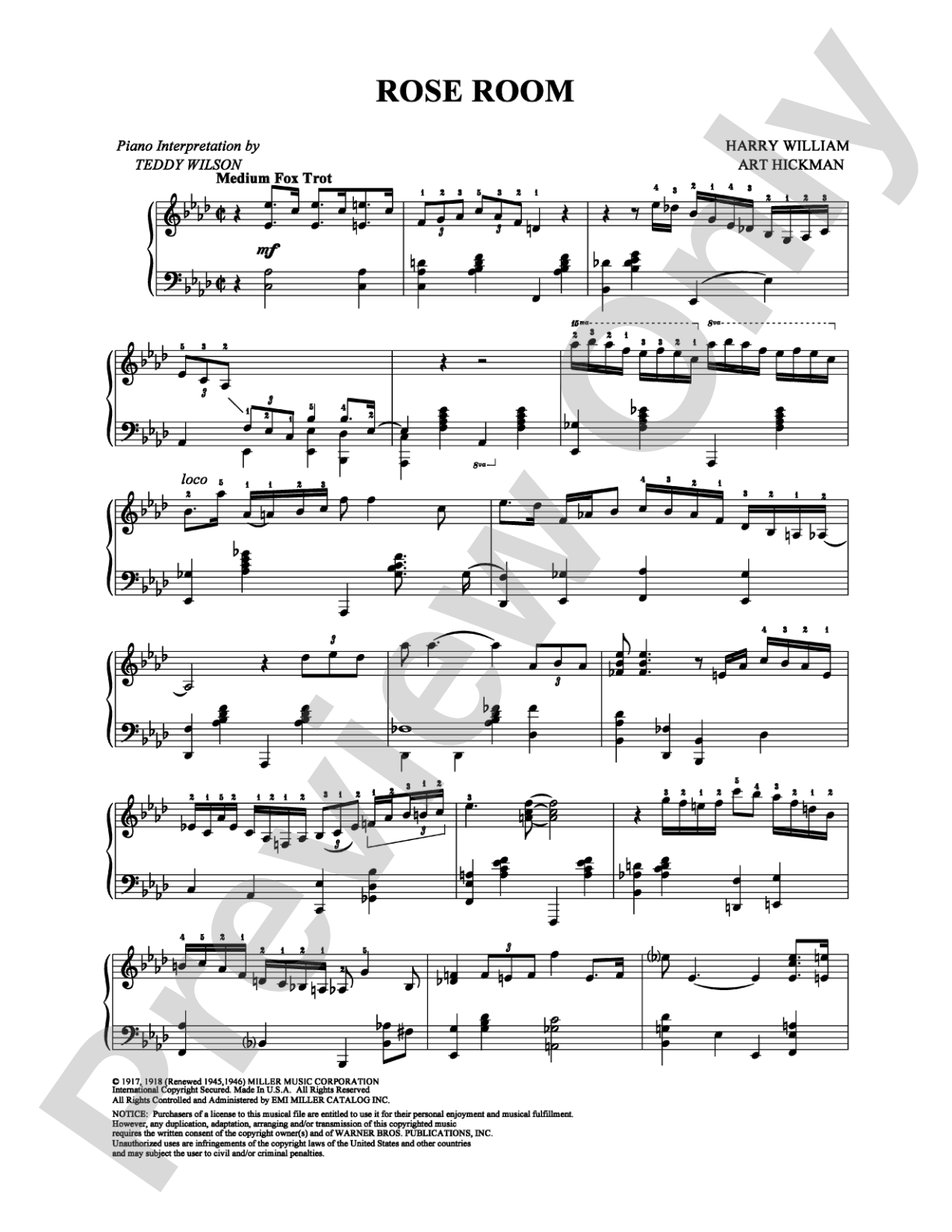
Teddy Wilson, Art Hickman, Harry Williams

Item: 00-PS-0007367

Digital Download
$3.99
Description

Rose Room: Piano Digital Sheet Music isn't in MakeMusic Cloud just yet...but it could be. Let us know you'd like to see it, and you'll help shape what comes next. In the meantime, start a free trial and dive into thousands of interactive titles your students can play along with today.

Sample Audio
No sample audio found.
Sample Video
Additional Details
SKU: 00-PS-0007367

More about this title

About the Artist: Teddy Wilson

Teddy Wilson (1912-1986) was a pianist and bandleader who shaped the sound of swing jazz during the 1930s and 1940s. His refined touch, sophisticated harmonies, and ability to blend seamlessly with other musicians made him a sought-after collaborator for small-group recordings and a pioneer in integrated jazz ensembles at a time when that was both musically and socially significant.

Wilson's influence on jazz piano technique remains substantial. He demonstrated how stride piano could be modernized through subtle touch and harmonic innovation, and his approach to comping and solo playing continues to serve as a model for musicians studying the swing era.

Why we love this

Rose Room showcases the essence of Wilson's style: elegant voicings, clear melodic phrasing, and the rhythmic sophistication that defined swing-era jazz piano. Performers studying jazz piano will find this standard offers direct access to how a master voiced changes and shaped a familiar melody with restraint and musicality.

What to expect

Poised and relaxed. Rose Room unfolds with the confidence of a standard that has been played thousands of times, yet Wilson's arrangement never sounds routine. There's a graceful inevitability to the phrasing and a warmth in the harmonies that invites the listener into an intimate moment of swinging musicianship.

Who it's for

Jazz pianists working to understand swing-era comping and solo voicing, whether through private study or ensemble rehearsal. This piece works equally well as a solo recital number or as repertoire for jazz combo or big-band arrangements where a piano feature fits the program.

How to get the most out of it

  • Attend to the left-hand rhythmic placement. Wilson's comping voice moves with the band's pulse, so lock the timing of your chord changes rather than rushing through passing chords.
  • Balance melody and harmony in the right hand. The theme shouldn't overwhelm the harmonic sophistication underneath it; let both layers breathe equally.
  • Reference a recording of Wilson's interpretation to absorb the rubato and phrasing. Written notation captures only part of swing piano language; listening reveals timing, dynamics, and touch that shape the music's character.
  • Keep your voicings clean and voiced close to the middle of the keyboard. Avoid the temptation to spread chords too wide; Wilson's sound comes from precision and clarity, not fullness across the entire range.

How to use it

Feature this piece in a jazz piano recital or as part of a standards-based program exploring different eras of piano jazz. It pairs naturally with other swing-era compositions and offers a strong showcase for a pianist's comping and interpretive skills without demanding technical fireworks.

Skills your students will build

  • Reading and interpreting jazz chord symbols and reharmonization
  • Swing-era comping rhythms and left-hand independence
  • Voicing chords in close position across the middle register
  • Phrasing and rubato within a steady pulse
  • Balance between melody, harmony, and rhythmic momentum

You May Also Like