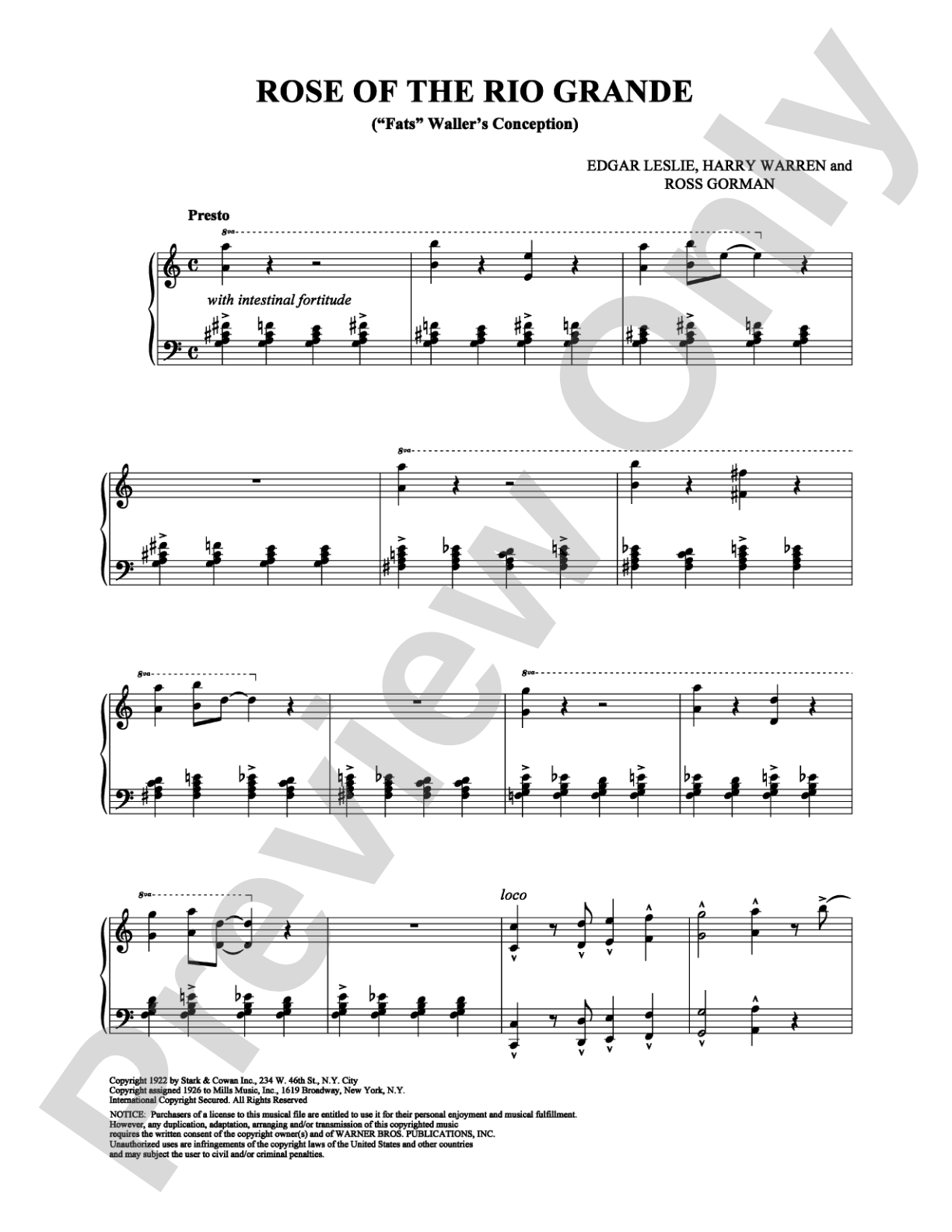
Rose of the Rio Grande (''Fats'' Waller's Conception): Piano Digital Sheet Music

Rose of the Rio Grande (''Fats'' Waller's Conception): Piano Digital Sheet Music

Harry Warren, Edgar Leslie, Ross Gorman

Item: 00-PS-0002246

Digital Download
$3.99
Description

Rose of the Rio Grande (''Fats'' Waller's Conception): Piano Digital Sheet Music isn't in MakeMusic Cloud just yet...but it could be. Let us know you'd like to see it, and you'll help shape what comes next. In the meantime, start a free trial and dive into thousands of interactive titles your students can play along with today.

Sample Audio
No sample audio found.
Sample Video
Additional Details
SKU: 00-PS-0002246

More about this title

About the Creator: Fats Waller

Thomas "Fats" Waller (1904-1943) was a pianist, organist, and composer whose virtuosity and wit made him one of jazz's most influential figures. His conception of "Rose of the Rio Grande" showcases his signature approach to the standard: sophisticated harmonic reharmonization layered over stride piano technique, delivered with the kind of musical intelligence that made him a favorite among serious musicians and general audiences alike.

Why we love this

Fats Waller's conception of this standard gives you direct access to one of jazz's most inventive pianists thinking through a melody. The stride piano foundation and harmonic sophistication make this far more than a lead sheet—it's a masterclass in how to inhabit a standard with personality and swing.

What to expect

Warm and conversational, with the easy swing of someone who knows the tune inside out. The piece breathes with rhythmic ease and harmonic richness, inviting you to inhabit the standard rather than simply execute it.

Who it's for

Jazz pianists serious about learning from recorded conceptions and students ready to tackle stride piano fundamentals. Pianists building a standard repertoire will find this both a playable arrangement and a window into mid-century jazz piano thinking.

How to get the most out of it

  • Shape the stride left hand with clarity and rhythmic independence; the bass notes and chords need to breathe separately from the melody's phrasing
  • Listen closely to how Waller's conception treats the tune's phrase architecture; his articulation choices signal where to land and release phrases
  • Balance the right-hand melody against the accompaniment so the harmonic color registers without overpowering the tune

How to use it

Feature this in a jazz recital or standards-focused program where you want to spotlight piano solo work. It works equally well as a standalone piece or paired with other stride-based arrangements to trace how different pianists approach the same material.

Skills your students will build

  • stride piano left-hand independence and rhythmic control
  • reading jazz harmony and reharmonization choices
  • interpreting a composed conception of a standard
  • swing articulation and phrasing in the right hand
  • balancing bass, harmony, and melody in a single-line arrangement

You May Also Like