
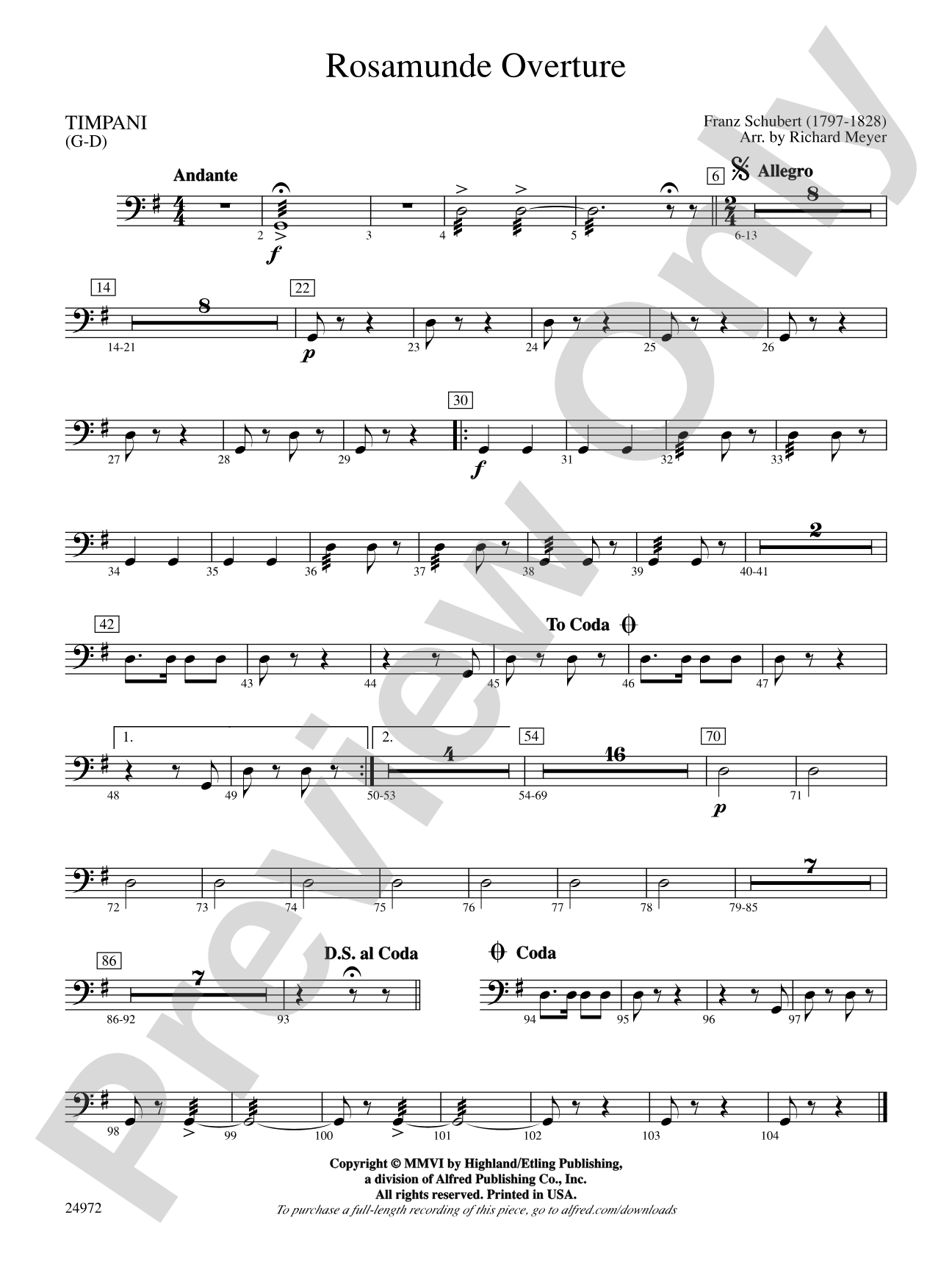

Rosamunde Overture: Timpani
By Franz Schubert / arr. Richard Meyer
Grade: 2
Item: 00-PC-0000959_TMP
$3.00
Pickup currently not available
Description
Schubert composed his incidental music to the Romantic drama Rosamunde, Princess of Cypress in less than three weeks, finishing just two days before the play's premiere in December of 1823. Not much time was left to rehearse the music, and no time at all to compose an overture. In fact, Schubert never did compose an overture to Rosamunde, but instead used an overture already composed for the drama The Magic Harp. While Rosamunde survived for only two performances, Schubert's charming music lives on. Festive and lyrical themes abound in this very playable arrangement that has been carefully crafted to preserve the sound of the original. A great way to introduce your students to one of the early Romantic period's great masters!


Don't just read it, hear it, play along with it, and watch your students grow with it. In MakeMusic Cloud, Rosamunde Overture: Timpani comes alive with professional accompaniment, adjustable tempo, and built-in practice tools that turn solo practice into real progress.
Open in the Player
Jump straight in and assign it today.
Start Your Free Trial
Open this title and explore the full library in minutes.
Sample Audio
1
Audio File
--:--
0:00
0:00
Sample Video
No sample videos found.
Additional Details
Series:
Highland/Etling First Philharmonic
Publisher:
Alfred Music
Page Count:
174
SKU:
00-PC-0000959_TMP
More about this title
About the Composer: Franz Schubert
Franz Schubert (1797-1828) stands as one of the bridge figures between Classical and Romantic music, composing across every major genre despite his short life and modest professional position in Vienna. His gift for melody was nearly inexhaustible; he wrote over 600 songs, nine symphonies, numerous chamber works, and substantial piano and vocal literature, much of it premiered only after his death.
Schubert's incidental music to theatrical works reveals how fluidly he moved between symphonic thinking and dramatic storytelling. Though he held no permanent conducting post and lived modestly, his influence on later Romantics was profound. His harmonic innovations, warm orchestration, and lyrical sensibility made him a model for composers who valued emotional directness over virtuosic display.
Why we love this
Richard Meyer's orchestration captures the transparency and charm of Schubert's invention without obscuring the original's appeal. This sits at exactly the right difficulty level for groups ready to move beyond simplified repertoire but not yet equipped for dense, modern scores. The festive and lyrical character gives students a genuine taste of early Romantic style with immediate, audible results.
What to expect
Rosamunde breathes with the elegance of a ballroom scene, shifting between festive, bright orchestral passages and more intimate, song-like moments. The harmonic warmth and graceful melodic lines create music that feels both immediate and refined, inviting rather than demanding.
Who it's for
This arrangement serves Grade 2 orchestras ready to tackle genuine Romantic repertoire without becoming bogged down in technical difficulty. Conductors can use it to teach students what Schubert sounds like as an orchestrator while still addressing ensemble fundamentals like balance, phrasing, and sectional coordination.
How to get the most out of it
- Balance the melodic material between first and second violins; Schubert often distributes themes across the section, and clarity matters more than volume.
- Let the winds breathe between phrases rather than sustaining uniformly; the lyricism depends on small spaces and releases.
- Check intonation in the lower brass during the lyrical passages, where sustained harmony parts can sag if not anchored by the ensemble's center.
- Rehearse the transitions between sections carefully; at this level, tempo steadiness and clear ensemble attacks make the largest musical difference.
How to use it
Program this as an opener or intermission piece for a concert pairing Classical-era works with Romantic selections. It also works well alongside student soloists or as part of a concert exploring theatrical music, where its story and occasion can add context.
Skills your students will build
- Recognizing and playing Romantic-period orchestration techniques
- Balancing transparent texture across multiple instrumental families
- Shaping lyrical phrases with intentional phrasing and breathing
- Coordinating ensemble attacks and transitions at a brisk tempo
- Reading a full orchestral score with multiple simultaneous lines