
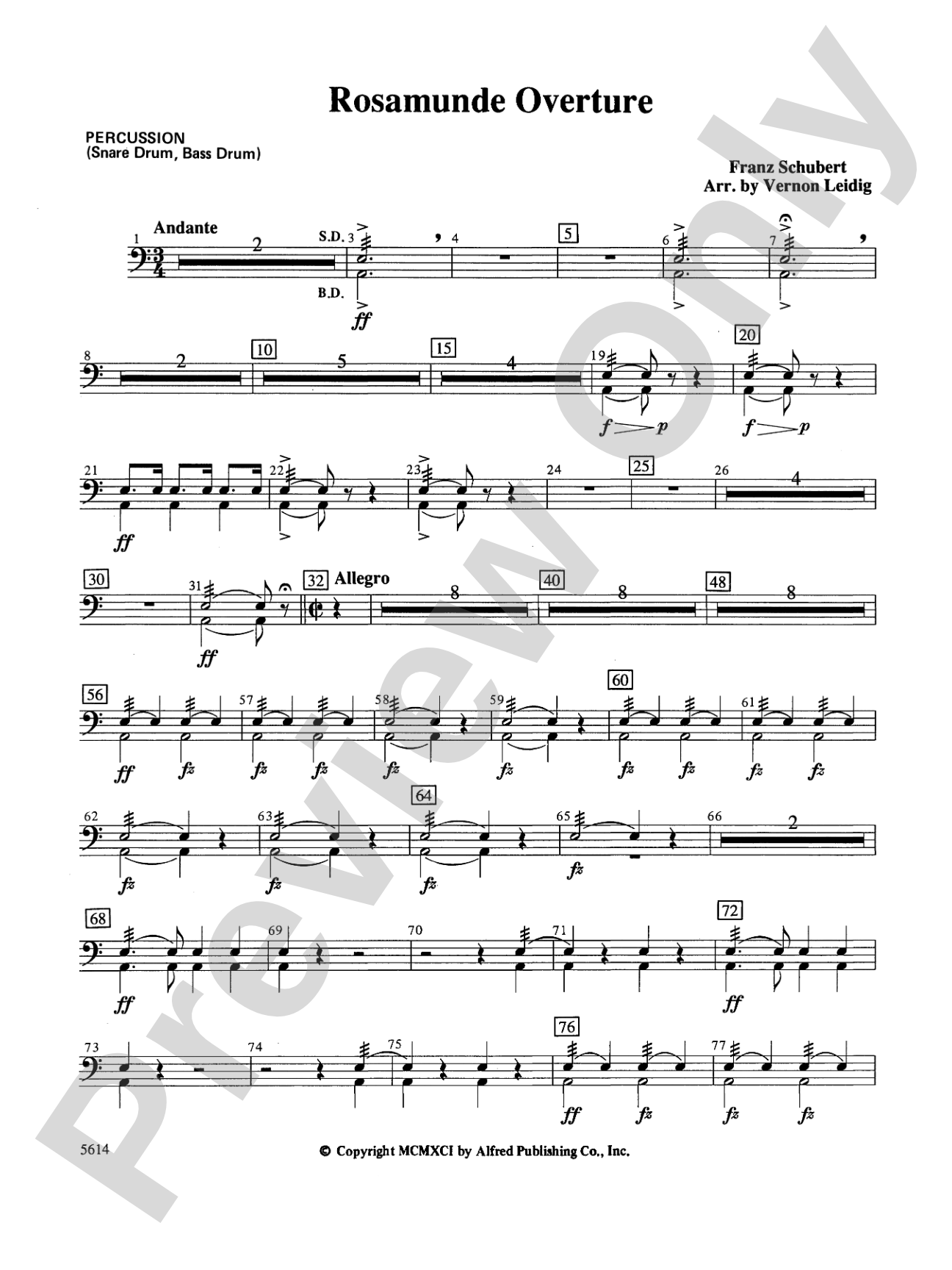

Rosamunde Overture, Opus 26: 1st Percussion
By Franz Schubert / arr. Vernon Leidig
Grade: 4
Item: 00-PC-0001891_PC1
$3.00
Pickup currently not available
Description
The essence and resonance of this timeless overture is perfectly preserved in Leidig's arrangement. Technical range is perfect for high school string or full orchestras. String parts are carefully edited with bowings and alternate fingerings for more advanced players. Opportunities for learning the subtleties of off-the-string classical style are also presented.


Don't just read it, hear it, play along with it, and watch your students grow with it. In MakeMusic Cloud, Rosamunde Overture, Opus 26: 1st Percussion comes alive with professional accompaniment, adjustable tempo, and built-in practice tools that turn solo practice into real progress.
Open in the Player
Jump straight in and assign it today.
Start Your Free Trial
Open this title and explore the full library in minutes.
Sample Audio
No sample audio found.
Sample Video
No sample videos found.
Additional Details
Series:
Highland/Etling Full Orchestra
Publisher:
Alfred Music
Page Count:
108
SKU:
00-PC-0001891_PC1
More about this title
About the Composer: Franz Schubert
Franz Schubert (1797-1828) composed during the twilight of the Classical era and the dawn of Romanticism, creating a bridge between Mozart's crystalline forms and the emotional expansiveness of the 19th century. Though he died at 31, he left behind over 600 compositions, including symphonies, chamber works, and vocal music that shaped the trajectory of Western classical music. His gift for melody and harmonic innovation made him a transformative figure in music education and concert repertoire.
For orchestral music educators, Schubert's works offer an ideal introduction to the Romantic sensibility while maintaining the structural clarity of Classical forms. His overtures, in particular, demonstrate how a composer can sustain dramatic momentum and lyrical beauty across substantial spans, making them indispensable teaching and performing works.
Why we love this
Leidig's adaptation captures Schubert's architectural elegance while making the work genuinely playable at the high school level without sacrificing orchestral color or expressive depth. The carefully edited string parts with bowings and fingering alternatives give advanced players meaningful challenges in Classical technique, while the overall orchestration remains accessible. This is the kind of arrangement that lets a school orchestra sound sophisticated and play something students will remember decades later.
What to expect
The Rosamunde Overture opens with graceful momentum and an almost operatic elegance, moving through episodes of lyrical warmth and buoyant orchestral conversation. There is lightness in the writing, a sense of inevitability in the phrasing, and moments of genuine tenderness that reveal why Schubert's melodies have endured; the overture feels both intimate and grand simultaneously.
Who it's for
This score is designed for high school orchestras with solid fundamentals and players ready to tackle ensemble refinement and stylistic awareness. It works equally well for full orchestras seeking a substantial Classical masterwork or for contest and festival programming where schools benefit from performing recognized repertoire at a competitive level.
How to get the most out of it
- Balance the lyrical principal melodic lines with supportive inner voices; Schubert's strength lies in the counterpoint between first and second violins, which requires clarity of texture rather than volume.
- Shape phrases with gentle dynamic contours rather than abrupt changes. The off-the-string articulations in the Classical style work best when the ensemble relaxes into the rhythmic pulse instead of forcing separation.
- Give woodwind entries space to breathe when they take the melody. Schubert often shifts the primary voice between strings and winds; resist the urge to reinforce with strings when the winds have the line.
- Use the suggested bowings as teaching points for string players on alternating and lifted strokes; they are intentional guides for achieving the transparent, dancing quality Schubert wrote for.
How to use it
Program this alongside lighter Romantic fare or as a sophisticated anchor to a all-Schubert concert. The work also fits naturally into a Classical masterworks series, where it can follow a Mozart overture to show the evolution of the form. At approximately 12 minutes, it is substantial enough to carry a concert segment and remains engaging for audiences unfamiliar with the composer.
Skills your students will build
- Off-the-string articulation and lifted bowings in Classical style
- Reading multiple string fingering options and choosing technique based on passage type
- Balancing independent melodic lines across multiple voices
- Sustaining long phrasing without pitch and rhythmic fatigue
- Coordinating exposed violin passages with accompaniment transparency
- Dynamic shaping in absence of modern expressive markings