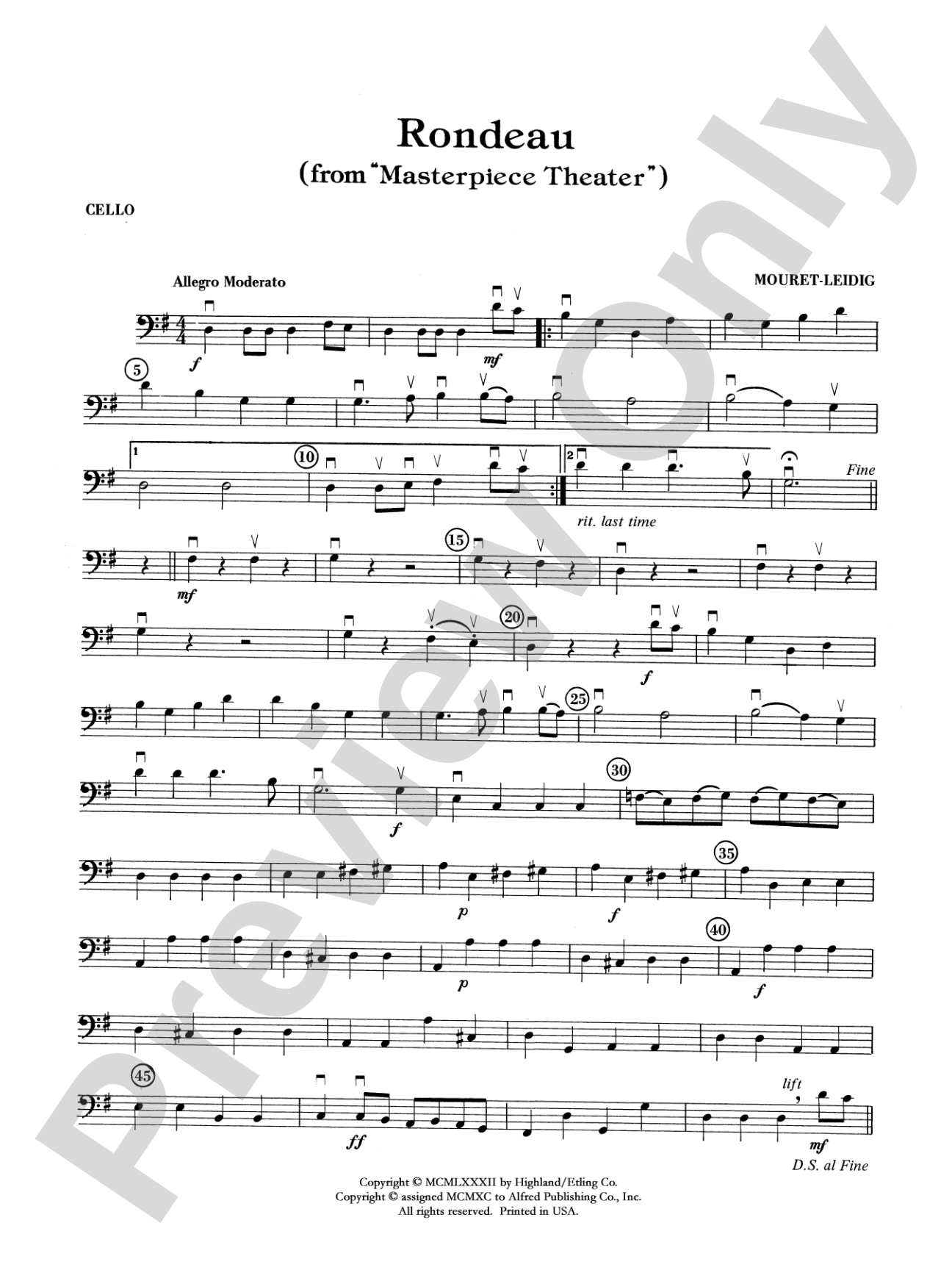
Rondeau (Theme from Masterpiece Theatre): Cello Sheet Music Preview

Rondeau (Theme from Masterpiece Theatre): Cello

By Jean Joseph Mouret / arr. Vernon Leidig

Grade: 2

Item: 00-PC-0000047_VC1

Digital Download
$3.00
Description
A Federation Festivals 2020-2024 selection.

Don't just read it, hear it, play along with it, and watch your students grow with it. In MakeMusic Cloud, Rondeau (Theme from Masterpiece Theatre): Cello comes alive with professional accompaniment, adjustable tempo, and built-in practice tools that turn solo practice into real progress.

Sample Audio
No sample audio found.
Sample Video
Additional Details
Series: Highland/Etling Full Orchestra
Publisher: Alfred Music
Page Count: 104
SKU: 00-PC-0000047_VC1

More about this title

About the Composer: Jean Joseph Mouret

Jean Joseph Mouret (1682-1738) was a French Baroque composer known for instrumental works that bridged the ornate French style with emerging galant sensibilities. His concerti grossi and orchestral suites were staples of the French court and demonstrate the elegant restraint characteristic of early 18th-century French music.

Why we love this

This arrangement opens the door to authentic Baroque orchestration at an accessible grade level. Vernon Leidig has crafted parts that balance transparency with full ensemble color, making it equally effective as a confidence builder for second-year orchestras and as a gateway to repertoire your students will recognize from television.

What to expect

Refined and buoyant. The Rondeau unfolds with the courtesy and measured grace of a formal dance, its recurring theme returning like a well-mannered guest. There's joy in the simplicity, and the repetition builds familiarity rather than tedium.

Who it's for

Grade 2 orchestras preparing for festival competition or building a concert program with accessible Baroque material. Conductors seeking a work that feels elegant and recognizable to audiences without placing extraordinary technical demands on developing musicians.

How to get the most out of it

  • Shape the opening melody with gentle crescendos and releases rather than rigid dynamics; Baroque phrasing benefits from conversation between voices.
  • Check balance between first and second violins carefully during the ritornello sections, as the lower voices carry important harmonic motion.
  • Establish a clear, steady pulse without rushing; Grade 2 ensembles often accelerate in charming passages like this one, so use the bowing patterns and rests to anchor tempo.
  • Voice the woodwind doublings so they reinforce rather than cover the strings; many Grade 2 parts double the upper lines, and careful dynamic control preserves clarity.

How to use it

Open a concert with this piece to establish refinement and control before advancing to more contemporary works. Its television heritage makes it an immediate crowd pleaser while signaling that your orchestra has classical foundations. Consider pairing it with Grade 2-3 works from the Classical era to build a mini-suite of structured, tuneful orchestral music.

Skills your students will build

  • Baroque phrasing and articulation
  • Ensemble balance in ritornello structure
  • Part independence in multi-line orchestration
  • Reading and executing French Baroque ornamentation
  • Sustained tone control in lyrical passages

You May Also Like