Rondeau (Theme from Masterpiece Theatre): 2nd Violin Sheet Music Preview

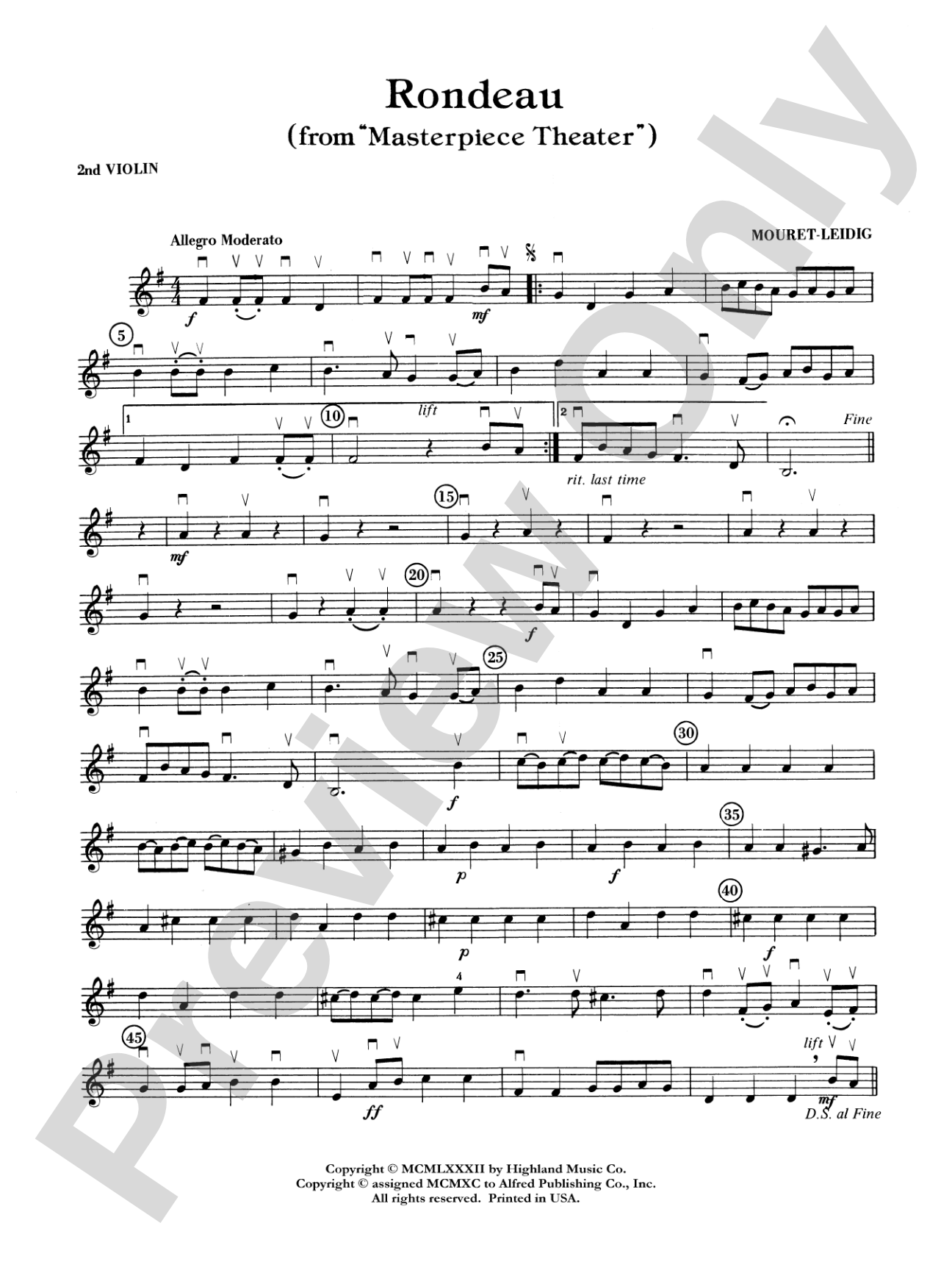
Rondeau (Theme from Masterpiece Theatre): 2nd Violin

By Jean Joseph Mouret / arr. Vernon Leidig

Grade: 2

Item: 00-PC-0000112_VN2

Digital Download
$5.99
Description
This title is available in MakeMusic Cloud.

Don't just read it, hear it, play along with it, and watch your students grow with it. In MakeMusic Cloud, Rondeau (Theme from Masterpiece Theatre): 2nd Violin comes alive with professional accompaniment, adjustable tempo, and built-in practice tools that turn solo practice into real progress.

Sample Audio
No sample audio found.
Sample Video
Additional Details
Series: Highland/Etling String Orchestra
Publisher: Alfred Music
Page Count: 72
SKU: 00-PC-0000112_VN2

More about this title

About the Composer: Jean Joseph Mouret

Jean Joseph Mouret (1682-1738) was a French Baroque composer celebrated for his instrumental works, particularly his fanfares and dance suites. He served as superintendent of music at the court of the Duke of Bourbon and gained renown across Europe for compositions that blended Italian melodic elegance with French harmonic sophistication. His Rondeau remains one of his most enduring works, having found new audiences centuries after his death through its adoption as the theme for the television program Masterpiece.

Mouret's gift for crafting memorable, graceful melodies made him a favorite among musicians of his era and continues to make his work accessible to student orchestras. His ability to balance simplicity with genuine musical substance means that even young players can grasp the essential character of his writing while working on foundational skills.

Why we love this

This arrangement captures the buoyant charm of Mouret's original without oversimplifying it. Grade 2 students will hear themselves playing genuine Baroque counterpoint and melodic phrasing from the first reading, which builds confidence fast. The Rondeau's fame as the Masterpiece Theatre theme gives it immediate cultural recognition, making it a natural choice for community concerts and festival programs where audiences connect immediately with the music.

What to expect

The music moves with the refined courtliness of a French dance suite, graceful and unhurried. Mouret's melody has an almost vocal quality, singing through the upper strings while lower voices provide gentle harmonic support, creating a sense of buoyant joy that feels both elegant and entirely unsentimental.

Who it's for

Grade 2 string orchestras and intermediate community ensembles looking for accessible yet substantive Baroque repertoire. This arrangement welcomes players still building vibrato control and secure rhythmic independence while offering rewarding musical expression. Directors seeking contest or festival material that audiences recognize and players can master quickly will find this especially useful.

How to get the most out of it

  • Shape the opening melody with careful attention to the natural rise and fall of the phrase; avoid playing through the climax as if all notes carry equal weight.
  • Balance the viola and cello parts supporting the melody so that harmonic voices emerge without overpowering the sopranos; encourage lower strings to listen actively.
  • Establish a steady, dance-like pulse without rushing; Baroque elegance depends on rhythmic clarity and forward motion, not speed.
  • Layer in dynamics gradually during rehearsals; start with the melodic line clearly defined, then add subtle shading in accompanimental figures once the basic structure is secure.

How to use it

Open a concert with this piece to establish an approachable, inviting tone that puts audiences at ease immediately. Program it alongside other Baroque arrangements to build a thematic concert around the period, or place it as a charming interlude between more substantial contemporary works. Its cultural familiarity makes it perfect for family concerts, school assemblies, or any program aimed at broadening community appreciation for classical music.

Skills your students will build

  • Baroque phrasing and articulation in a melodic context
  • Part independence in multi-line string writing
  • Sustained tone quality over longer phrases
  • Rhythmic clarity in dance-form structures
  • Dynamic shaping within a lyrical musical narrative

You May Also Like